
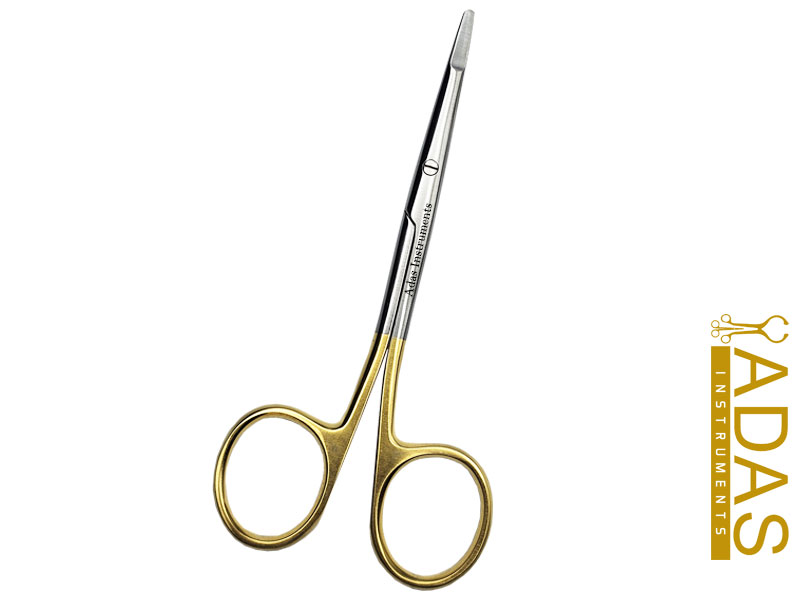
Ragnell Blepharoplasty Scissors, Curved, Rounded Tips
$ 25.60
Ragnell blepharoplasty scissors are fine curved eyelid scissors finishing in rounded ends rather than points, which makes them the instrument for teasing tissue apart rather than dividing it. Insert the shut tips into a plane, spread them, and the layers separate along their own interface instead of along a line a sharp blade has imposed.
- A rounded end travels beneath thin lid skin where a point would emerge through it
- It cannot open the orbital septum by accident, which is the whole reason for holding one nearby
- Buy it to sit beside a pointed pair, not in place of one
49 in stock (can be backordered)

What Ragnell blepharoplasty scissors are
Ragnell blepharoplasty scissors are the rounded ended pattern in an eyelid set, taken up whenever the aim is to part tissue along its own planes instead of cutting a line through it.
A pointed instrument cuts wherever it is put, including through things the surgeon did not intend to divide. On an eyelid, what sits behind the plane being opened is the orbital septum and behind that the globe. So there is a use case for an instrument that is deliberately bad at penetrating: push the closed tips into a plane, open them, and the tissue parts along its own line of least resistance instead of along a line the blade imposed.
Adas Instruments makes this pattern in tungsten carbide, with the gold finger rings that mark carbide across the trade.
What the blunt tips on Ragnell blepharoplasty scissors buy
Blunt tip eyelid scissors do three things a pointed pair cannot do safely.
The first is spreading. Closed tips inserted into a plane and then opened will find the natural interface between two layers. That is how the pretarsal and preseptal planes are best opened: not cut apart, but persuaded apart, so the surgeon ends up in the plane nature provided rather than one they created.
The second is working blind for short stretches. There are moments in lid surgery where the tips go somewhere the eye cannot fully follow, under a skin edge or around the orbital rim. A rounded end in that position slides. A point finds whatever is in front of it.
The third is confidence near the septum, and it is why Ragnell blepharoplasty scissors get picked up at that exact moment. Opening orbital septum is a deliberate act with consequences, and an instrument that will not do it accidentally is worth having in the hand when the alternative is a sharp tip a millimetre away from it.
The trade is real and should be stated. These are not the instrument for cutting a skin ellipse to a marked line. They will do it, poorly, and a pointed pair will do it properly. Ragnell blepharoplasty scissors are a second instrument on the tray, not a replacement for the first.
Clinical applications
| Task | Why the rounded tip suits it |
|---|---|
| Opening the preseptal plane | Closed tips inserted and spread find the natural interface rather than cutting a new one |
| Undermining a lid skin edge | Slides under thin skin where a point would come through it |
| Dissection near the orbital septum | Will not open the septum by accident, which a sharp tip can |
| Fat pad exposure | Teases fat clear of surrounding tissue before anything is divided |
| Ptosis surgery | Separates onto the levator without risking what lies beneath it |
| Lacrimal and canthal work | Blunt dissection in a confined space close to delicate structures |
| Oculoplastic reconstruction | General blunt dissection through periocular tissue planes |
How Ragnell blepharoplasty scissors sit alongside the pointed patterns
The honest way to think about the four eyelid patterns we make is as two jobs, not four instruments.
Cutting is one job: a marked skin ellipse, a muscle trim, a graft edge. That belongs to a pointed curved pair, and which one depends on how often you operate and what your fingers prefer.
Separating is the other job, and it belongs here. Most lid cases need both, which is why a tray that carries only a pointed pair tends to see the surgeon using it bluntly, closed, pushing, which is precisely how fine tips get sprung.
Buying the Ragnell pattern as the second instrument therefore protects the first one as well as the patient. That is not a sales argument so much as an observation about how fine scissors actually get destroyed.
Technical specification
Read off our own stock rather than a trade catalogue.
| Detail | Specification |
|---|---|
| Instrument type | Ragnell blepharoplasty scissors, curved, rounded tips |
| Blade | Fine and curved, blunt ended |
| Edge options | Tungsten carbide, or tungsten carbide supercut |
| Handle | Finger ring, gold coloured as the carbide marker |
| Material | High quality medical grade stainless steel |
| Sterilisation | Reusable, fully autoclavable, supplied non-sterile |
| Rust prevention | Passivated and boil tested, ultrasonically cleaned before packing |
| Marking | Laser marked with the pattern name and the Adas Instruments reference |
| Reference | AD-15.350 |
| Price | From 25.60 dollars |
Care and sterilisation of Ragnell blepharoplasty scissors
A rounded tip is sturdier than a point, which changes what to watch for rather than removing the need to watch.
The tips will not bend as readily, so the thing that goes wrong here is the rounding itself. A rounded end that has been knocked against a retractor picks up a flat or a burr, and a burr on an instrument used to spread tissue is exactly the wrong feature: it catches on the layer it is supposed to slide along. Run the closed tips gently across a fingernail through a glove; anything that snags has a burr.
Carbide carries its own servicing condition. Send the pair only to a workshop that states it handles carbide, since an abrasive set up for stainless will strip the brazed plate away. Mention the supercut grind too, where the build has one.
The rest is quick. Rinse cold at once, run the ultrasonic, sterilise with the lock spread open, dry it out thoroughly, give the screw a single drop of oil each week, and keep the pair trayed rather than loose.
Made by Adas Instruments
We shape and polish the tips of our Ragnell blepharoplasty scissors here, and on this pattern the polish is the product. A rounded end that has been ground and left rough will drag through a plane instead of sliding, which defeats the reason for buying blunt tip eyelid scissors at all.
Both carbide builds are held, from 25.60 dollars. Ragnell blepharoplasty scissors are the dearest of our four eyelid patterns, which is worth explaining rather than hiding: the tip shaping and finishing take longer than grinding a point does. Ask for an evaluation pair and use it for spreading, not for cutting, which is the test that tells you whether the finish is right. Supplied branded or plain for distributors.
Frequently asked questions
What are Ragnell blepharoplasty scissors used for?
Blunt dissection on and around the eyelid: opening the preseptal plane, undermining a skin edge, teasing out fat pads and separating onto the levator. The rounded tips let the closed blades be pushed into a plane and spread, so tissue parts along its own interface.
Why are the tips blunt?
So the instrument cannot penetrate what it is not meant to. Behind the plane being opened in lid surgery sits the orbital septum and behind that the globe, and a rounded end slides along thin tissue where a point goes through it.
Can I use them to cut the skin ellipse?
They will, but badly. Cutting to a marked line is a job for a pointed curved pair. Ragnell blepharoplasty scissors are the second instrument on an eyelid tray rather than a substitute for the first, and most cases need both.
Why are these the most expensive of the eyelid patterns?
Shaping and polishing a rounded tip takes longer than grinding a point, and on this instrument the quality of that polish is the whole value, because a rough rounded end drags through a plane instead of sliding along it.
What should I check when they arrive?
Run the closed tips gently across a fingernail through a glove. Nothing should snag. A burr or a flat on the rounded end will catch on the very layer the instrument exists to slide along, and it is the one fault that matters on this pattern.
Related instruments and categories
Catalogued with the blepharoplasty instruments, and separately among the plastic surgery scissors.
For cutting rather than separating, the pointed patterns are the curved blepharoplasty scissors as the general instrument and the carbide only Kaye blepharoplasty scissors for heavy use. If it is the handle that tires rather than the edge, the strap looped build alters the grip and leaves the blade alone.
| Weight | 0.05 kg |
|---|---|
| Blade Type | Tungsten Carbide, Tungsten Carbide Supercut |
Be the first to review “Ragnell Blepharoplasty Scissors, Curved, Rounded Tips”
Shipping & Delivery Policy
Processing Time: In-stock items are dispatched within 24-48 hours. For custom or out-of-stock items, production time is approximately 10-15 days.
Global Delivery Estimates
We partner with world-class couriers (DHL, FedEx) to ensure fast, tracked delivery.
- USA & Canada: 3-5 Business Days
- Europe & UK: 4-6 Business Days
- Rest of World: 5-7 Business Days
*We offer Air Cargo and Sea Freight options for bulk wholesale orders.
Customs & Duties
International buyers are responsible for any customs duties or taxes imposed by their country. Adas Instruments is not responsible for delays caused by customs clearance.
Lost Packages & Insurance
If your package is lost in transit, please contact us immediately. We offer full support and replacements for confirmed lost shipments. Note: You must report non-delivery within 3 weeks to be eligible for an insurance claim.
Related products
Reviews
There are no reviews yet.