
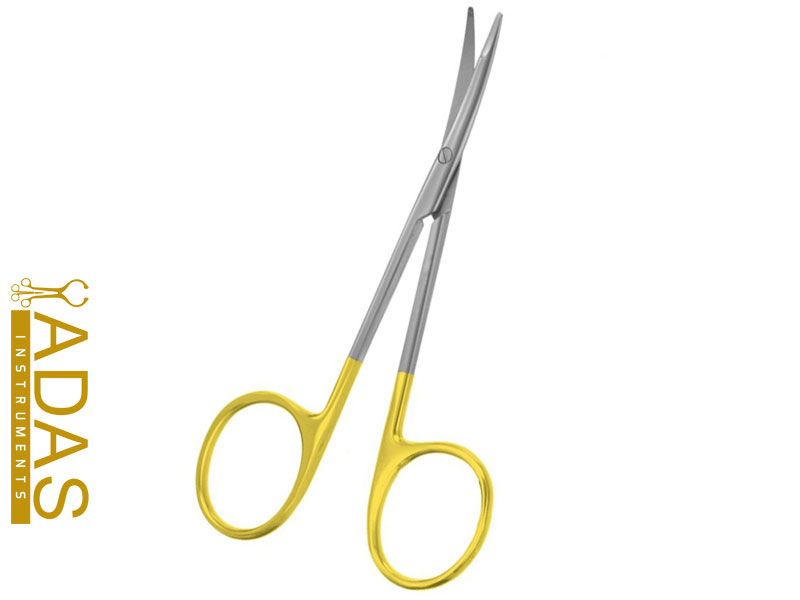
Blepharoplasty Scissors, Curved, for Eyelid Surgery
$ 22.50
Blepharoplasty scissors are very small curved surgical scissors used on the eyelid, where the skin runs about half a millimetre thick and the globe sits immediately behind whatever is being cut. Small means the pair is held like a pen and driven from the fingers; curved means the tips stay in sight through the whole stroke rather than disappearing behind the shanks.
- Removes the drawn skin, thins orbicularis and dissects down to the levator
- The curve tracks the lid’s own convexity, so the blade meets tissue along its length
- Our general purpose eyelid pattern, and the sensible first instrument for the tray
50 in stock (can be backordered)

What blepharoplasty scissors are
Blepharoplasty scissors are the miniature instruments an eyelid list is built around, used to divide and dissect tissue in a field measured in millimetres. Nearly every pattern in the category is curved, and that curve is functional rather than cosmetic.
Eyelid skin over the tarsal plate is around half a millimetre thick. There is no fat layer to absorb a misplaced tip, and the globe sits directly behind everything being cut. So the instrument has to be small enough to be controlled from the fingers rather than the wrist, and shaped so that the tips can be seen at all times.
This pair is the curved pattern, and Adas Instruments makes it for skin excision and fine dissection through an upper or lower lid incision.
Why blepharoplasty scissors are curved and small
Two features define the category, and both follow from the anatomy.
Small comes first. A short instrument is held like a pen, which means the movement comes from the fingers. Finger movement resolves to a fraction of a millimetre; wrist movement does not. On a lid you are cutting to a line drawn in marker pen, and the line matters, because an asymmetry of a millimetre between two lids is visible across a room.
The curve does something less obvious. It lifts the tips clear of the surgeon’s own hand and clear of the blade shafts, so the cutting end stays in view through the whole stroke. A straight pair of the same size buries its own tips behind the shanks as the hand rotates. On thick skin that is a nuisance; on a lid it means cutting where you cannot see.
Curved blepharoplasty scissors also follow the natural convexity of the lid and the orbital rim, so the blade stays in contact along its length instead of touching at one point.
Clinical applications
| Where it is used | The task |
|---|---|
| Upper lid surgery | Removes the drawn skin ellipse, then takes a strip of orbicularis |
| Lower lid blepharoplasty | Opens the subciliary plane and trims skin conservatively |
| Transconjunctival approach | Cuts through conjunctiva into the fat compartments |
| Ptosis surgery | Dissects to the levator aponeurosis in a field a few millimetres across |
| Fat pad excision | Divides orbital fat once the septum has been opened |
| Canthal surgery | Fine cutting at the lateral and medial canthus |
| Oculoplastic reconstruction | Lid margin repair, graft trimming and general periocular work |
Choosing between the blepharoplasty scissors we make
Four patterns of blepharoplasty scissors cover the whole of eyelid surgery between them, and the differences are worth understanding before ordering, because they are not interchangeable in the hand.
This curved pair is the general instrument, and the one to buy first if you are equipping a tray from nothing. It cuts skin, it trims muscle and it dissects, and it is the pattern most surgeons reach for by default.
The Kaye pattern is the same idea executed in tungsten carbide only, for a surgeon doing lid work every week rather than occasionally. The ribbon fingers version changes the handle rather than the blade, and suits anyone whose fingers tire during long lists. The Ragnell pattern is the blunt tipped one, for undermining rather than cutting, and it is the safest of the four against the globe.
Technical specification
Read off the blepharoplasty scissors on our own shelf rather than from a trade catalogue.
| Detail | Specification |
|---|---|
| Instrument type | Blepharoplasty scissors, curved |
| Blade | Fine and curved, tapering to the tip |
| Handle | Standard finger ring |
| Material | High quality medical grade stainless steel |
| Sterilisation | Reusable, fully autoclavable, supplied non-sterile |
| Rust prevention | Passivated and boil tested, ultrasonically cleaned before packing |
| Marking | Laser marked with the pattern name and the Adas Instruments reference |
| Reference | AD-21.221 |
| Price | 22.50 dollars |
Care and sterilisation of blepharoplasty scissors
Looking after a fine eyelid instrument comes down to the last two millimetres of it.
Tips this slender bend if anything at all presses on them, and once bent they no longer meet, so the pair stops cutting at the end and starts chewing. A pair that has been dropped into a tray with heavier instruments is already suspect. These belong in a micro tray with tip protectors, or in their own pouch, and never loose.
Inspect by closing the blades slowly against a light and looking for daylight at the very end. There is no partial credit here: if the tips do not meet, the instrument is finished for lid work even if it still cuts paper in the middle.
Beyond that, the routine is short because the instrument is small. Rinse cold immediately, ultrasonic clean, autoclave with the joint open, dry completely, and oil the screw weekly. A drop is plenty; excess oil on a small joint collects debris.
Made by Adas Instruments
We make all four patterns of blepharoplasty scissors here, which is the only reason the comparison above is worth anything: nobody is being steered towards whichever one happens to be in stock.
On an instrument this size the thing that separates a good pair from a bad one is how the two blades were matched to each other before assembly, because a pair of fine tips that were never truly mated will never close properly however carefully they are used. Ours are matched and then tested on tissue paper, which shows a gap that the eye misses. Ask for an evaluation pair and repeat that test yourself. We supply branded or plain for distributors.
Frequently asked questions
What are blepharoplasty scissors used for?
Cutting and dissecting on the eyelid: excising the marked skin in an upper lid blepharoplasty, opening the subciliary plane in a lower lid, trimming orbicularis muscle and dividing orbital fat. They are also used throughout oculoplastic reconstruction.
Why are eyelid scissors curved?
So the tips stay visible. A curve lifts the cutting end clear of the shanks and of the surgeon’s hand, which a straight pair of the same size does not do once the hand rotates. The curve also follows the convexity of the lid, keeping the blade in contact along its length.
How small are they?
Small enough to hold like a pen rather than like a tool, which is the point: the cut is then driven by the fingers, and fingers resolve to a fraction of a millimetre where a wrist does not.
Which eyelid pattern should I buy first?
This curved pair. It cuts skin, trims muscle and dissects, so it covers most of what an eyelid list needs. Add the blunt tipped Ragnell pattern second, for undermining, and the carbide Kaye pattern if lid surgery is a weekly rather than an occasional part of your practice.
How should the tips be protected?
Keep the pair in a micro tray with tip guards or in its own pouch, never loose among heavier instruments. Check for daylight between the closed tips before every list; if they no longer meet, the instrument is done for lid work regardless of how it cuts further back.
Related instruments and categories
These blepharoplasty scissors appear in two places on the site: among the blepharoplasty instruments, next to the lid retractors, markers and fine forceps, and again in plastic surgery scissors.
Our three other eyelid patterns are the Kaye blepharoplasty scissors in carbide, the ribbon fingers version with flat handles, and the blunt tipped Ragnell blepharoplasty scissors. For the smallest work of all outside the orbit, the Castroviejo micro scissors are finer again.
| Weight | 0.05 kg |
|---|
Be the first to review “Blepharoplasty Scissors, Curved, for Eyelid Surgery”
Shipping & Delivery Policy
Processing Time: In-stock items are dispatched within 24-48 hours. For custom or out-of-stock items, production time is approximately 10-15 days.
Global Delivery Estimates
We partner with world-class couriers (DHL, FedEx) to ensure fast, tracked delivery.
- USA & Canada: 3-5 Business Days
- Europe & UK: 4-6 Business Days
- Rest of World: 5-7 Business Days
*We offer Air Cargo and Sea Freight options for bulk wholesale orders.
Customs & Duties
International buyers are responsible for any customs duties or taxes imposed by their country. Adas Instruments is not responsible for delays caused by customs clearance.
Lost Packages & Insurance
If your package is lost in transit, please contact us immediately. We offer full support and replacements for confirmed lost shipments. Note: You must report non-delivery within 3 weeks to be eligible for an insurance claim.
Related products

Reviews
There are no reviews yet.