
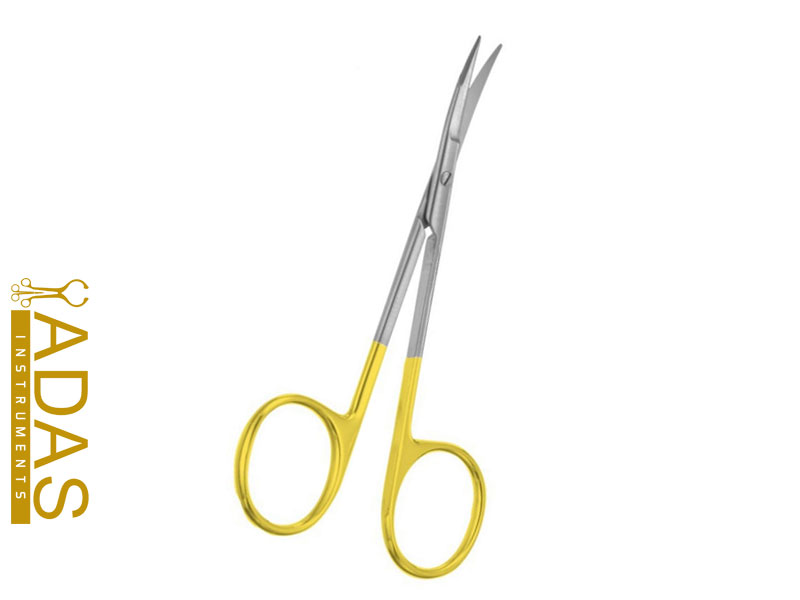
Kaye Blepharoplasty Scissors, Curved, Tungsten Carbide Only
Price range: $ 18.50 through $ 23.50
Kaye blepharoplasty scissors are fine curved eyelid scissors offered with tungsten carbide edges and nothing else, for a practice where lid surgery turns up on every list. Steel edges dull by degrees and the hand quietly answers with more closing force, which is the last thing half millimetre lid skin wants. Carbide does not fade at that rate.
- Two builds only: carbide, or carbide plus a supercut razor grind on one edge
- Gold loops are the trade’s marker for a brazed insert, not a styling choice
- Equally at home as fine facial scissors once you are away from the orbit

What Kaye blepharoplasty scissors are
Kaye blepharoplasty scissors are the carbide only member of our eyelid range, made for a surgeon whose operating week always contains lid work rather than one whose week occasionally does.
That single restriction is the whole character of the pattern. Every other fine facial scissor we make can be had with a plain ground edge, because for occasional use a plain edge is perfectly adequate and costs less. This one cannot, and the reason is what happens to a steel edge under repetition.
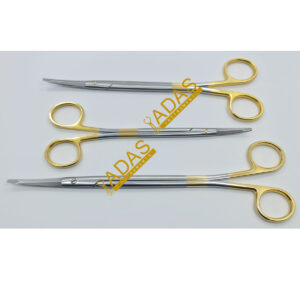
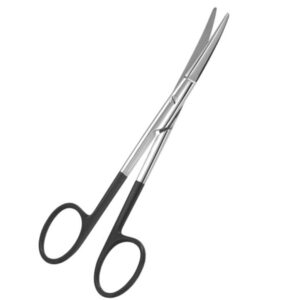
Adas Instruments offers it in two builds, carbide and carbide supercut, and the pair in the photograph carries the gold rings that mark a carbide instrument throughout the trade.
Why Kaye blepharoplasty scissors are carbide only
A ground stainless edge does not go blunt suddenly. It rounds off across dozens of cases, and the surgeon compensates without noticing, applying a little more closing force each week to get the same cut.
On thick tissue that compensation is invisible. On an eyelid it is not. Orbicularis and half millimetre skin do not tolerate a blade that crushes before it parts, and the extra force needed to make a tired edge bite is the force that pushes a tip somewhere it should not go. The failure is gradual and then it is a complication.
Carbide inserts do not round off at the same rate, which is the argument for Kaye blepharoplasty scissors in one sentence. They are brazed to the blade and are several times harder than surgical stainless, so the edge a surgeon learned the feel of in month one is roughly the edge they still have in month twelve. For fine facial scissors used constantly, that consistency is worth more than the price difference.
The supercut build adds a razor grind on one edge as well. Delicate facial scissors gain more from that grind than heavy instruments do, because the tissue is thin enough that any crushing at all shows in the healed result.
Clinical applications
| Procedure | What the instrument does |
|---|---|
| Upper lid blepharoplasty | Cuts the marked skin ellipse and trims muscle, repeatedly and identically across a list |
| Lower lid blepharoplasty | Works the subciliary plane and trims skin to a conservative margin |
| Ptosis repair | Dissects onto the levator aponeurosis where the field is a few millimetres wide |
| Asian lid surgery | Fine work on the pretarsal tissues, where edge consistency matters most |
| Canthoplasty | Cutting at the canthal angles |
| Brow and mid face work | General use as delicate facial scissors away from the orbit |
| Oculoplastic reconstruction | Lid margin and graft work through repeated lists |
The two builds of Kaye blepharoplasty scissors
Carbide, or carbide with a supercut grind. Both are stock.
Plain carbide is the one to take if you want an edge that behaves the same for years and you are not cutting anything unusually fine. It is also the cheaper of the two, and easier to have serviced, because plenty of sharpeners handle carbide while fewer will reproduce a razor grind correctly.
Carbide supercut is for the surgeon working on pretarsal tissue, thin lower lid skin, or anything where a crushed edge would show. It cuts with noticeably less closing force, which is the point rather than a side effect. The trade is that resharpening has to go to someone who will regrind rather than simply flatten it.
Technical specification
Taken from the Kaye blepharoplasty scissors we hold rather than from a catalogue.
| Detail | Specification |
|---|---|
| Instrument type | Kaye blepharoplasty scissors, curved, carbide only |
| Blade | Fine and curved, tapering |
| Edge options | Tungsten carbide, or tungsten carbide supercut |
| Handle | Standard finger ring, gold finished to mark the carbide |
| Material | High quality medical grade stainless steel |
| Sterilisation | Reusable, fully autoclavable, supplied non-sterile |
| Rust prevention | Passivated and boil tested, ultrasonically cleaned before packing |
| Marking | Laser marked with the pattern name and the Adas Instruments reference |
| Reference | AD-21.211 |
| Price | From 18.50 dollars |
Looking after Kaye blepharoplasty scissors
Carbide changes the maintenance rather than removing it.
The edge lasts, so the failure mode moves to the tips and the joint. Tips on curved eyelid scissors are slender enough to bend under almost nothing, and a bent tip on a carbide pair is worse than on a steel one, because the instrument still feels sharp and the surgeon trusts it. Sight along the closed blades under a lamp before each list and look for light showing at the extreme end.
The service rule is absolute and it is where most carbide instruments are ruined: a wheel set up for steel will lift the insert clean off. Anything sent out for sharpening goes to someone who states that they work on carbide, and if the pair is a supercut, say so as well.
Otherwise: cold rinse the moment it leaves the field, ultrasonic clean, autoclave with the joint open, dry fully, one drop of oil on the screw weekly. Keep it in a micro tray with tip protection, never loose.
Made by Adas Instruments
We braze and grind the carbide for these Kaye blepharoplasty scissors here, and we offer the pattern in nothing else because offering a plain version of it would be selling the wrong instrument to the surgeon who wants this one.
Brazing quality is the thing to interrogate in any carbide instrument, because a poorly brazed insert can separate from the blade in service, and on an eyelid that is not a small event. Ours are brazed, ground and then load tested before packing. Both builds of Kaye blepharoplasty scissors are shelf stock from 18.50 dollars. Ask for an evaluation pair, keep it through a few reprocessing cycles, and look at the insert seams afterwards. Supplied branded or plain for distributors.
Frequently asked questions
What are Kaye blepharoplasty scissors used for?
Eyelid surgery, chiefly upper and lower lid blepharoplasty, ptosis repair and canthal work, and as delicate facial scissors elsewhere on the face. The carbide edges suit a practice doing this work continually rather than now and then.
Why are Kaye blepharoplasty scissors carbide only?
Because a ground steel edge rounds off gradually and the surgeon compensates with extra closing force without noticing. On half millimetre lid skin that extra force is exactly what causes trouble. Carbide holds its edge long enough that the instrument feels the same across years, and that consistency is the reason to buy the pattern at all.
What does the supercut build add?
A razor grind on one edge as well as the carbide. It cuts with less closing force, which matters on pretarsal tissue and thin lower lid skin where any crushing shows in the result. It needs a sharpener who will regrind rather than flatten it.
What do the gold rings mean?
They mark tungsten carbide, here and across the instrument trade. The purpose is practical: whoever services the instrument needs to know not to put it on a steel wheel, which would lift the insert off.
How do Kaye blepharoplasty scissors compare with the plain curved pattern?
The geometry is close; the difference is the edge and who it is for. The plain curved blepharoplasty scissors are the sensible first purchase for an eyelid tray. These are what a surgeon buys once lid work is a fixed part of every week.
Related instruments and categories
You will find this pattern in the blepharoplasty instruments listing and again in plastic surgery scissors.
The general purpose pattern is the curved blepharoplasty scissors. Where the handle rather than the edge is what tires, the ribbon fingers version changes the handle instead. To separate tissue instead of dividing it, the rounded end of the Ragnell pattern sits more safely beside a globe.
| Weight | 0.05 kg |
|---|---|
| Blade Type | Tungsten Carbide, Tungsten Carbide Supercut |
Be the first to review “Kaye Blepharoplasty Scissors, Curved, Tungsten Carbide Only”
Shipping & Delivery Policy
Processing Time: In-stock items are dispatched within 24-48 hours. For custom or out-of-stock items, production time is approximately 10-15 days.
Global Delivery Estimates
We partner with world-class couriers (DHL, FedEx) to ensure fast, tracked delivery.
- USA & Canada: 3-5 Business Days
- Europe & UK: 4-6 Business Days
- Rest of World: 5-7 Business Days
*We offer Air Cargo and Sea Freight options for bulk wholesale orders.
Customs & Duties
International buyers are responsible for any customs duties or taxes imposed by their country. Adas Instruments is not responsible for delays caused by customs clearance.
Lost Packages & Insurance
If your package is lost in transit, please contact us immediately. We offer full support and replacements for confirmed lost shipments. Note: You must report non-delivery within 3 weeks to be eligible for an insurance claim.
Related products


Reviews
There are no reviews yet.