
Fomon Dorsal Scissors, Angled Nasal Scissors for Rhinoplasty and Septoplasty
Price range: $ 10.00 through $ 48.00
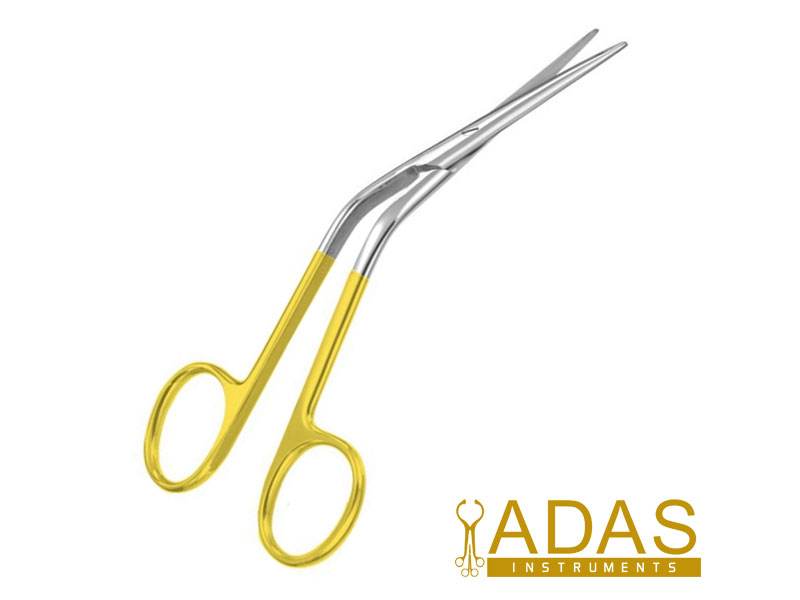
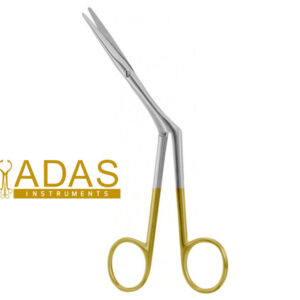
Fomon dorsal scissors are angled surgical scissors used to cut the cartilage of the nasal bridge during rhinoplasty and septoplasty. The bend falls partway along the shank, between the finger rings and the working edges, dropping your hand clear of the nostril while the edges stay flat on the dorsum. Blunt ends, slim straight blades, six edge builds from a plain ground edge up to carbide supercut.
- The bend keeps your hand below the sightline in a closed approach
- Blunt ends make it harder to catch the mucosa behind whatever you are cutting
- Pick plain, supercut, carbide or ceramic coated according to how hard the pair will work

What Fomon dorsal scissors are
Fomon dorsal scissors are the angled pattern a rhinoplasty surgeon reaches for when the cartilaginous bridge of the nose has to be cut down from the inside. Dorsal means the bridge, and the instrument is named for the work rather than for a material or a size. Catalogues also list the pattern as angled nasal scissors, and it is the same tool under a plainer name.
What defines it is the bend. The shanks lift away from the plane of the finger rings, and the blades then run on straight and slim from the end of that lift. Nothing about the cutting edges is unusual. The geometry between the rings and the edges is the entire point of the design, and it is what separates Fomon dorsal scissors from an ordinary pair of straight nasal scissors.
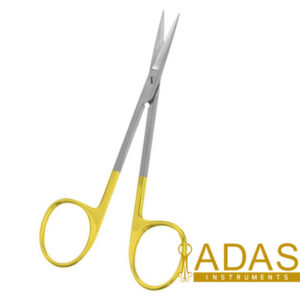
Adas Instruments makes this pattern in house in six blade specifications. Gold on the rings and shanks is the trade signal for tungsten carbide edges, so what you are looking at in the product photograph above is the carbide version rather than the plain steel one.
Why the shanks are angled
Inside a nose there is no room to hold a straight instrument and still see what it is cutting. Put a straight scissor through a marginal or an intercartilaginous incision and the rings end up pointing back at the surgeon, with the hand sitting directly over the tip of the nose. The blades are in the right place and the surgeon cannot see them. Fomon dorsal scissors exist to fix that one problem.
The angle moves the hand without moving the blades. Because the shanks lift, the rings finish below and to the side of the nostril while the working edges stay flat along the dorsum. The surgeon looks down the axis of the nose past the hand instead of through it, which is why Fomon dorsal scissors keep turning up on closed rhinoplasty trays where the exposure is narrowest.
Surgeons mention a second gain more often than visibility, which is wrist position. A straight instrument used in the same place forces the wrist into extension, and a wrist held at the end of its range is a wrist that has lost its fine control. Trimming two or three millimetres off a dorsal hump is not a job for a wrist under strain. The angle lets the forearm, the wrist and the blades sit in one relaxed line, and control at the tips comes from the fingers.
The tips themselves are blunt rather than pointed on this pattern. Cartilage is cut with the length of the blade, not with the point, and a blunt end is far less likely to push through the mucosa on the far side of what is being cut.
Clinical applications
Fomon dorsal scissors are a rhinoplasty instrument first, but any procedure that involves cutting cartilage along the bridge through a small opening puts them on the tray.
| Procedure | What the instrument does |
|---|---|
| Dorsal hump reduction | Takes the cartilaginous hump down to the planned profile, working along the bridge rather than across it |
| Closed rhinoplasty | Cuts cartilage through a marginal or intercartilaginous incision, where a straight instrument cannot be aimed at all |
| Septoplasty | Divides septal cartilage and trims the caudal and dorsal strut deep inside the nose |
| Septorhinoplasty | Handles the septal and the dorsal work in one instrument instead of two |
| Revision rhinoplasty | Cuts scar and old graft material along a bridge that has been operated on before |
| Nasal reconstruction | Shapes cartilage grafts once they are already sitting in the pocket |
| ENT nasal surgery | General cartilage and soft tissue cutting where the angle buys the sightline |
Blade and edge options for Fomon dorsal scissors
Six specifications are listed at the top of this page and the difference between them is real, not a finish preference.
Standard is a conventional ground edge in stainless. Supercut replaces one of those edges with a razor grind, so the instrument parts cartilage with less crushing, which matters when the piece being cut is going back in as a graft. Tungsten carbide inserts the cutting edges as separate carbide plates, which hold sharpness far longer than steel and are the reason a carbide pair costs more and lasts longer. Ceramic coated adds a hard non reflective surface over the shanks and blades, which cuts glare under theatre lights and helps when a camera is running.
The combinations follow from that. Carbide and supercut together give the longest lasting razor edge. Ceramic coated with carbide gives the same edge life with no glare. All six are stock specifications on Fomon dorsal scissors rather than special orders. If you are buying one pair to find out whether the pattern suits your hand, the standard version is the sensible place to start.
Technical specification
Everything below is confirmed for the Fomon dorsal scissors we hold in stock rather than quoted from a general catalogue.
| Detail | Specification |
|---|---|
| Instrument type | Fomon dorsal scissors, angled shanks with straight blades |
| Angle | Shanks lifted away from the plane of the finger rings |
| Blade | Slim and straight, carried on from the end of the bend |
| Tips | Blunt |
| Edge options | Standard, standard supercut, tungsten carbide, tungsten carbide supercut, ceramic coated with tungsten carbide, ceramic coated supercut with tungsten carbide |
| Handle | Standard finger ring |
| Material | High quality medical grade stainless steel |
| Sterilisation | Reusable, fully autoclavable, supplied non-sterile |
| Rust prevention | Passivated and boil tested, ultrasonically cleaned before packing |
| Marking | Laser marked with the pattern name and the Adas Instruments reference |
| Reference | AD-210.24 |
| Price | From 10 dollars |
Care and sterilisation of Fomon dorsal scissors
The angle that makes this instrument useful is also the thing that gets damaged. A bend is a stress point, and a bent shank throws the blades out of line with each other so the pair stops cutting cleanly at the tips. That damage almost never happens in theatre. It happens in storage, under the weight of a retractor or a bone instrument that was dropped into the same box. Fomon dorsal scissors belong in a bracketed tray with the shank supported.
Wash them cold the moment they come off the field, before anything has a chance to dry. Cartilage debris and blood set hard in a box lock and a stiff joint on an angled instrument is very hard to feel through, because the angle already absorbs some of the feedback from the tips. Ultrasonic clean, then autoclave with the joint fully open so steam reaches inside the lock, dry the instrument completely, and put a drop of instrument oil on the screw once a week.
Hold the blades of your Fomon dorsal scissors up to a light before every list and look along the closed edges. On angled nasal scissors a small misalignment is not obvious at arm’s length, and it shows up as a pair that crushes cartilage instead of cutting it. A carbide pair that has gone dull needs resharpening by someone who works on carbide, not on steel.
Made by Adas Instruments
Fomon dorsal scissors are manufactured here rather than bought in, and that is the reason the edge specification is a stock choice instead of a special order. All six versions sit on the shelf, with the standard edge starting at 10 dollars.
An angled pattern only proves itself in one hand, so we send evaluation pairs to hospitals and distributors before anyone commits to a set. Orders go out branded Adas Instruments, or unbranded for distributors who put their own mark on, and we laser a customer reference on request.
Frequently asked questions
What are Fomon dorsal scissors used for?
Cutting cartilage along the bridge of the nose, mainly in dorsal hump reduction during rhinoplasty. They are also used in septoplasty to divide septal cartilage, and in revision work to cut scar and old graft material where the exposure is narrow.
Why are Fomon dorsal scissors angled?
To get the hand out of the sightline. Lifting the shanks drops the finger rings below and to one side of the nostril, while the cutting edges stay flat along the bridge. Use a straight instrument in that position and it hides its own tips, and it pushes the wrist into extension at the same time.
What is the difference between dorsal and lateral Fomon scissors?
The dorsal pattern is angled to work along the bridge of the nose. The lateral pattern is angled for the lower and upper lateral cartilages and the soft tissue beside them. Most rhinoplasty surgeons end up owning both, because the two bends reach two different planes and neither substitutes for the other.
Are the tips sharp or blunt?
Fomon dorsal scissors are supplied blunt tipped. Cartilage is cut with the length of the blade rather than with the point, and a blunt end is much less likely to push through mucosa on the far side of the cut.
Is tungsten carbide worth the extra cost?
If the pair is in regular use, yes. Carbide edges are separate inserts that hold sharpness far longer than a ground steel edge, so a carbide pair of Fomon dorsal scissors goes through more lists before it needs attention. For occasional use, or for a first pair bought to try the pattern, the standard edge is enough.
Related instruments and categories
You will find this pattern listed under rhinoplasty instruments, next to the elevators, rasps and osteotomes it shares a tray with, and again under plastic surgery scissors with the rest of our scissor range.
If the work is on the lateral cartilages instead of the bridge, Fomon lateral scissors are the companion angle. Our second angled dorsal option is the Cottle dorsal pattern, and for fine cutting right at the nasal tip there is a 10 cm pair, the Converse scissors.
| Weight | 0.05 kg |
|---|---|
| Blade Type | Ceramic coated + TC, Ceramic coated Super cut + TC, Standard, Standard Supercut, Tungsten Carbide, Tungsten Carbide Supercut |
Be the first to review “Fomon Dorsal Scissors, Angled Nasal Scissors for Rhinoplasty and Septoplasty”
Shipping & Delivery Policy
Processing Time: In-stock items are dispatched within 24-48 hours. For custom or out-of-stock items, production time is approximately 10-15 days.
Global Delivery Estimates
We partner with world-class couriers (DHL, FedEx) to ensure fast, tracked delivery.
- USA & Canada: 3-5 Business Days
- Europe & UK: 4-6 Business Days
- Rest of World: 5-7 Business Days
*We offer Air Cargo and Sea Freight options for bulk wholesale orders.
Customs & Duties
International buyers are responsible for any customs duties or taxes imposed by their country. Adas Instruments is not responsible for delays caused by customs clearance.
Lost Packages & Insurance
If your package is lost in transit, please contact us immediately. We offer full support and replacements for confirmed lost shipments. Note: You must report non-delivery within 3 weeks to be eligible for an insurance claim.
Related products


Reviews
There are no reviews yet.