
Fomon Lateral Scissors, Curved 12.5 cm Nasal Scissors for Cartilage and Soft Tissue
Price range: $ 14.00 through $ 24.00
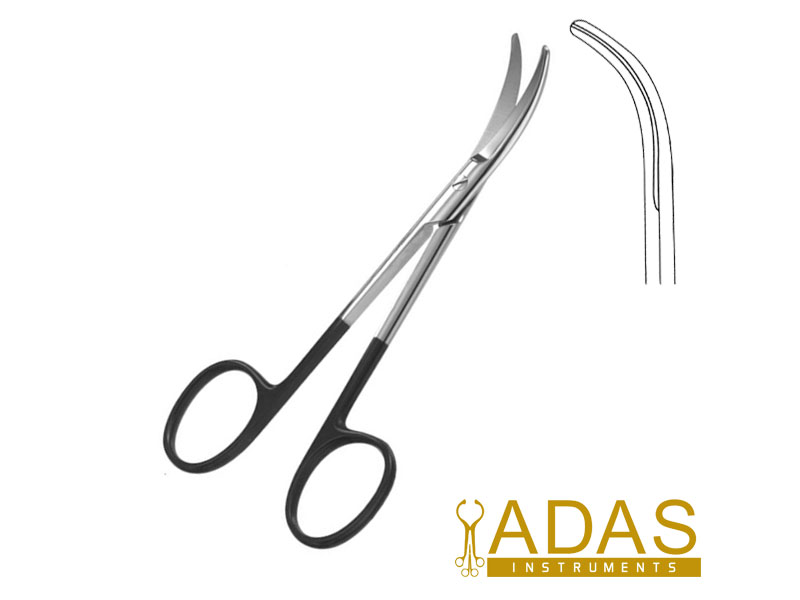
Fomon lateral scissors are fine curved surgical scissors used to dissect and trim the alar cartilage and the middle vault, and the soft tissue covering them. One smooth curve runs from joint to tip, which tracks a curved cartilage rather than meeting it at a single point, and the ends are rounded rather than sharp. The pair measures 12.5 cm, or 5 inches.
- Curved blades track the ala and the dome rather than lifting off them
- Blunt ends suit undermining thin alar skin where a point would catch
- Four edges: standard, super cut, tungsten carbide, or both together

What Fomon lateral scissors are
Fomon lateral scissors are the fine curved pattern a rhinoplasty surgeon works with out at the sides of the nose, on the lower and upper lateral cartilages. It is made at 12.5 cm, five inches. Catalogues split the name in two, listing fomon lower lateral scissors and fomon upper lateral scissors, but the instrument on this page serves both regions. It also appears simply as fomon nasal scissors.
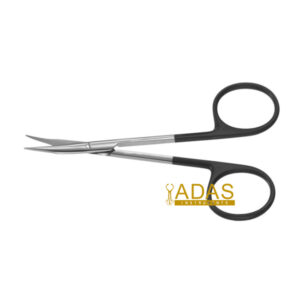
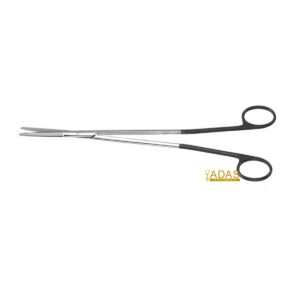
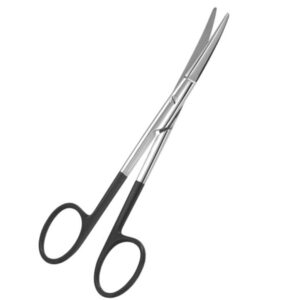
The blades are what to look at in the photograph. They leave the joint and sweep upward in one smooth curve, slim the whole way, finishing in rounded ends rather than points. The inset in the photograph is a single blade seen side on, which is the clearest view of how much curve there actually is.
That is a different solution to the same problem the dorsal patterns solve. A Fomon dorsal scissor bends at the shank. Fomon lateral scissors leave the shank alone and curve the blade instead, and the pair photographed here is the plain steel version, which is why there is no gold on the rings.
Why Fomon lateral scissors are curved and not angled
The lower lateral cartilage is not a flat plate. It is a curved strip that wraps round the nostril and turns at the dome, and the plane the surgeon needs to open follows that curve. A straight blade crossing a curved surface only touches it at one point; everything else is either lifted off the tissue or digging into it.
Fomon lateral scissors sit along the contour instead. Run the closed tips under the skin of the ala and the curve follows the cartilage rather than fighting it, so the plane opens with the blade in contact along its whole length. Open the blades slightly and the same curve spreads the tissue.
Rounded tips matter as much as the curve. Skin over the alar cartilage is thin, and there is very little between the plane being opened and the outside of the nose. A pointed tip in that position finds the dermis. A blunt one slides. This is why Fomon lateral scissors are as often used for blunt dissection as for cutting, and why surgeons reach for them to undermine a flap before they reach for anything sharper.
The other consequence is direction. On Fomon lateral scissors the blades cut in an arc, which means the instrument is handed in practice even though it is symmetrical: most surgeons turn the curve up for undermining and down for trimming the caudal edge of a cartilage.
Clinical applications
Fomon lateral scissors cover the part of a rhinoplasty that happens out at the sides and the tip, rather than on the bridge.
| Procedure | Role of the instrument |
|---|---|
| Tip rhinoplasty | Opens the plane over the lower lateral cartilages and trims cephalically along their upper edge |
| Alar work | Undermines the skin of the ala with the curve following the cartilage underneath |
| Upper lateral cartilage release | Separates the upper lateral cartilage from the septum and from the overlying tissue |
| Open approach dissection | Raises the skin flap over the dome and the middle vault after a columellar incision |
| Cartilage graft trimming | Shapes a rim, shield or alar batten graft with a curve that matches the graft’s own shape |
| Septoplasty | Cuts soft tissue and mucosa near the caudal septum where a curve reaches better than a straight blade |
| Nasal reconstruction and ENT | Fine dissection anywhere in the nose that needs a blunt curved tip rather than a point |
Blade and edge options for Fomon lateral scissors
The selector above this text offers four builds of Fomon lateral scissors. There is no ceramic coated version of this pattern, unlike our dorsal ones, so the decision is purely about the edge.
Standard is a conventional edge ground in stainless, sharpened and finished the usual way, and it is the version in the photograph. Super cut standard puts a razor grind on one of the two edges. On a curved blade that grind is worth more than it is on a straight one, because a curve already has to shear across tissue at a changing angle, and a razor edge stops that shearing turning into dragging.
Tungsten carbide brazes carbide inserts along the cutting edges. Carbide holds an edge across many more procedures than stainless, which is what you want on a pair used for daily tip work, and carbide instruments carry gold rings so that nobody sharpens them on a steel wheel. Super cut with tungsten carbide combines both, and it is the version to buy if this pair is going to be the one you always reach for.
Technical specification
Every figure here is taken from the pairs on our own shelf, not copied out of a trade catalogue.
| Detail | Specification |
|---|---|
| Instrument type | Fomon lateral scissors, curved, for nasal cartilage and soft tissue |
| Overall length | 12.5 cm, 5 inches |
| Blade | Slim, curved in one smooth sweep from the joint |
| Tips | Rounded, suitable for blunt dissection as well as cutting |
| Edge options | Standard, super cut standard, tungsten carbide, super cut with tungsten carbide |
| Handle | Standard finger ring |
| Material | High quality medical grade stainless steel |
| Sterilisation | Reusable, fully autoclavable, supplied non-sterile |
| Rust prevention | Passivated and boil tested, ultrasonically cleaned before packing |
| Marking | Laser marked with the pattern name and the Adas Instruments reference |
| Reference | AD-215.70 |
| Price | From 14 dollars |
Care and sterilisation of Fomon lateral scissors
Fomon lateral scissors have one weakness above all others, and it is the last few millimetres of the tips. They are thin, they sit at the end of a curve, and a curve concentrates any sideways force right there. Tips get sprung by being levered, and they get bent by being stacked under something heavier in a tray. Once the two tips no longer meet, the pair will part tissue along the middle of the blade and then stop, which on a nasal flap is worse than not cutting at all.
So check the tips before every list. Close the blades slowly against a light and look for a gap at the very end. If there is one, take the pair out of service.
The rest is routine. Rinse under cold water immediately, because blood and cartilage debris set inside a small joint quickly. Ultrasonic clean, autoclave with the joint open, dry it completely before storage, and oil the screw once a week. Send carbide and super cut pairs only to a sharpener who handles those specifically, since an ordinary wheel flattens a razor grind and lifts a carbide insert.
Made by Adas Instruments
Fomon lateral scissors are made on our own benches, so all four edge specifications are stock rather than special order, starting at 14 dollars.
Because the curve on this pattern is ground rather than stamped, the two blades on a pair are matched to each other during manufacture, which is the part that decides whether the tips will still meet in two years. We send evaluation pairs out before a hospital or a distributor places a full order, and instruments can be supplied unmarked or laser marked to a customer’s own reference.
Frequently asked questions
What are Fomon lateral scissors used for?
Dissecting and trimming at the alar and middle vault cartilages in rhinoplasty. They open the plane over the alar cartilage, release the upper lateral cartilage, raise the skin flap in an open approach and shape cartilage grafts. The blunt curved tips mean they are used for spreading tissue as much as for cutting it.
What is the difference between the upper and lower lateral versions?
The names describe where the instrument is used, not two different instruments. There is one pair of Fomon lateral scissors, not two. Suppliers list fomon upper lateral scissors and fomon lower lateral scissors separately because surgeons search for them that way; the 12.5 cm curved pattern on this page covers both.
Why curved rather than angled?
Because the cartilage it works on is curved. An angled shank, as on the Fomon dorsal pattern, moves the hand out of the sightline for work along the straight bridge. The curve on Fomon lateral scissors follows a contour instead, which is what the ala and the dome need.
What length are they?
12.5 cm, which is 5 inches. That is short enough to be held like a pen and controlled from the fingers, and long enough to reach the middle vault through a marginal incision.
Which edge should I order?
Standard if you are trying Fomon lateral scissors for the first time, or using them occasionally. Super cut with tungsten carbide if it is going to be in a tip rhinoplasty tray every week, because carbide keeps the edge and the razor grind stops a curved blade dragging.
Related instruments and categories
Fomon lateral scissors are filed under rhinoplasty instruments beside the elevators, rasps, osteotomes and retractors from the same tray, and in plastic surgery scissors with everything else we grind.
For the bridge rather than the sides, the angled patterns are the Fomon dorsal scissors and the Cottle dorsal scissors. At the nasal tip itself, where 12.5 cm is still too much instrument, there is the 10 cm Converse scissors. For soft tissue away from cartilage altogether, see the Joseph dissecting scissors.
| Weight | 0.05 kg |
|---|---|
| Select Scissors Type | Standard Scissors, Super Cut Standard, Super Cut Tungsten Carbide, Tungsten Carbide |
Be the first to review “Fomon Lateral Scissors, Curved 12.5 cm Nasal Scissors for Cartilage and Soft Tissue”
Shipping & Delivery Policy
Processing Time: In-stock items are dispatched within 24-48 hours. For custom or out-of-stock items, production time is approximately 10-15 days.
Global Delivery Estimates
We partner with world-class couriers (DHL, FedEx) to ensure fast, tracked delivery.
- USA & Canada: 3-5 Business Days
- Europe & UK: 4-6 Business Days
- Rest of World: 5-7 Business Days
*We offer Air Cargo and Sea Freight options for bulk wholesale orders.
Customs & Duties
International buyers are responsible for any customs duties or taxes imposed by their country. Adas Instruments is not responsible for delays caused by customs clearance.
Lost Packages & Insurance
If your package is lost in transit, please contact us immediately. We offer full support and replacements for confirmed lost shipments. Note: You must report non-delivery within 3 weeks to be eligible for an insurance claim.
Related products

Reviews
There are no reviews yet.