
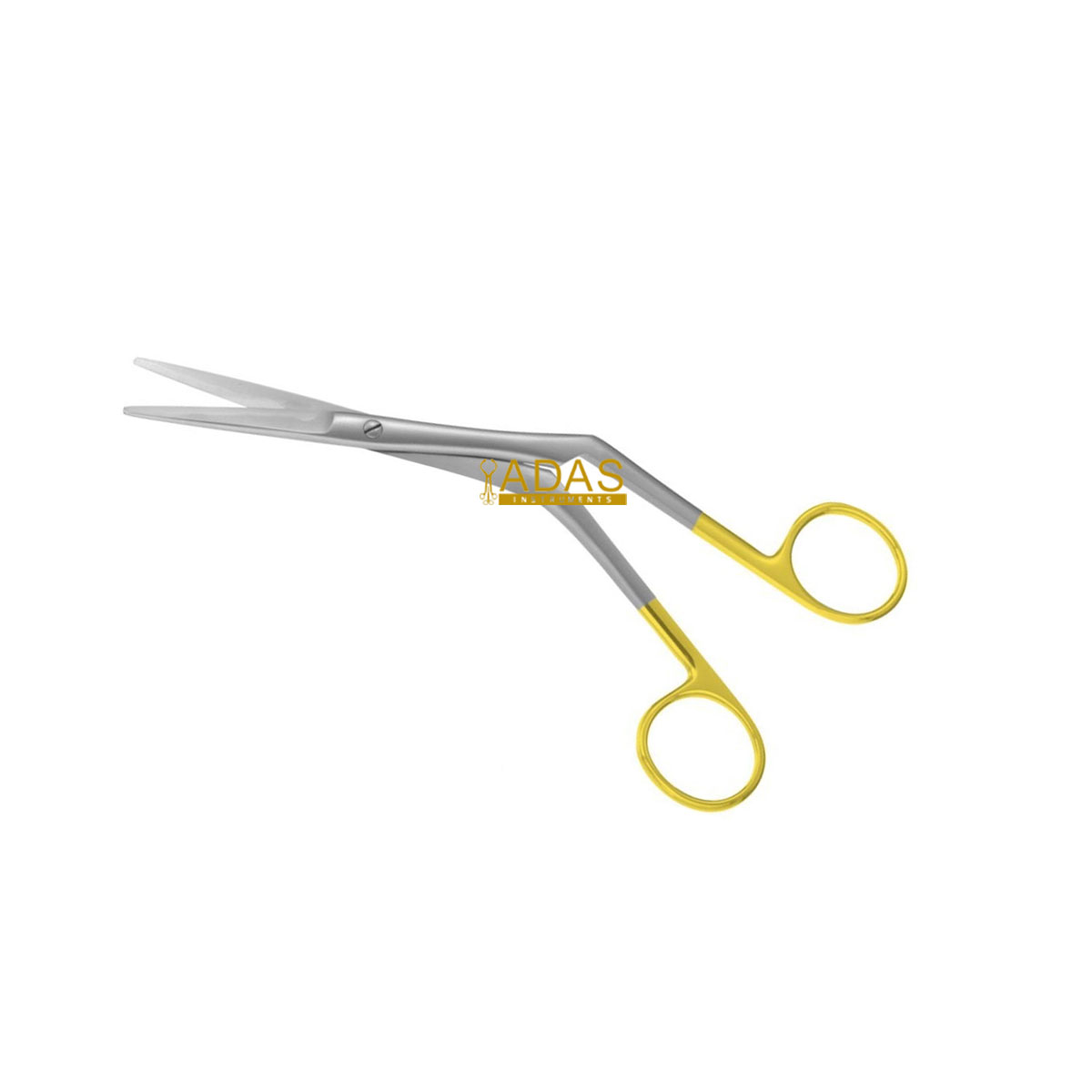
Septal Nasal Scissors, Angled, Serrated, 18.5 cm
$ 28.00
Septal scissors are angled surgical scissors used to divide the cartilage and the bone of the nasal septum during septoplasty. They are built heavier than the other nasal patterns, because hard septal cartilage and the bone plate sitting behind it will spring a lighter blade. The pattern is 18.5 cm overall.
- Heavy blades and a stiff joint for cartilage and thin bone
- Micro serrated both edges, both tips blunt
- Angled shank, blades reach the posterior septum
Available on backorder

What septal scissors are
Septal scissors are the pattern built for the hardest cut in nasal surgery, through septal cartilage and the bony plate sitting behind it. They are the heavy instrument on a rhinoplasty tray. They exist to cut, trim and dissect tough septal cartilage and the thin bone behind it, material that ordinary surgical scissors will skid off rather than divide. Adas Instruments builds them at 18.5 cm with an angled shank and serrated blades, and older catalogues list the same instrument as septum scissors.
Weight is the point. Septal scissors are not delicate instruments, and they are not meant to be: a fine tissue scissor closes on cartilage and pushes it aside. Septal scissors are built with thicker blades and a stiffer joint so the force the surgeon applies at the rings arrives at the cutting edge instead of being lost in flex.
Clinical applications
In septoplasty the deviated part of the septum has to be trimmed or removed, and most of that is quadrangular cartilage with a strip of vomer or perpendicular plate at the back. Angled septal scissors take both, which is why some catalogues simply call them septal cartilage scissors. The surgeon works through a hemitransfixion incision, lifts the mucoperichondrial flaps, and then cuts the cartilage to shape with the blades lying along the plane of the septum.
Rhinoplasty uses septal scissors for the same reason. Caudal septal trimming, harvesting a cartilage graft from the septum, and dividing the septum from the upper laterals all want an instrument that cuts cartilage cleanly on the first pass. A ragged cartilage edge does not heal into a straight nose.
They also turn up in transsphenoidal approaches to the pituitary, where the surgical corridor runs straight back through the nose and the septum has to be opened and cleared before the sella can be reached.
| Procedure | What the instrument does | Why this pattern |
|---|---|---|
| Septoplasty | Cuts and trims deviated quadrangular cartilage | Heavy blades divide cartilage instead of flexing on it |
| Bony septum work | Takes a strip of vomer or perpendicular plate | Stiff joint delivers the force from the rings to the edge |
| Rhinoplasty | Caudal septal trimming and cartilage graft harvest | Clean first pass cuts leave a graft that sits flat |
| Upper lateral release | Divides the septum from the upper lateral cartilages | Serrations hold springy cartilage while the blades close |
| Transsphenoidal approach | Opens and clears the nasal corridor to the sella | Blunt tips are safe working towards the skull base |
The angle, and where 18.5 cm puts the blades
The shank is angled so the finger rings sit below the surgeon’s sightline into the nostril. That is the same logic as every other intranasal instrument, and there is no way around it: a straight pair puts the hand exactly where the eye needs to be.
18.5 cm is chosen so the blades reach the posterior septum with the rings still comfortably outside the nose. Shorter and the hand fouls the nostril rim on a deep cut. Longer and the instrument starts to feel vague, which is the last thing wanted when cutting within a millimetre of the skull base.
Serrations that hold cartilage
Cartilage is slippery and it is springy, and a smooth blade on wet cartilage behaves like a smooth blade on a wet bar of soap. Micro serrations along the edge bite in and hold the tissue while the blades close, so the cut lands on the line the surgeon marked rather than a few millimetres in front of it.
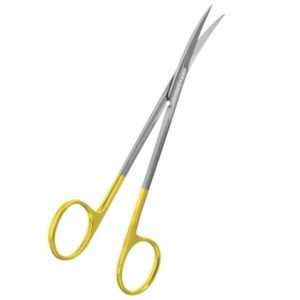
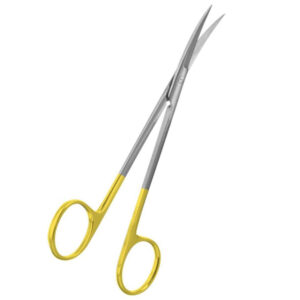
The tips are blunt. Working next to the cribriform plate and the skull base, a sharp point buys nothing and risks a great deal. Blunt tips also allow the closed instrument to separate mucosa from cartilage before any cutting begins. The photograph on this page shows the tungsten carbide version, which is identified by the gold finger rings. The plain steel version is identical in shape.
Tungsten carbide edges are available on septal scissors. Cartilage and thin bone are the hardest things any nasal instrument is asked to cut, so this is the pattern where carbide earns its cost fastest, and a carbide pair is identified by gold rings on the handles.
Where this pattern sits in the tray
Think of the nasal scissors on a tray as a set of three jobs. Cartilage and bone go to the angled septal pattern. Long reach along the turbinate goes to the Heymann. Everyday intranasal soft tissue cutting goes to the Knight. Most ENT lists carry at least two of the three, and a septoplasty list will not start without the septal pair.
Technical specification
| Detail | Specification |
|---|---|
| Instrument type | Septal nasal scissors, angled shank, heavy pattern |
| Overall length | 18.5 cm, 7.25 inches |
| Blade | Heavy, micro serrated both edges |
| Tips | Blunt, blunt |
| Handle | Standard finger ring |
| Edge options | Serrated as standard, tungsten carbide on request |
| Material | High quality medical grade stainless steel |
| Sterilisation | Reusable, fully autoclavable, supplied non-sterile |
| Rust prevention | Passivated and boil tested, ultrasonically cleaned before packing |
| Marking | Laser marked with the pattern name and the Adas Instruments reference |
| Reference | AD-215.19 |
Care and sterilisation
Cartilage debris packs into serrations and sets hard, so septal scissors need ultrasonic cleaning rather than a wipe and a rinse. Put it in cold water at the end of the case, run it through the ultrasonic bath, and check the serrations under a light before it goes back in the set.
Heavy blades take heavy loads, and the joint is what gives way first. If the pair starts to feel loose at the screw, or the blades cross rather than shear, take it out of service and send it for adjustment. Forcing a loose heavy scissor through cartilage is how blades chip. Steam sterilise with the joint open and dry the pair fully before it is stored; a drop of oil on the screw each week keeps the action even.
Ordering from Adas Instruments
Adas Instruments produces the septal pattern in our own workshops, so serration depth, blade weight and a carbide upgrade are things we set during manufacture. We supply single pairs for evaluation, full sets for theatre, and unbranded stock for distributors who put their own name on it.
Frequently asked questions
What are septal scissors used for?
Cutting and trimming septal cartilage and the thin bone behind it, in septoplasty and rhinoplasty. They are also used to open the nasal corridor in transsphenoidal approaches to the pituitary.
How are septal scissors different from ordinary nasal scissors?
Septal scissors are heavier. Thicker blades and a stiffer joint let them divide cartilage and thin bone, where a fine tissue scissor would flex and push the cartilage aside instead of cutting it.
Why are the blades serrated?
Wet cartilage slides. Micro serrations grip it while the blades close, so the cut lands where it was placed rather than sliding forward under pressure.
What length is this pattern?
18.5 cm, about 7.25 inches. That reaches the posterior septum while the finger rings stay clear of the nostril rim.
Can they be supplied with tungsten carbide edges?
Yes, on request. Cartilage and bone are the hardest cutting this instrument does, so carbide holds a working edge through far more sterilising cycles than steel alone. Carbide pairs are marked with gold rings.
Related instruments and categories
Nasal scissors sit in two places on this site: the rhinoplasty instruments pages, alongside the elevators, osteotomes and forceps that share the tray, and the plastic surgery scissors pages, alongside every other scissor pattern we make.
For long reach along the turbinate use the Heymann turbinectomy scissors. For general intranasal soft tissue the Knight nasal scissors. The Walter nasal scissors handle the nasal dorsum.
| Weight | 0.06 kg |
|---|---|
| Select Size | 18.5 cm / 7 1/4" |
| Blade | Heavy, micro serrated both edges, blunt tips |
| Shank | Angled |
Be the first to review “Septal Nasal Scissors, Angled, Serrated, 18.5 cm”
Shipping & Delivery Policy
Processing Time: In-stock items are dispatched within 24-48 hours. For custom or out-of-stock items, production time is approximately 10-15 days.
Global Delivery Estimates
We partner with world-class couriers (DHL, FedEx) to ensure fast, tracked delivery.
- USA & Canada: 3-5 Business Days
- Europe & UK: 4-6 Business Days
- Rest of World: 5-7 Business Days
*We offer Air Cargo and Sea Freight options for bulk wholesale orders.
Customs & Duties
International buyers are responsible for any customs duties or taxes imposed by their country. Adas Instruments is not responsible for delays caused by customs clearance.
Lost Packages & Insurance
If your package is lost in transit, please contact us immediately. We offer full support and replacements for confirmed lost shipments. Note: You must report non-delivery within 3 weeks to be eligible for an insurance claim.
Related products

Reviews
There are no reviews yet.