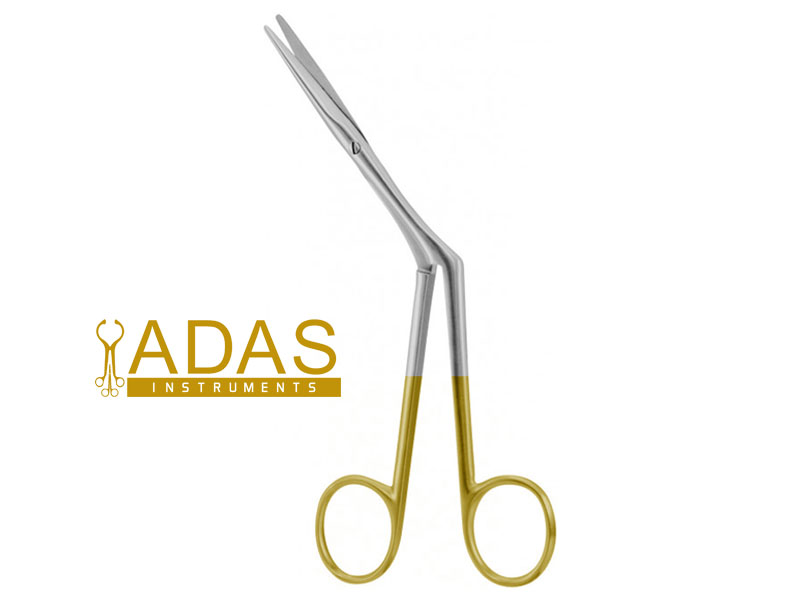
Heymann Turbinectomy Scissors, Long Angled Blades, 18 cm
Price range: $ 17.00 through $ 23.00
Turbinectomy scissors are angled surgical scissors used to trim an enlarged inferior turbinate and to cut mucosa inside the nasal cavity. The Heymann pattern carries unusually long blades on an angled shank, and that reach is what lets the tips get behind a turbinate through a nostril. 18 cm overall.
- Long blades, longer than the Knight or Walter patterns
- Smooth on both blades as standard, both tips blunt
- One serrated edge on request for wet mucosa

What turbinectomy scissors are
Turbinectomy scissors are long bladed, angled scissors made for one job: trimming the inferior turbinate so a patient can breathe through the nose again. The turbinate sits well back in the nasal cavity, wrapped in thick mucosa over a bony core, and a general purpose scissor simply does not reach it. Heymann is the pattern most ENT surgeons name when they ask for turbinectomy scissors, or simply turbinate scissors, and the catalogues that list it as Heymann nasal scissors mean the same instrument. Adas Instruments makes it in 18 cm.
Two things separate these from the shorter intranasal patterns. The blades are long, which is what gets the cutting edge to the posterior end of the concha. And the shank is angled, so the surgeon’s hand sits below the line of sight rather than in front of it.
Clinical applications
Inferior turbinate hypertrophy is one of the commonest reasons a nose stops working, and partial turbinectomy is one of the commonest answers. The surgeon takes the lower and medial part of the swollen concha, leaving enough mucosa behind to keep the nose from drying out. That is a judgement call, and it needs an instrument that cuts exactly where it is placed.
Turbinectomy scissors manage that because the blades are long enough to sit along the turbinate rather than poking at it. A short blade has to take the tissue in several bites, and every extra bite is another chance to leave a ragged edge that bleeds and crusts.
The same instrument is used for the mucosal cuts in septoplasty and for intranasal dissection during rhinoplasty, where the work is deeper than a Fomon or a Joseph can comfortably reach.
| Procedure | What the instrument does | Why this pattern |
|---|---|---|
| Partial turbinectomy | Trims the lower and medial part of an enlarged inferior concha | Long blades lie along the turbinate and cut it in one pass |
| Turbinate reduction | Removes tough mucous membrane over bone | Blade length reaches the posterior end without several bites |
| Septoplasty | Makes the mucosal cuts along the septum | Angled shank keeps the hand below the sightline |
| Rhinoplasty | Intranasal dissection deeper than a Fomon can reach | Reach is the whole point of the pattern |
| Revision nasal surgery | Divides scarred mucosa at depth | Blunt tips separate a plane before cutting it |
Long blades and why the length is the point
Most people looking at a catalogue photograph notice the angle first. The blades matter more. A Heymann turbinectomy scissor carries a longer cutting edge than the Knight or the Walter patterns, and that length is not there for show. It lets the surgeon lay the blades along the length of the concha and make one continuous cut.
The tips are blunt. Nasal mucosa tears if you look at it wrong, and the last thing anyone wants two centimetres inside a nostril is a sharp point. Blunt tips also let the closed instrument be used to push tissue aside and find a plane before any cutting starts.
Blade shape follows the lateral wall of the nose rather than running dead straight, which matters because the wall is not flat and a flat blade cuts a chord across a curve. The photograph on this page shows the tungsten carbide version, which is identified by the gold finger rings. The plain steel version is identical in shape.
Heymann against the other nasal patterns
Surgeons often keep more than one nasal scissor on the tray, and the choice of turbinectomy scissors comes down to depth and blade length. Heymann turbinectomy scissors are the long bladed option for the turbinate. The Knight pattern has shorter serrated blades for general intranasal cutting. The angled septal pattern is for cartilage along the septum. The Walter is short, double S curved, and works over the nasal dorsum.
If a list is mostly turbinate reduction, the Heymann is the one that stays in the surgeon’s hand.
Edge and finish choices
Standard Heymann turbinectomy scissors from Adas Instruments have two smooth blades, which is what most surgeons order. One serrated edge is available on request, and it helps on wet mucosa that slides away from a smooth blade.
Tungsten carbide edges are an option too, and on a turbinate list that runs every week they pay for themselves: carbide stays sharp for far more sterilising cycles than plain steel. Any pair built that way leaves the factory with gold rings, which is the convention theatre staff already know.
Technical specification
| Detail | Specification |
|---|---|
| Instrument type | Heymann turbinectomy scissors, angled shank, long blades |
| Overall length | 18 cm, 7 inches |
| Blade | Long, slightly curved, smooth as standard |
| Tips | Blunt, blunt |
| Handle | Standard finger ring |
| Edge options | Smooth as standard, one serrated edge on request, tungsten carbide on request |
| Material | High quality medical grade stainless steel |
| Sterilisation | Reusable, fully autoclavable, supplied non-sterile |
| Rust prevention | Passivated and boil tested, ultrasonically cleaned before packing |
| Marking | Laser marked with the pattern name and the Adas Instruments reference |
| Reference | AD-216.18 |
Care and sterilisation
Turbinate work is bloody, and blood is what kills instruments. Get the pair into cold water as soon as it comes off the field. Hot water cooks protein onto steel and no amount of scrubbing afterwards will lift it cleanly.
Long blades bend if they are thrown loose into a tray with heavy retractors, so these should travel in a stringer or a bracketed case. Check the tips meet along their whole length before every list; a pair that has been sprung will cut at the base and chew at the point. Sterilise with the joint wide open so steam gets to the box lock, dry the pair before it is put away, and oil the screw once a week.
Ordering from Adas Instruments
We make Heymann turbinectomy scissors to order in our own factory, so blade length, serration and a carbide upgrade are all things we set on the bench rather than quote as a special. Hospitals usually take a sample pair first and run it through a few lists before ordering a set, and that is fine with us.
Frequently asked questions
What are turbinectomy scissors used for?
Trimming or removing part of an enlarged inferior turbinate so the nasal airway opens up. The same pair is also used for mucosal cuts in septoplasty and for intranasal dissection in rhinoplasty.
Why are Heymann turbinectomy scissors angled?
The angle in the shank puts the surgeon’s hand below the line of sight, so the blade tips stay visible deep in the nostril. A straight instrument hides the very thing being cut.
How long are the blades?
The blades on Heymann turbinectomy scissors are longer than on the Knight or Walter patterns, which is the point of the design. The extra length lets the blades lie along the concha and take it in one cut instead of several bites.
Are the blades smooth or serrated?
Smooth on both blades as standard. One serrated edge is available on request and helps where mucosa is wet and slides away from a smooth blade.
Are they autoclavable?
Yes. They ship non-sterile and go through a standard steam cycle with the joint held open. Dry them fully afterwards, because water sitting in a box lock is where pitting begins.
Related instruments and categories
Nasal scissors sit in two places on this site: the rhinoplasty instruments pages, alongside the elevators, osteotomes and forceps that share the tray, and the plastic surgery scissors pages, alongside every other scissor pattern we make.
For shorter intranasal cutting see the Knight nasal scissors. For septal cartilage use the angled septal nasal scissors. For dissection over the nasal dorsum the Walter nasal scissors carry a double S curve.
| Weight | 0.05 kg |
|---|---|
| Select Size | 18 cm / 7" |
| Blade | Long, smooth both blades, blunt tips |
| Shank | Angled |
Be the first to review “Heymann Turbinectomy Scissors, Long Angled Blades, 18 cm”
Shipping & Delivery Policy
Processing Time: In-stock items are dispatched within 24-48 hours. For custom or out-of-stock items, production time is approximately 10-15 days.
Global Delivery Estimates
We partner with world-class couriers (DHL, FedEx) to ensure fast, tracked delivery.
- USA & Canada: 3-5 Business Days
- Europe & UK: 4-6 Business Days
- Rest of World: 5-7 Business Days
*We offer Air Cargo and Sea Freight options for bulk wholesale orders.
Customs & Duties
International buyers are responsible for any customs duties or taxes imposed by their country. Adas Instruments is not responsible for delays caused by customs clearance.
Lost Packages & Insurance
If your package is lost in transit, please contact us immediately. We offer full support and replacements for confirmed lost shipments. Note: You must report non-delivery within 3 weeks to be eligible for an insurance claim.
Related products


Reviews
There are no reviews yet.