Knight Nasal Scissors, Angled, Serrated, 18 cm
$ 26.00
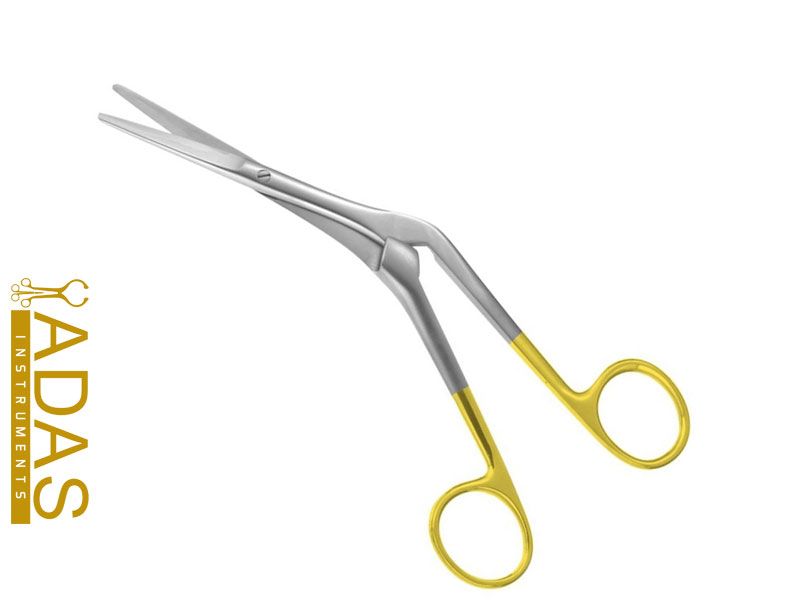
Knight nasal scissors are angled surgical scissors used to cut and dissect mucosa and cartilage inside the nose. Surgeons reach for them in turbinate reduction, septoplasty and rhinoplasty, where the work sits deep in the nasal cavity and the hand has to stay out of the sightline. The pattern is 18 cm overall with serrated blades.
- Angled shank, blades sit level with the inferior turbinate
- One serrated edge as standard, both tips blunt
- Blade curve upward or downward, smooth blades on request
Available on backorder

What Knight nasal scissors are
Knight nasal scissors are angled scissors used inside the nose, where the working space is a few millimetres wide and the surgeon cannot afford to lose sight of the blade tips. The pattern is named for the angle built into the shank rather than for the blade shape, and that single bend is the reason the instrument exists. Adas Instruments makes the Knight in 18 cm, which puts the blades level with the inferior turbinate while the finger rings stay outside the nostril.
The blades are slim and serrated on one edge. The serration is not decoration. Nasal mucosa is wet and it slides, and a smooth blade tends to push tissue ahead of the cut instead of taking it. A serrated edge holds, so the cut starts where the surgeon put it and finishes there.
Why the angle matters in the nostril
Hold a straight scissor in a nostril and your hand ends up directly in front of the thing you are trying to see. The angle in a Knight nasal scissor drops the handle below the line of sight. That is the whole argument for the pattern, and it is why every ENT catalogue carries one.
The second effect of the angle is reach. The nasal aperture narrows towards the back, and a straight instrument runs out of room before the blades arrive at the posterior end of the turbinate. The bend lets the blades continue along the axis of the cavity while the shanks clear the rim of the nostril.
Blunt tips finish the design. The nasal lining tears easily and bleeds at once, so a sharp point in a confined space is a liability rather than an advantage. Knight scissors are made blunt on purpose, and a surgeon who wants a sharp intranasal point is reaching for a different instrument.
Clinical applications
Turbinate reduction is where these scissors do most of their work. The inferior turbinate carries tough mucous membrane over bone, and trimming it needs an instrument that can hold the tissue and cut it in one motion. Knight nasal scissors are the usual choice, and the serrated blade is the reason.
In septoplasty they divide cartilage and mucoperichondrium along the septum, and trim the caudal edge once the deviation has been corrected. In rhinoplasty they take over the intranasal part of the dissection, past the point where a Fomon or a Joseph is still working too far forward to be useful.
They also turn up in polypectomy and in releasing adhesions after earlier surgery, anywhere the cut has to be made deep and out of easy view. Surgeons who search for nostril scissors, knight turbinate scissors or plain nasal scissors are almost always describing this instrument.
| Procedure | What the instrument does | Why this pattern |
|---|---|---|
| Turbinate reduction | Holds and trims tough mucous membrane over the inferior concha | Serrated edge grips wet tissue so the cut does not slide |
| Septoplasty | Divides cartilage and mucoperichondrium, trims the caudal edge | Angled shank reaches the septum with the tips in view |
| Rhinoplasty | Takes the intranasal part of the dissection | Short blades work where a Fomon or a Joseph is too far forward |
| Polypectomy | Cuts polyp stalks deep in the cavity | Blunt tips will not puncture the lining alongside |
| Adhesion release | Divides scar bands after earlier nasal surgery | Serration holds fibrous tissue instead of pushing it |
Blade and serration options
Adas Instruments stocks Knight nasal scissors with one serrated blade as standard, which is the pattern most surgeons expect. Two smooth blades are available on request for work on cartilage alone, where grip matters less and a clean shearing cut matters more. Used that way they serve as nasal cartilage scissors, and a few surgeons keep a smooth pair on the tray for exactly that job.
Tungsten carbide inserts can be fitted at the cutting surfaces. Carbide holds an edge far longer than steel through repeated autoclave cycles, and it is worth specifying on an instrument that gets used in every turbinate list. Carbide pairs are marked with gold rings so they are not confused on the tray.
Size and pattern
Knight nasal scissors are made in one length for intranasal work, and that is 18 cm, or seven inches. Shorter than that and the rings crowd the nostril. Longer than that and the instrument becomes unwieldy in a cavity that is only a few centimetres deep.
The angle is fixed at the shank. Anything else about the blade, serration on one side or two, or a smooth pair, is set during manufacture rather than chosen from stock.
The photograph on this page shows the tungsten carbide version, which is identified by the gold finger rings. The plain steel version is identical in shape.
Technical specification
| Detail | Specification |
|---|---|
| Instrument type | Knight nasal scissors, angled shank |
| Overall length | 18 cm, 7 inches |
| Blade | Slim, one serrated edge as standard |
| Tips | Blunt, blunt |
| Handle | Standard finger ring |
| Edge options | Serrated one side, smooth on request, tungsten carbide on request |
| Material | High quality medical grade stainless steel |
| Sterilisation | Reusable, fully autoclavable, supplied non-sterile |
| Rust prevention | Passivated and boil tested, ultrasonically cleaned before packing |
| Marking | Laser marked with the pattern name and the Adas Instruments reference |
| Reference | AD-214.17 |
Care and sterilisation
Blood dries fast in a serrated edge, so rinse the instrument in cold water before anything else and never let it sit dirty through a case list. Warm water sets protein into the serrations and then only ultrasonic cleaning will shift it.
Knight nasal scissors are fully autoclavable. Open the joint completely so steam reaches the box lock, and dry the instrument before it goes back in the tray. Water left in a joint is where pitting starts. A drop of instrument milk on the screw once a week keeps the action smooth, and any pair that starts to feel gritty should come out of service for inspection rather than being forced.
Ordering from Adas Instruments
Adas Instruments manufactures Knight nasal scissors in house, so a serration change, a carbide upgrade or a different blade curve is a production instruction rather than a special order. Sample pairs go out for evaluation before a hospital commits to a set, and we supply under our own name or plain for distributors.
Frequently asked questions
What are Knight nasal scissors used for?
Turbinate reduction first of all, then septoplasty and rhinoplasty. They cut, trim and dissect soft tissue and cartilage inside the nasal cavity, and the angled shank lets the blades reach the back of the turbinate while the surgeon’s hand stays out of the line of sight.
Why are Knight nasal scissors angled?
The bend drops the handle below the line of sight so the blade tips stay visible in the nostril. It also lets the blades follow the axis of the nasal cavity while the shanks clear the rim, which a straight scissor cannot do.
Are the blades serrated?
One serrated edge is standard. Serration grips wet mucosa so the cut starts where the surgeon placed it instead of sliding forward. Two smooth blades are available on request for work on cartilage alone.
What length do Knight nasal scissors come in?
18 cm, or seven inches. That puts the blades level with the inferior turbinate while the finger rings stay outside the nostril.
Are they autoclavable?
Yes. They are fully autoclavable and supplied non-sterile. Open the joint completely so steam reaches the box lock, and dry the instrument before it goes back in the tray.
Related instruments and categories
Nasal scissors sit in two places on this site: the rhinoplasty instruments pages, alongside the elevators, osteotomes and forceps that share the tray, and the plastic surgery scissors pages, alongside every other scissor pattern we make.
For heavier turbinectomy work the Heymann turbinectomy scissors carry longer blades. For septal cartilage and thin bone use the angled septal nasal scissors. For dissection over the nasal dorsum the Walter nasal scissors are the double S curved pattern.
| Weight | 0.05 kg |
|---|---|
| Select Size | 18 cm / 7" |
| Blade | One serrated edge, blunt tips |
| Shank | Angled |
Be the first to review “Knight Nasal Scissors, Angled, Serrated, 18 cm”
Shipping & Delivery Policy
Processing Time: In-stock items are dispatched within 24-48 hours. For custom or out-of-stock items, production time is approximately 10-15 days.
Global Delivery Estimates
We partner with world-class couriers (DHL, FedEx) to ensure fast, tracked delivery.
- USA & Canada: 3-5 Business Days
- Europe & UK: 4-6 Business Days
- Rest of World: 5-7 Business Days
*We offer Air Cargo and Sea Freight options for bulk wholesale orders.
Customs & Duties
International buyers are responsible for any customs duties or taxes imposed by their country. Adas Instruments is not responsible for delays caused by customs clearance.
Lost Packages & Insurance
If your package is lost in transit, please contact us immediately. We offer full support and replacements for confirmed lost shipments. Note: You must report non-delivery within 3 weeks to be eligible for an insurance claim.
Related products
Reviews
There are no reviews yet.