Walter Nasal Scissors, Double S Curve, 14 cm
$ 23.00
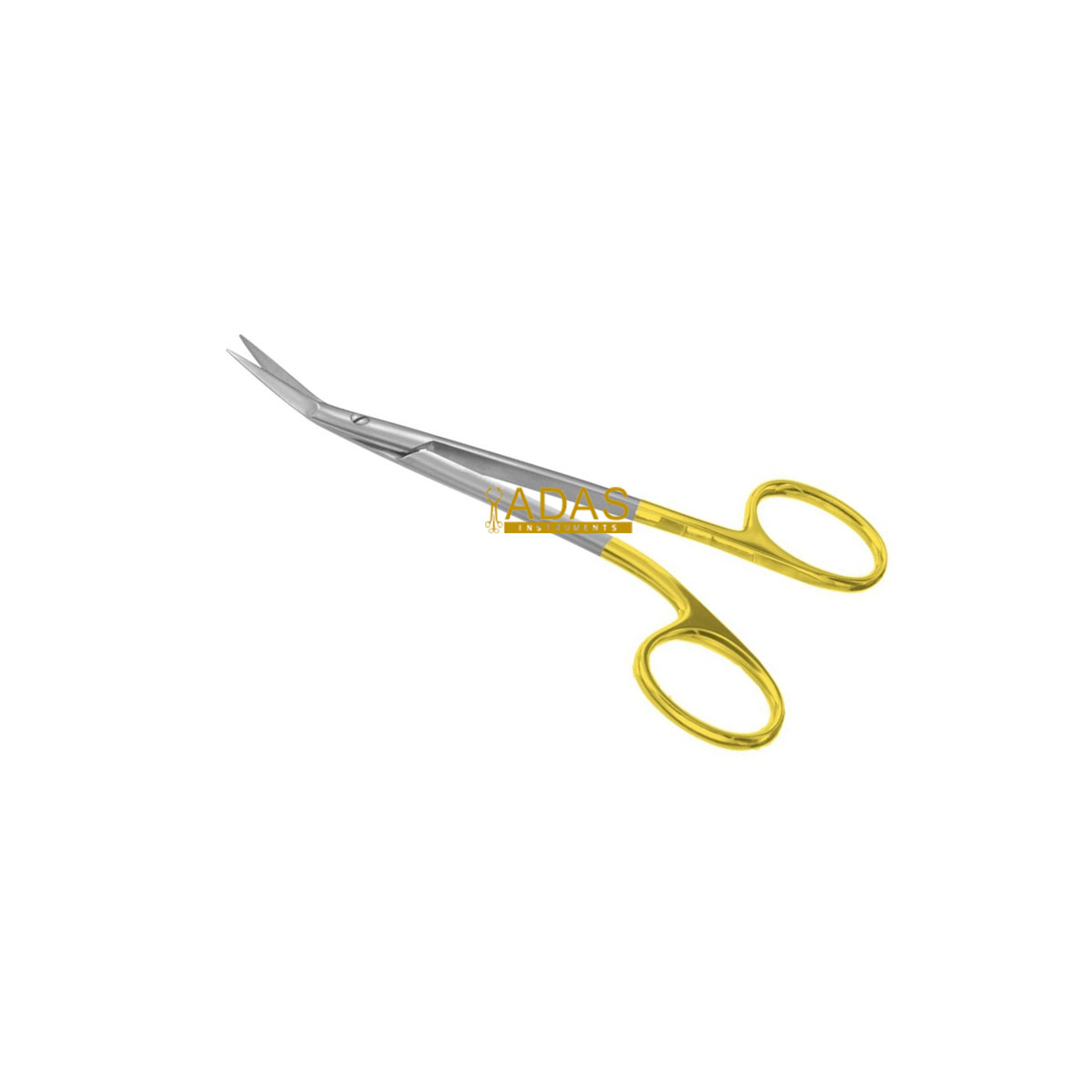
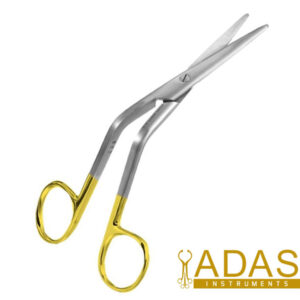
Nasal scissors are surgical scissors shaped to reach inside the nose, where the field is narrow and a straight instrument hides its own tips. The Walter pattern does that with a double S curved shank, and is used in rhinoplasty to lift skin and soft tissue off the bridge and to trim the cartilaginous dorsum. 14 cm overall.
- Double S curve, blades lie flat on the dorsum
- Fine smooth blades as standard, both tips blunt
- Also listed as Walter Cottle nasal scissors
Available on backorder

What nasal scissors are
Nasal scissors are fine bladed surgical scissors made for working inside and on the nose, where the space is narrow and the surgeon has to see the blade tips at all times. Almost every pattern shares two features: a shank that is angled or curved so the hand does not block the view, and blunt tips, because nasal lining tears at the slightest provocation. The named patterns a surgeon meets on a tray are Cottle, Fomon, Joseph, Knight, Heymann and Walter, and each one exists because a particular cut needed a particular shape.
The Walter is the dorsal pattern, and when a catalogue lists dorsal dissection scissors for rhinoplasty this is usually the instrument meant. Adas Instruments makes it at 14 cm with the double S curve that catalogues also list under the name Walter Cottle nasal scissors.
The Walter pattern and its double S curve
Look at a Walter from the side and the shank bends twice, once away from the blades and once back. That double S is not decoration. It lifts the finger rings clear of the patient’s face while leaving the blades lying flat along the nasal dorsum, which no single bend can do.
The practical result is that a surgeon can run the blades up the dorsum from the tip to the radix with an unobstructed view of the tips, and without the rings pressing on the cheek or the brow. On a straight or single angled pair, the hand has to lift and the blades lose contact with the plane.
14 cm keeps the instrument short. The dorsum is close to the surface and a long scissor here is all leverage and no control.
Clinical applications
The main job is raising the soft tissue envelope over the dorsum in rhinoplasty. The surgeon opens at the columella or through an intercartilaginous incision and then works up over the cartilaginous and bony dorsum, staying in the supraperichondrial and supraperiosteal plane so the envelope lifts as one sheet. A clean plane here is what stops the skin from thinning or contracting oddly months later.
The same instrument trims the dorsal septum, divides the scroll between the upper laterals and the alar cartilages, and takes small tissue adjustments around the tip. Because the blades are fine, the Walter is also used for delicate work in revision cases where the tissue is scarred and a heavier pattern would tear rather than cut.
| Procedure | What the instrument does | Why this pattern |
|---|---|---|
| Dorsal dissection | Raises the soft tissue envelope over the nasal dorsum | Double S curve keeps the blades flat on the dorsum |
| Dorsal septum trimming | Takes small amounts from the cartilaginous dorsum | Fine blades remove tissue a fraction at a time |
| Scroll division | Separates the upper laterals from the alar cartilages | Short length gives control close to the surface |
| Tip refinement | Small soft tissue adjustments around the tip | Blunt fine tips will not buttonhole thin skin |
| Revision rhinoplasty | Cuts through scarred envelope tissue | Fine blades cut scar where a heavy pair would tear |
The four nasal scissor patterns compared
Surgeons rarely carry only one pair, and the choice is about shape, not quality. The Walter, with its double S curve, is for the dorsum. The Knight nasal scissors have short serrated blades and an angled shank for general cutting inside the nostril. The Heymann turbinectomy scissors carry long blades to reach along the inferior turbinate. The angled septal nasal scissors are the heavy pair for cartilage and thin bone.
Blade, tips and edge options
Standard Walter nasal scissors from Adas Instruments have fine smooth blades with blunt tips. Smooth is right for dissection in a clean plane, where the blades are opening tissue as much as cutting it.
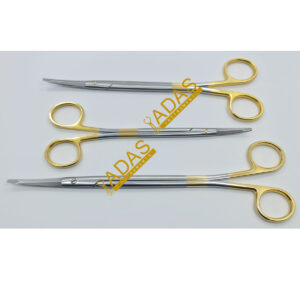
A serrated edge is available on request and is worth asking for if the work is mostly revision surgery through scar. The photograph on this page shows the tungsten carbide version, which is identified by the gold finger rings. The plain steel version is identical in shape. Tungsten carbide inserts are also available; on a fine bladed instrument carbide mainly buys edge life rather than cutting force, and a carbide pair is marked with gold rings.
Technical specification
| Detail | Specification |
|---|---|
| Instrument type | Walter nasal scissors, double S curve |
| Overall length | 14 cm, 5.5 inches |
| Blade | Fine, smooth as standard |
| Tips | Blunt, blunt |
| Handle | Standard finger ring |
| Edge options | Smooth as standard, serrated on request, tungsten carbide on request |
| Material | High quality medical grade stainless steel |
| Sterilisation | Reusable, fully autoclavable, supplied non-sterile |
| Rust prevention | Passivated and boil tested, ultrasonically cleaned before packing |
| Marking | Laser marked with the pattern name and the Adas Instruments reference |
| Reference | AD-244-14 |
Care and sterilisation
Fine blades are the easiest to ruin. The double curve means Walter scissors cannot be laid flat with other instruments without something resting on the blades, so it belongs in a bracketed tray or a protective tip guard, not loose in a box with retractors.
Rinse in cold water straight after the case, then ultrasonic clean. Hold the pair up to a light and look along the closed blades; if daylight shows between them the tips have been sprung and the pair will crush rather than cut. Sterilise with the joint open, dry thoroughly, oil the screw weekly.
Ordering from Adas Instruments
We manufacture nasal scissors across all the standard patterns, so a Walter can be supplied with a serrated edge, carbide inserts or a slightly different curve without it becoming a special order. Evaluation pairs are available before a set is bought, and we produce plain instruments for distributors as well as instruments marked with our own name.
Frequently asked questions
What are nasal scissors used for?
Cutting, trimming and dissecting soft tissue and cartilage in and around the nose, in rhinoplasty, septoplasty and turbinate surgery. Each named pattern suits a particular part of that work, which is why most trays carry more than one.
What are Walter nasal scissors used for?
Raising the soft tissue envelope over the nasal dorsum in rhinoplasty, trimming the dorsal septum and dividing the scroll area. They are also useful in revision surgery where the tissue is scarred.
Why does the Walter have a double S curve?
So the blades can lie flat along the dorsum while the finger rings stay clear of the patient’s face. A single angle cannot do both at once, and the surgeon would have to lift the hand and lose the plane.
Are Walter and Walter Cottle nasal scissors the same thing?
Yes. Both names describe the same double S curved pattern, and catalogues use them interchangeably.
What length is this pattern?
14 cm, about 5.5 inches. The nasal dorsum is close to the surface, so a short instrument gives better control than a long one.
Related instruments and categories
Nasal scissors sit in two places on this site: the rhinoplasty instruments pages, alongside the elevators, osteotomes and forceps that share the tray, and the plastic surgery scissors pages, alongside every other scissor pattern we make.
Inside the nostril, the Knight nasal scissors take general soft tissue cutting, the Heymann turbinectomy scissors reach along the inferior turbinate, and the angled septal nasal scissors cut cartilage and thin bone.
| Weight | 0.05 kg |
|---|---|
| Select Size | 14 cm / 5 1/2" |
| Blade | Fine, smooth both blades, blunt tips |
| Shank | Double S curve |
Be the first to review “Walter Nasal Scissors, Double S Curve, 14 cm”
Shipping & Delivery Policy
Processing Time: In-stock items are dispatched within 24-48 hours. For custom or out-of-stock items, production time is approximately 10-15 days.
Global Delivery Estimates
We partner with world-class couriers (DHL, FedEx) to ensure fast, tracked delivery.
- USA & Canada: 3-5 Business Days
- Europe & UK: 4-6 Business Days
- Rest of World: 5-7 Business Days
*We offer Air Cargo and Sea Freight options for bulk wholesale orders.
Customs & Duties
International buyers are responsible for any customs duties or taxes imposed by their country. Adas Instruments is not responsible for delays caused by customs clearance.
Lost Packages & Insurance
If your package is lost in transit, please contact us immediately. We offer full support and replacements for confirmed lost shipments. Note: You must report non-delivery within 3 weeks to be eligible for an insurance claim.
Related products
Reviews
There are no reviews yet.