
Kaye Facelift Scissors, Serrated Tungsten Carbide, 14 to 23 cm
Price range: $ 19.50 through $ 28.00
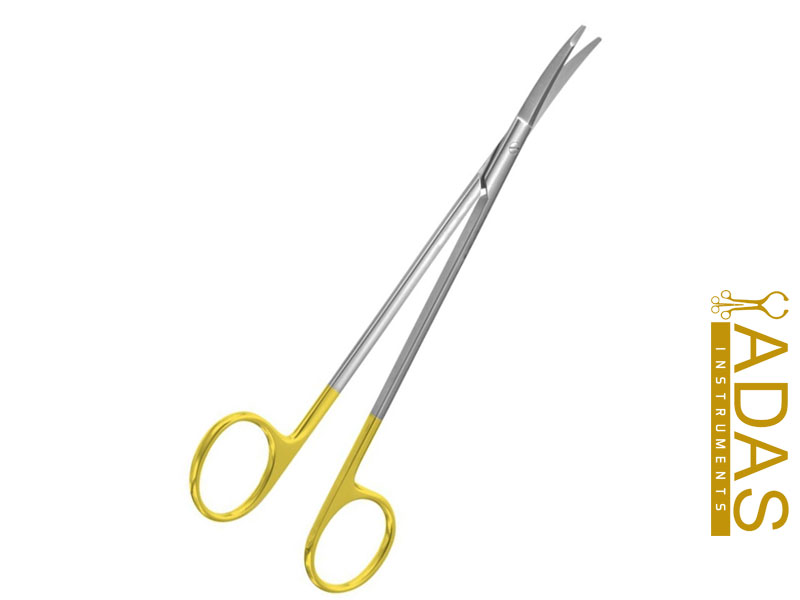
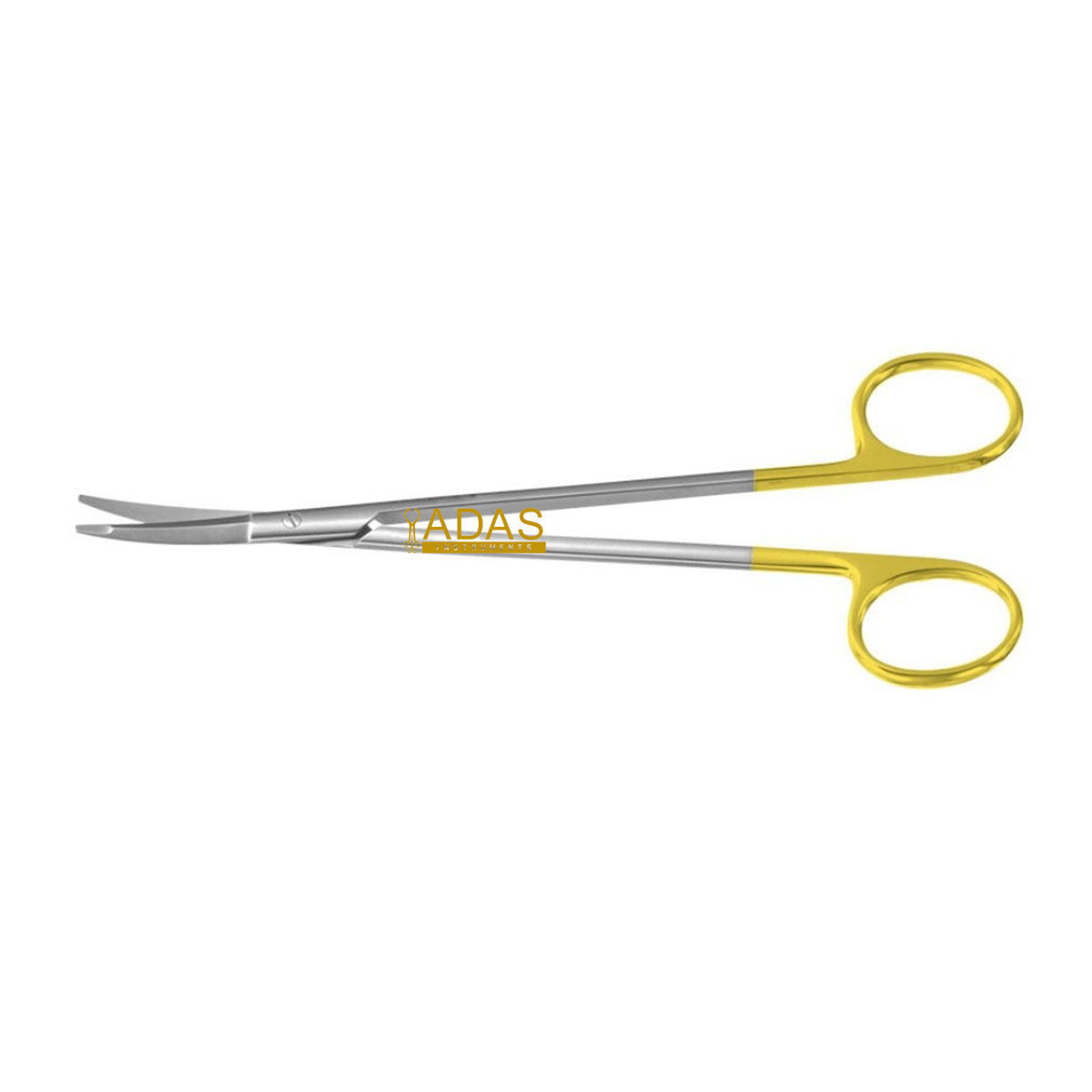
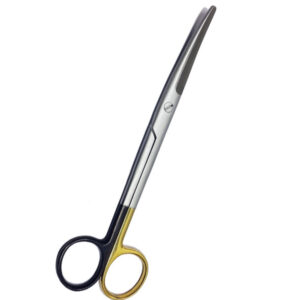
Kaye facelift scissors are long, slim surgical scissors used to raise the skin of the face and neck away from what lies under it in a facelift. Their edges carry teeth rather than a plain bevel, and the point of that is grip: a flap turns fibrous in one place and greasy in the next, which makes a smooth blade skid, and teeth do not let it. Five lengths, curved or straight blades.
- 14 cm through to 23 cm, so one pattern handles close jawline work and a full neck lift
- Carbide on the cutting edges, which is what the gold finger rings announce
- Grip means less force, and less force means the tip stays where you aimed it

What Kaye facelift scissors are
Kaye facelift scissors are the serrated pattern in a rhytidectomy set, used where a flap has to come up off the fat and muscle below it without tearing. The teeth along each cutting edge are the whole difference between these and a plain ground pair.
That choice is about grip, not sharpness. Fibrous septa in one spot, greasy fat in the next, and a plain blade meeting the underside of a flap will run along it instead of parting it. Teeth stop the running, so the cut lands where the surgeon aimed.
Adas Instruments makes these in five lengths from 14 cm to 23 cm, with curved or straight blades, and the pairs photographed on this page have gold rings, which is how carbide edges are marked across the trade.
Why serrated facelift scissors suit a flap
On Kaye facelift scissors the flap is the whole argument. Raise it cleanly and the result holds; thin it, tear it or buttonhole it and no amount of suturing recovers the loss. So the question for any facelift scissor is not how sharply it cuts but how predictably.
Serrated facelift scissors are predictable in a way plain ones are not. A plain blade on fibrous septa either bites or skids, and which one happens depends on the angle of approach and how wet the field is. Teeth take that variable out. They hold the tissue for the fraction of a second it takes the opposing edge to shear it, so one pass does what two might otherwise do.
The second gain is force. Kaye facelift scissors let the surgeon work with less of it. Pushing harder to make a plain blade bite is how a tip ends up somewhere it should not be.
The cost is cleaning. Debris packs between teeth and sets, and once it has, the serration grips nothing. That is a reprocessing discipline rather than a design flaw, and it is covered below.
Clinical applications
Kaye facelift scissors belong to face and neck work, and to any procedure where a flap has to be raised over a curved surface without being thinned.
| Procedure | What the instrument does |
|---|---|
| Facelift, rhytidectomy | Undermines the skin of the cheek and the preauricular area, separating flap from fat and muscle |
| Neck lift | Opens the plane from the mastoid across to the midline. Used as neck lift scissors, the two longest lengths earn their keep here |
| SMAS dissection | Cuts the deeper facial layer while the nerves and vessels running through it are protected |
| Brow and temple lift | Raises tissue over the curve of the skull, where a straight plain blade skids |
| Revision facelift | Parts scar tissue from a previous operation, which is where the teeth matter most |
| Neck and jawline contouring | Fine undermining close to the marginal mandibular nerve, using the shorter lengths |
| Reconstructive flap surgery | General flap elevation outside aesthetic work |
Sizes and blade shape
Kaye facelift scissors come in five lengths and two blade shapes, all held in stock rather than quoted as specials.
| Length | Where it suits |
|---|---|
| 14 cm, 5½ inches | Close work near the marginal mandibular nerve and around the parotid tail, where reach is a liability |
| 16 cm, 6¼ inches | Short scar and mid face procedures |
| 18 cm, 7 inches | The general purpose length, and the one most surgeons buy first |
| 20 cm, 8 inches | Neck work, where the pocket runs well beyond the incision |
| 23 cm, 9 inches | Full neck lift, reaching from the mastoid to the midline in one pass |
Curved blades follow the contour of a cheek or a jawline and are the usual choice for undermining. Straight blades cut to a line and handle sutures, and surgeons who do a lot of facelift work tend to keep one of each rather than choosing.
Technical specification
Every line below describes the Kaye facelift scissors on our own shelf, not a figure copied from a trade catalogue.
| Detail | Specification |
|---|---|
| Instrument type | Kaye facelift scissors, tungsten carbide facelift scissors with a serrated edge |
| Blade | Slim and long shanked, curved or straight |
| Edge | Serrated, with tungsten carbide inserts |
| Lengths | 14 cm, 16 cm, 18 cm, 20 cm and 23 cm |
| Handle | Standard finger ring |
| Material | High quality medical grade stainless steel |
| Sterilisation | Reusable, fully autoclavable, supplied non-sterile |
| Rust prevention | Passivated and boil tested, ultrasonically cleaned before packing |
| Marking | Laser marked with the pattern name and the Adas Instruments reference |
| Reference | AD-221-37 |
| Price | From 19.50 dollars |
Care and sterilisation of Kaye facelift scissors
Two things end the working life of this pattern, and neither happens while it is cutting.
The first is dried tissue in the serration of your Kaye facelift scissors. Teeth full of set protein grip nothing, so the instrument quietly stops doing the one job it was bought for, and nobody notices until a flap tears. Rinse under cold water the moment the pair leaves the field, then brush along the edge with a soft instrument brush before it goes into the ultrasonic bath. A wipe is not enough.
The second is a bent tip. A long slim shank bends if something heavier lands on it in a tray, and on a serrated pair a bend shows up as teeth that no longer meet their opposing edge. Store Kaye facelift scissors in a bracketed tray, not loose in a box, and check the closed edges against a light before every list.
Autoclave with the joint fully open so steam reaches inside the box lock, dry the instrument completely, and put a drop of instrument oil on the screw weekly. Resharpening goes to someone who works on carbide; an ordinary wheel will lift an insert and flatten the teeth in one pass.
Made by Adas Instruments
We cut and finish the serration on our Kaye scissors here rather than buying blades in, which matters because serration is where a cheap pair fails. Teeth that are stamped rather than cut have a rounded profile that grips for a while and then stops, and the pair feels fine in the hand while it is quietly getting worse.
All five lengths and both blade shapes of these Kaye facelift scissors are shelf stock, starting at 19.50 dollars. Ask for an evaluation pair in the length you use most and test it on the tissue you actually work on. We supply under our own name or plain for distributors, and mark instruments to a customer reference on request.
Frequently asked questions
What are Kaye facelift scissors used for?
Raising and separating the skin flap of the face and neck during a facelift or neck lift, and cutting the deeper SMAS layer. The serrated carbide edges grip fibrous and greasy tissue that a plain blade would slide across.
Why are Kaye facelift scissors serrated?
For grip rather than for sharpness. The flap is fibrous in places and greasy in others, so a smooth edge either bites or skids depending on the angle and how wet the field is. Teeth hold the tissue while the opposing edge shears it, which makes the cut predictable and lets the surgeon use less force.
Which length of Kaye facelift scissors should I order first?
18 cm, 7 inches. It is the general purpose length and the one most surgeons buy first. Order 23 cm as neck lift scissors if that is the bulk of your work. Add 14 cm for close work near the marginal mandibular nerve.
Curved or straight blades?
Curved for undermining, because the blade follows the contour of a cheek or a jawline. Straight for cutting to a line and for sutures. Surgeons doing regular facelift work usually keep one of each rather than choosing.
How should the serration on Kaye facelift scissors be cleaned?
Cold rinse straight off the field, then brush along the edge with a soft instrument brush before the ultrasonic bath. Dried tissue between the teeth stops them gripping, which defeats the whole point of the pattern, and a wipe will not shift it.
Related instruments and categories
This pattern sits under plastic surgery scissors with our full scissor range, and under facelift and neck lift instruments with the retractors, elevators and forceps that share the tray.
The Kaye Freeman facelift scissors are the companion pattern in the same five lengths. Where the tip needs to be blunt and broad rather than serrated, the Trepsat facelift dissection scissors end each blade in a flat spatula. For the finest work of all, once the plane is already open, there are the Kaye rhytidectomy dissecting scissors.
| Weight | 0.06 kg |
|---|---|
| Select Scissors Blades | Curved Blades, Straight Blades |
| Select Size | 14 cm / 5.5", 16 cm/6¼”, 18cm / 7", 20cm / 8", 23 cm / 9" |
Be the first to review “Kaye Facelift Scissors, Serrated Tungsten Carbide, 14 to 23 cm”
Shipping & Delivery Policy
Processing Time: In-stock items are dispatched within 24-48 hours. For custom or out-of-stock items, production time is approximately 10-15 days.
Global Delivery Estimates
We partner with world-class couriers (DHL, FedEx) to ensure fast, tracked delivery.
- USA & Canada: 3-5 Business Days
- Europe & UK: 4-6 Business Days
- Rest of World: 5-7 Business Days
*We offer Air Cargo and Sea Freight options for bulk wholesale orders.
Customs & Duties
International buyers are responsible for any customs duties or taxes imposed by their country. Adas Instruments is not responsible for delays caused by customs clearance.
Lost Packages & Insurance
If your package is lost in transit, please contact us immediately. We offer full support and replacements for confirmed lost shipments. Note: You must report non-delivery within 3 weeks to be eligible for an insurance claim.
Related products
Reviews
There are no reviews yet.