



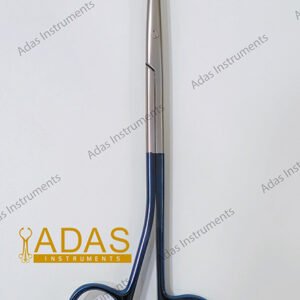
Trepsat Facelift Dissection Scissors, Spatula Tip, 16 to 20 cm
Price range: $ 44.00 through $ 48.00
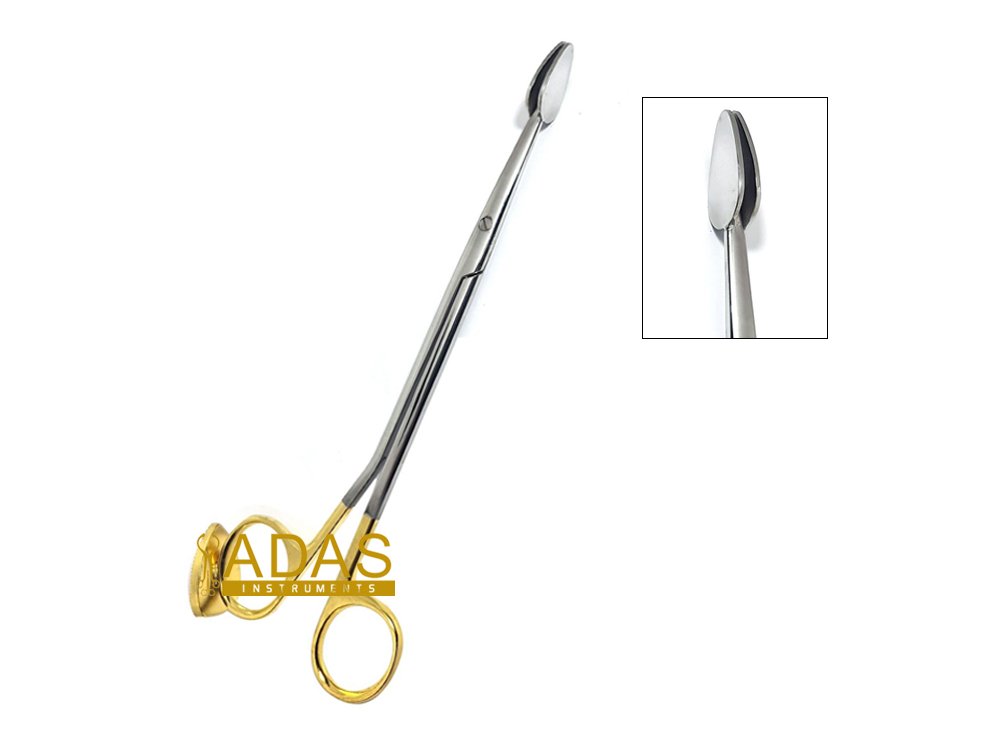
Facelift dissection scissors are long, slim surgical scissors used to lift facial and neck skin off the fat and muscle underneath it. On the Trepsat pattern each blade finishes in a flat, blunt spatula instead of a point, so the end rides along the underside of a flap rather than punching through it. Spatula widths run 5 to 25 mm, on a pair 16 cm, 18 cm or 20 cm long.
- Lengths: 16 cm, 18 cm and 20 cm
- Tip: flat spatula, blunt, 5 mm to 25 mm wide
- Use: undermining skin flaps, SMAS and neck lift dissection

What facelift dissection scissors are
Facelift dissection scissors are the long, slim scissors a surgeon uses to separate the skin of the face and neck from what lies under it, then to cut only where cutting is wanted. Most of the work is not cutting at all. The closed or slightly opened tips are run through the plane to open it, and that is why the tip shape decides whether the instrument is any good.
The Trepsat is the spatula tipped pattern, and catalogues list the same instrument as Trepsat scissors, a Trepsat dissector or simply a facelift dissector. Instead of a point, each blade ends in a flat spoon, and Adas Instruments makes these facelift dissection scissors at 16 cm, 18 cm and 20 cm.
The spatula tip, and buttonholing
The thing every facelift surgeon is avoiding is a buttonhole, a small hole poked straight through the skin flap from underneath. It happens when a tip finds the dermis instead of the plane below it, and on a face it is not a small problem.
Spatula tip scissors cannot easily do that. The end is broad and flat with no corner to catch, so when it meets resistance it slides along the underside of the flap rather than into it. That is the whole design argument, and it is why facelift dissection scissors appear in the literature as spatula tipped scissors rather than under a brand name.
The second effect is speed. A flat tip spreads a wider channel per pass, so a surgeon can run the slightly opened blades through the subcutaneous plane and open a pocket in a few strokes instead of twenty. Less time under the flap means less bruising afterwards.
Clinical applications
Trepsat facelift dissection scissors earn their place in facelift and neck lift work, and in any procedure where a flap has to be raised over a curved surface without thinning it.
| Procedure | What the instrument does | Why the spatula tip |
|---|---|---|
| Facelift (rhytidectomy) | Undermines the skin flap over the cheek and jawline | The flat tip slides under the flap instead of into it |
| Neck lift | Opens the plane from the mastoid across to the midline | 20 cm reaches the whole pocket from one incision |
| SMAS dissection | Opens the deeper facial layer above the nerves | A blunt spatula separates tissue without cutting through it |
| Brow and forehead lift | Raises the flap over the curve of the skull | A wide tip covers ground on a broad convex surface |
| Revision facelift | Works through scar from earlier surgery | Slim shanks find a plane that is no longer clean |
Tip width, 5 mm to 25 mm
Tip width is the choice that matters more than length. Adas Instruments supplies these facelift scissors with the spatula at 5, 10, 15, 20 and 25 mm wide.
A narrow tip, 5 or 10 mm, is for working close to the tail of the parotid and around the marginal mandibular nerve, where the pocket has to be opened carefully and no wider than needed. A wide tip, 20 or 25 mm, is for the open cheek and the neck, where the plane is broad and the object is to cover ground.
Most surgeons settle on two widths rather than one, a narrow pair for the risky areas and a wide pair for everything else.
Sizes and finish
Facelift dissection scissors come in three lengths here, and the choice is about how far from the incision the work happens. 16 cm, or 6¼ inches, for short scar and mid face work. 18 cm, or 7 inches, as the general purpose length. 20 cm, or 8 inches, for a full neck lift where the pocket runs from the mastoid to the midline.
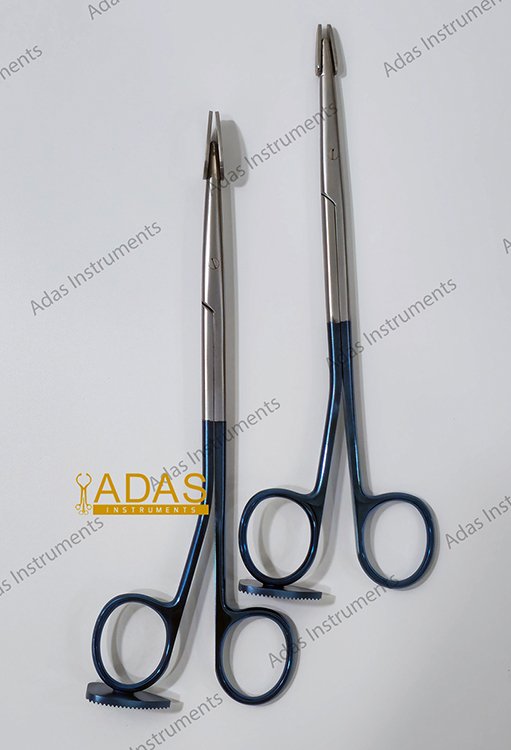
The photographs on this page show two finishes: a blue titanium anodised pair, and a pair with gold rings, which is the trade convention for tungsten carbide edges. Both are the same pattern and the same geometry.
Technical specification
| Detail | Specification |
|---|---|
| Instrument type | Trepsat facelift dissection scissors, spatula tip |
| Overall length | 16 cm (6¼ inches), 18 cm (7 inches), 20 cm (8 inches) |
| Tip | Flat spatula, blunt, 5 mm to 25 mm wide |
| Blade | Slim, long shanked, for blunt and sharp dissection |
| Handle | Standard finger ring |
| Material | High quality medical grade stainless steel |
| Sterilisation | Reusable, fully autoclavable, supplied non-sterile |
| Rust prevention | Passivated and boil tested, ultrasonically cleaned before packing |
| Marking | Laser marked with the pattern name and the Adas Instruments reference |
| Reference | AD-500-16 |
Care and sterilisation
On a Trepsat dissector the spatula tip is the part that gets damaged, and it gets damaged in the tray rather than in theatre. A flat tip that has been knocked against a retractor picks up a burr, and a burr is exactly the thing that catches a flap. Check the tips against a light before every list and take the pair out of service if an edge is no longer smooth.
Rinse cold straight off the field, then ultrasonic clean; blood dried into a box lock is what stiffens the action. Autoclave with the joint open, dry the instrument fully, and oil the screw weekly. Long slim shanks bend if heavy instruments are stacked on them, so these belong in a bracketed tray, not loose.
Made by Adas Instruments
Adas Instruments makes these facelift dissection scissors in house, which means tip width, length and a carbide or titanium finish are set during manufacture rather than quoted as a special order. 44 dollars at 16 cm, 46 at 18 cm and 48 at 20 cm, and evaluation pairs go out before a hospital buys a set.
Frequently asked questions
What are facelift dissection scissors used for?
Separating the skin flap of the face or neck from the fat and muscle beneath it, then cutting only where the surgeon wants a cut. They are also used for SMAS dissection, where the deeper facial layer is opened while the nerves and vessels running through it are protected.
Why do Trepsat scissors have a spatula tip?
To stop buttonholing. A broad flat tip has no corner to catch in the dermis, so it slides along the underside of the flap instead of through it. The same flat shape opens a wider channel per pass, which makes the dissection quicker.
Which tip width should I order?
Most surgeons keep two. A 5 or 10 mm tip for work near the parotid tail and the marginal mandibular nerve, and a 20 or 25 mm tip for the open cheek and neck where the plane is broad.
What lengths are available?
16 cm, 18 cm and 20 cm. The shortest suits short scar and mid face work, 18 cm is the general purpose length, and 20 cm reaches across a full neck lift.
Are they autoclavable?
Yes, fully autoclavable and supplied non-sterile. Open the joint completely so steam reaches the box lock, and dry the pair before it goes back in the tray.
Related instruments and categories
This pattern sits in two places on this site: the facelift and neck lift instruments pages, alongside the retractors, elevators and markers that share the tray, and the plastic surgery scissors pages, alongside every other scissor pattern we make.
For sharp dissection in the same plane the Kaye rhytidectomy dissecting scissors are the razor edge option. The Freeman Gorney facelift dissecting scissors are the heavier curved pattern, and the Gorney platysma scissors are for the neck band itself.
| Weight | 0.08 kg |
|---|---|
| Select Size | 16 cm/6¼”, 18cm / 7", 20cm / 8" |
| Tip options | 15mm Wide, 10mm Wide, 20mm Wide, 25mm Wide, 5mm Wide |
Be the first to review “Trepsat Facelift Dissection Scissors, Spatula Tip, 16 to 20 cm”
Shipping & Delivery Policy
Processing Time: In-stock items are dispatched within 24-48 hours. For custom or out-of-stock items, production time is approximately 10-15 days.
Global Delivery Estimates
We partner with world-class couriers (DHL, FedEx) to ensure fast, tracked delivery.
- USA & Canada: 3-5 Business Days
- Europe & UK: 4-6 Business Days
- Rest of World: 5-7 Business Days
*We offer Air Cargo and Sea Freight options for bulk wholesale orders.
Customs & Duties
International buyers are responsible for any customs duties or taxes imposed by their country. Adas Instruments is not responsible for delays caused by customs clearance.
Lost Packages & Insurance
If your package is lost in transit, please contact us immediately. We offer full support and replacements for confirmed lost shipments. Note: You must report non-delivery within 3 weeks to be eligible for an insurance claim.
Related products


Reviews
There are no reviews yet.