
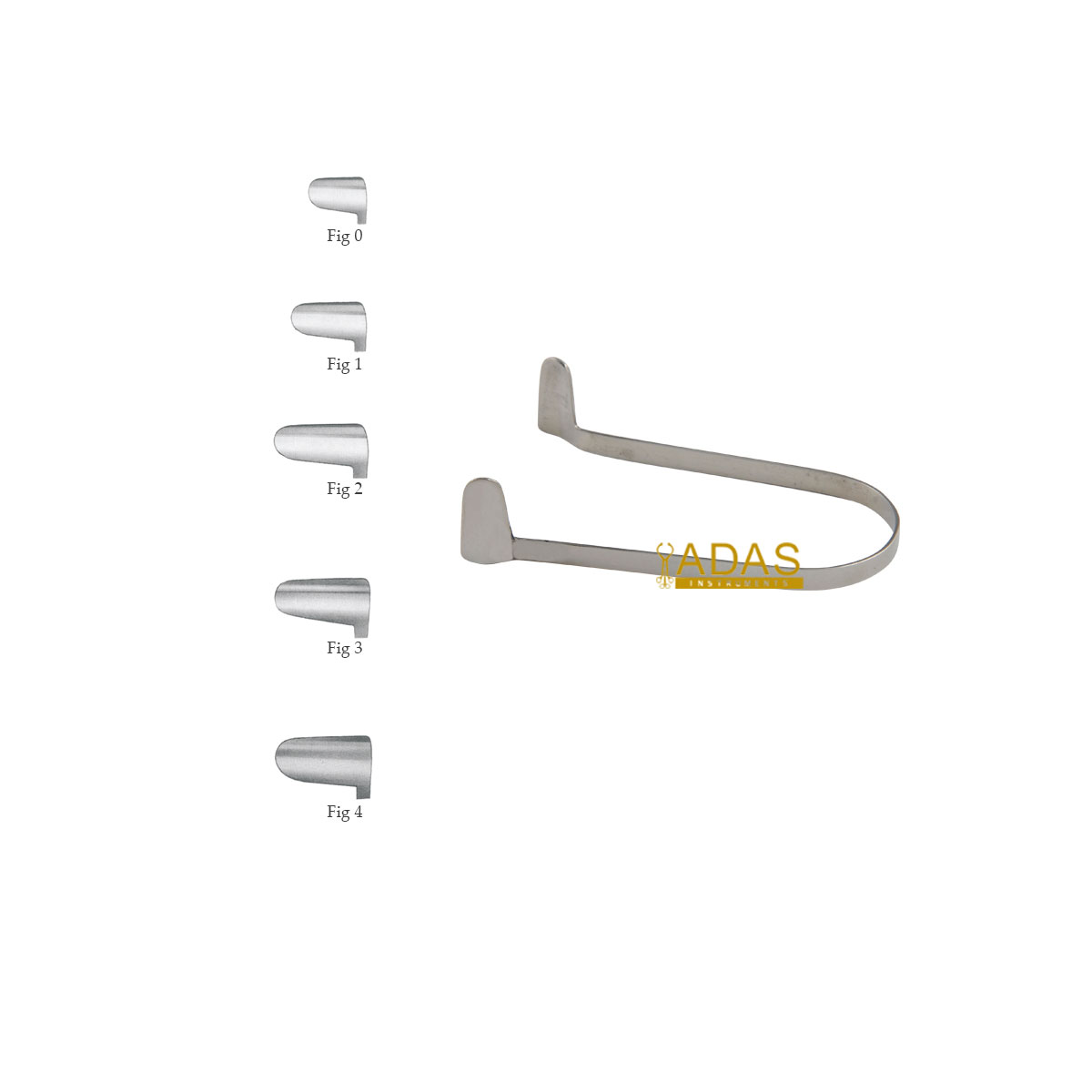
Thudichum Nasal Speculum | Spring Pattern, Fig 0 to Fig 4
$ 4.50
The Thudichum nasal speculum is the one you hold: no screw, no pliers handle, just a U of sprung steel with two blades on it. The way it is used is the whole instrument, so here it is: it is held in the non dominant hand, with the loop of the spring resting on the index finger, which leaves the dominant hand free for suction, a light or an instrument. Fig 0 to Fig 4, and most clinics end up owning three of them.
Key Features
- Spring pattern, held in the non dominant hand, nothing to lock
- The loop sits on the index finger, blades controlled by the middle and ring fingers
- Fig 0, Fig 1, Fig 2, Fig 3 and Fig 4
- For anterior rhinoscopy, packing, foreign bodies and biopsy
- One piece of sprung steel with no joint, no screw and nothing to work loose
- Cut from high quality medical grade stainless steel and fully autoclavable
- Three year replacement warranty against manufacturing defects
- Item code ADR-458.00

What a Thudichum nasal speculum is
Most instrument pages explain what a thing does. This one has to explain how it is held, because that is what people are asking. Our own Search Console records fourteen impressions for “how to hold nasal speculum” at position 9.4 and five more for the same question with the name in it at 8.8, the best positions this category has. So the answer goes first.
Here it is: it is held in the non dominant hand, with the loop of the spring resting on the index finger, which leaves the dominant hand free for suction, a light or an instrument. Google’s own description puts it the same way, that the instrument is held in the examiner’s non dominant hand, leaving the dominant hand free for suction, forceps or a light. For most people that means the left hand holds the speculum, which is why the “left hand” search exists at all.
The rest follows from the shape. One piece of sprung steel bent into a U with a blade on each end. Squeeze and they open, let go and they close. No joint, no screw, nothing to work loose, which is why a nineteenth century pattern is still on clinic trays.
It was invented by John Louis William Thudichum, and his surname is where the trouble starts. People type Thudicum nasal speculum, without the h, about four times as often as they type the correct one: thirteen impressions against three in our own search data. The product and the web address keep the correct spelling. Both forms are on this page because both are how the instrument is written down.
It is also, for most clinics, the nasal speculum for anterior rhinoscopy: the one that comes out of the drawer when somebody needs looking at. Our record carries Fig 0 to Fig 4 and nothing else, no blade millimeters and no overall length. Rival listings quote 19.5 by 10.5 mm and an insulated 12.5 by 8.0 mm variant. Those are their instruments.
Key design features
How it is held, which is the whole instrument
The loop of the U rests across the index finger of the non dominant hand, the middle and ring fingers squeeze the limbs to open the blades, and the thumb steadies it. The dominant hand never touches the speculum, which is the point: it is free for a sucker, a pack or a headlight the whole time.
One piece, no joint
No screw, no box joint, no spring fitted into a handle. One piece of steel bent and tempered, with nothing to loosen, lose or reassemble wrongly, which is why it outlasts almost everything else in a clinic drawer.
Five Fig sizes
Fig 0 to Fig 4 on our own record, smallest to largest. Fig 0 and Fig 1 for children and narrow nares, Fig 2 for general adult work, Fig 3 and Fig 4 for a full adult view. Most clinics buy three.
It does not lock, and that is deliberate
A sprung speculum tells your fingers how hard the nostril is pushing back for as long as it is in there, and on an awake patient that feedback is worth more than a free hand. When you need the speculum to hold itself you are operating, and the instrument for that is a Killian.
Which Fig size to order, and what we do not publish
Five sizes from our own record, and one row that is an honest gap.
| Choice | Options | How to decide |
|---|---|---|
| Fig size | Fig 0 or Fig 1 | Children and narrow nares |
| Fig size | Fig 2 | General adult examination. The single first purchase |
| Fig size | Fig 3 or Fig 4 | A full adult view, and the widest we make |
| Fig size | Three of the five | The usual clinic order: Fig 1, Fig 2 and Fig 3 |
| Blade millimeters and overall length | NOT published by us | Rivals quote 19.5 x 10.5 mm and an insulated 12.5 x 8.0 mm. Those are theirs. Our record carries the Fig range and nothing else. Ask us if a figure has to be matched |
Where it is used
A clinic instrument, used far more often than anything else on this page of the catalog.
| Procedure | What the speculum does | Note |
|---|---|---|
| Anterior rhinoscopy | Opens the nostril to inspect septum, mucosa and turbinates | The main use, and the reason the holding question is the most searched one |
| Nasal packing | Holds the nostril open while a pack goes in for a nosebleed | The free dominant hand is what makes this workable alone |
| Foreign body removal | Widens the path so a grasper can get past | Google names this use explicitly |
| Biopsy | Opens the field for a small sample | Front of the nose only |
| Teaching | The instrument every ENT student is shown first | Also the one they are examined on, which is why the search demand is what it is |
What it opens, and what it must not do
Short blades and no lock between them explain every row here.
| The task | What this speculum does | What it must not do |
|---|---|---|
| Opening a nostril to look | Sprung blades, opened and felt by the fingers | It must NOT be forced wider than it wants to go. The spring is telling you something and overriding it is how an awake patient remembers the appointment |
| Leaving a hand free | It is held in the non dominant hand by design | It is not self retaining. Nothing holds it open and nothing should be wedged into it |
| Reaching the back of the nose | Nothing. These are short blades | The posterior septum needs a long bladed Killian or Cottle |
| Being a known size | We publish Fig 0 to Fig 4 and no millimeters | Nobody should order a Fig number to match an existing set until we have measured ours. It is on our owed list |
How it compares with the other four specula
It is the far corner of the table: the shortest blades and the only one with no mechanism at all.
| Speculum | Holds itself open | Blades | Buy it when |
|---|---|---|---|
| Thudichum nasal speculum, this page | No. You hold it, non dominant hand | Fig 0 to Fig 4 | Anterior rhinoscopy, and you want the other hand completely free |
| Hartmann | No, spring tension in a pliers handle | 20 to 30 mm cone blades | Examination, and you prefer a handle to a loop |
| Killian | Yes, set screw | 35 to 90 mm | Operating. Both hands needed elsewhere |
| Cottle | Yes, thumb screw | 35 to 90 mm | Septal and rhinoplasty work |
| Fiber optic Killian | Yes, set screw | 35 to 90 mm plus light | A deep dark field |
Materials and finish
Every Thudichum nasal speculum we make is cut from high quality medical grade stainless steel. The steel itself is made to a German specification. We do not publish a grade number. A certificate says nothing about whether a spring still returns to the same place after two hundred autoclave cycles, because on a one piece instrument the spring IS the instrument and there is nothing else to replace. The answer to that is in the making rather than in the alloy.
The bend is formed and then tempered, and the temper is the craft on this pattern. A Thudichum bent cold and never relieved opens easily on the bench and arrives at a clinic eighteen months later as a pair of tongs.
The two blades are ground as a matched pair so they open parallel, and the edges are rolled blunt because this instrument goes into an awake nose.
Caring for it
Wash and dry it open. The only place water hides on a one piece instrument is the inside of the bend, which is exactly where it sits if you put it away closed.
Warm water and a soft brush, nothing abrasive on the blade faces. Autoclave with the tray. Squeeze and let go every so often: it should snap back to the same place. When it stops there is nothing to tighten and the instrument is finished, which is the honest trade for having no parts.
Ordering and wholesale
Every Thudichum nasal speculum is made by Adas Instruments in our own workshop and sold direct, which is why the price sits where it does against the catalog houses. Order one for a single tray, or in quantity for a hospital list or a distributor line. We do OEM work under your own brand and your own item numbers. Send us a sample and we will hold a run to your pattern rather than ours. Stock items ship from our own workshop. Backorder items take 10 to 12 working days to make. Every instrument carries a three year replacement warranty against manufacturing defects. Production is controlled under an ISO 13485 quality management system.
Frequently asked questions
How do you hold a Thudichum nasal speculum?
In the NON DOMINANT hand. The loop rests across the index finger, the middle and ring fingers squeeze the limbs to open the blades, and the thumb steadies it. The dominant hand never touches it, so it stays free for suction, a pack or a light. For most examiners that means the speculum is in the left hand.
Is the Thudichum nasal speculum self retaining?
No. There is no screw and nothing locks. It is a spring you hold, and on an awake patient that is the right answer because your fingers feel what the nostril is doing the whole time. If you need both hands free, the Killian and the Cottle lock open.
How to use Thudicum nasal speculum?
Hold it in the non dominant hand with the loop across the index finger and introduce it closed, along the floor of the nostril rather than up against the septum. Let the spring do the opening once it is in. Google asks this question with the short spelling, so it is answered here in the same spelling; the correct one is Thudichum, with the h, and a third form, thudiculum, exists as well.
What do the Fig numbers mean?
Fig 0 to Fig 4 are five blade sizes, smallest to largest. We publish the Fig range because it is our own attribute; we do not publish what each one measures in millimeters, because our record does not carry that. It is on our list.
Thudichum or Hartmann for a clinic?
Both are examination specula and neither locks. The Thudichum leaves your whole other hand free and costs less; the Hartmann has a pliers handle some examiners prefer, and an infant 20 mm blade. If you see children, buy the Hartmann too.
Related products and categories
For the other examination speculum, with a pliers handle and an infant blade, the Hartmann nasal speculum. For a long bladed one that holds itself open, the Cottle nasal speculum or the Killian nasal speculum.
The rest of this family sits under nasal speculum and polypus instruments, and the wider set for the operation is under rhinoplasty instruments.
| Weight | 0.09 kg |
|---|---|
| Select Fig | Fig 0, Fig 1, Fig 2, Fig 3, Fig 4 |
Be the first to review “Thudichum Nasal Speculum | Spring Pattern, Fig 0 to Fig 4”
Shipping & Delivery Policy
Processing Time: In-stock items are dispatched within 24-48 hours. For custom or out-of-stock items, production time is approximately 10-15 days.
Global Delivery Estimates
We partner with world-class couriers (DHL, FedEx) to ensure fast, tracked delivery.
- USA & Canada: 3-5 Business Days
- Europe & UK: 4-6 Business Days
- Rest of World: 5-7 Business Days
*We offer Air Cargo and Sea Freight options for bulk wholesale orders.
Customs & Duties
International buyers are responsible for any customs duties or taxes imposed by their country. Adas Instruments is not responsible for delays caused by customs clearance.
Lost Packages & Insurance
If your package is lost in transit, please contact us immediately. We offer full support and replacements for confirmed lost shipments. Note: You must report non-delivery within 3 weeks to be eligible for an insurance claim.
Related products

Reviews
There are no reviews yet.