




Hartmann Nasal Speculum | Infant 20 mm to Large 30 mm Cone Blades
Price range: $ 19.50 through $ 45.00
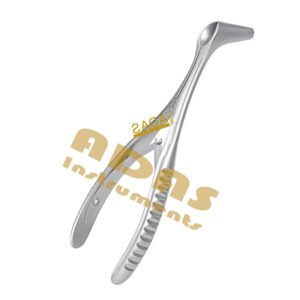
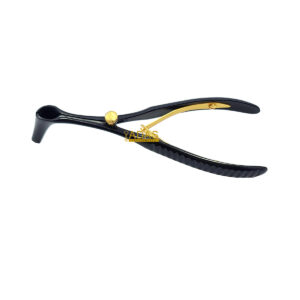
The Hartmann nasal speculum is the examination instrument of the five. Short cone blades, four sizes from an infant 20 mm to a large 30 mm, and a pliers handle with a spring in it so one hand opens the blades and the other stays free. It does not lock, and for looking into a nose rather than operating in one that is the right answer: you feel what the tissue is doing the whole time.
Key Features
- Four blade sizes: infant 20 mm, small 22 mm, medium 25 mm, large 30 mm
- Short tapering cone blades with blunt edges
- Spring tension pliers handle, opened with one hand
- Does NOT lock open, which is deliberate on an examination speculum
- Black coated, gold shafts or plain steel finish
- Cut from high quality medical grade stainless steel and fully autoclavable
- Three year replacement warranty against manufacturing defects
- Item code ADR-450.03

What a Hartmann nasal speculum is
Hartmann nasal specula are the sprung pattern. Three of the five specula we make hold themselves open and two do not, and the Hartmann nasal speculum is deliberately in the smaller group. There is no screw. The handle is a pliers shape with a spring in it, you squeeze and the blades open, you release and they close. Google’s own description of the mechanism is a spring tension configuration opened with single handed finger pressure.
For an examination that is the better instrument, and the reason is feel. A locked speculum is a fixed width and the hand that set it has gone. A sprung one is telling your fingers how hard the ala is pushing back for the whole time it is in the nose, and on a nasal examination speculum used thirty times in a clinic morning that matters more than a free hand does.
The blades are the other half of it: short, tapering cones with blunt contoured edges. Short because an examination is about the front of the nose, the septum, the mucosa and the inferior turbinate, and blunt because the instrument goes in on somebody who is awake.
Our four sizes are our own: infant 20 mm, small 22 mm, medium 25 mm and large 30 mm. The 20 mm is why this is the one page in the category that may honestly call itself a pediatric nasal speculum; no other instrument we make here has an infant blade.
One comparison worth making, because Google makes it first. The answer for this pattern says the Hartmann profile is highly similar to the Vienna and Halle variants. We do not make a Vienna, and “vienna nasal speculum” is searched 590 times a month, so if you have been issued a Vienna and are looking for the same thing, this is the closest pattern on our shelf. That is a comparison, not a claim that they are the same instrument.
Key design features
Spring tension, not a screw
Squeeze to open, release to close, one hand. Nothing locks. On an examination that is the feature, not a limitation: your fingers know what the nostril is doing. When you want the speculum to hold itself and give you a hand back, you want a Killian or a Cottle and you are no longer examining, you are operating.
Four sizes, and one of them is for infants
20, 22, 25 and 30 mm on our own record, named infant, small, medium and large. The 22 and 25 cover almost all adult clinic work. The 20 mm is the only infant blade in this category and it is the reason a pediatric list buys from this page.
Cone blades with blunt edges
Tapering, so the blade is narrowest where it enters and spreads behind it, and blunt along the edge because the patient is awake and the mucosa is not anesthetized. Google describes the same geometry as facilitating a gentle insertion that guards against accidental tissue trauma, which is a long way of saying it should not hurt.
Serrated handle outsides
Horizontal serrations on the outside of each handle. A clinic speculum is held in a gloved hand that may have gel or blood on it, and a smooth handle turns in the grip at the moment you least want it to.
Which blade size to order
Four real figures, all from our own attribute set, which makes this the best evidenced size table in the category.
| Blade | Named | Usually chosen for |
|---|---|---|
| 20 mm | Infant | Children and very narrow nares. The only infant blade we make here |
| 22 mm | Small | Adolescents and small adult nares |
| 25 mm | Medium | General adult clinic work. The single sensible first purchase |
| 30 mm | Large | A full adult view, and the widest we make on this pattern |
| Finish | Black, gold shafts or plain | Black kills the glare off an overhead light. It is a coating on steel |
Where it is used
A clinic instrument before it is an operating room one, and a nasal speculum exam is most of what it does.
| Procedure | What the speculum does | Blade |
|---|---|---|
| Anterior rhinoscopy | Opens the nostril to inspect septum, mucosa and turbinates | 22 or 25 mm |
| Pediatric examination | The same, on a child | 20 mm |
| Foreign body removal | Widens the nostril enough to get a grasper past | 25 mm |
| Nasal packing | Holds the nostril while a pack goes in for a nosebleed | 25 or 30 mm |
| Biopsy | Opens the field for a small sample at the front of the nose | 25 mm |
What it opens, and what it must not do
Most of this list follows from the blades being short and the handle being sprung.
| The task | What this speculum does | What it must not do |
|---|---|---|
| Examining a nose | Short cone blades, spring tension, feel in the fingers | It must NOT be squeezed to the stop on an awake patient because the view is not enough. If 30 mm is not enough the answer is a different instrument, not more force |
| Reaching the posterior septum | Nothing. The blades are 20 to 30 mm | This is not a surgical speculum. The back of a septum needs a 75 or 90 mm Killian |
| Freeing a hand | Nothing. It does not lock | If you need both hands, buy the Killian or the Cottle. Wedging this one open is how a spring is ruined |
| Being a Vienna | The profile is similar and we say so | It is NOT a Vienna and we do not sell one. If a list specifies Vienna, ask us before substituting |
How it compares with the other four specula
The lock and the blade length decide everything, and this page is the short unlocked corner of the table.
| Speculum | Holds itself open | Blades | Buy it when |
|---|---|---|---|
| Hartmann, this page | No, spring tension | 20 to 30 mm cone blades | Examination, a clinic list, or a child |
| Thudichum | No, you hold it | Fig 0 to Fig 4, short | Anterior rhinoscopy where you want the whole other hand free |
| Killian | Yes, set screw | 35 to 90 mm | Operating, not examining |
| Cottle | Yes, thumb screw | 35 to 90 mm | Septal and rhinoplasty work |
| Fiber optic Killian | Yes, set screw | 35 to 90 mm plus light | A deep dark corridor |
Materials and finish
Every Hartmann nasal speculum we make is cut from high quality medical grade stainless steel. The steel itself is made to a German specification. We do not publish a grade number. A certificate says nothing about whether a spring still pushes back the same way after two hundred autoclave cycles, because a spring that has gone soft turns an examination speculum into a pair of tongs. The answer to that is in the making rather than in the alloy.
The spring is part of the handle rather than a separate fitted piece, so there is nothing to work loose and nothing to replace. The trade is that a tired spring is a tired instrument, which is why the temper matters more here than on the screw patterns.
The two cone blades are ground as a matched pair so they open parallel, and the edges are rolled blunt after grinding rather than left as they come off the wheel. No sharp external edge anywhere on the outline, and the coating goes on after the grinding so no coating sits on a working face.
Caring for it
Wash it open and dry it open. The spring section holds water in the bend and a speculum put away wet corrodes where you cannot see it.
Warm water and a soft brush, nothing abrasive on the blade faces. Autoclave with the tray. Squeeze it closed and let go every so often: the blades should spring back briskly to the same place. A lazy return is a soft spring, and a soft spring on a clinic instrument is felt by the patient before it is noticed by anybody else.
Ordering and wholesale
Every Hartmann nasal speculum is made by Adas Instruments in our own workshop and sold direct, which is why the price sits where it does against the catalog houses. Order one for a single tray, or in quantity for a hospital list or a distributor line. We do OEM work under your own brand and your own item numbers. Send us a sample and we will hold a run to your pattern rather than ours. Stock items ship from our own workshop. Backorder items take 10 to 12 working days to make. Every instrument carries a three year replacement warranty against manufacturing defects. Production is controlled under an ISO 13485 quality management system.
Frequently asked questions
What is a Hartmann nasal speculum used for?
Examining the inside of a nose: anterior rhinoscopy to inspect the septum, the mucosa and the inferior turbinates, plus foreign body removal, nasal packing and biopsy at the front of the nose. The short cone blades and the sprung handle make it a clinic instrument rather than a surgical one.
Is the Hartmann nasal speculum self retaining?
No, and that is deliberate. It is a pliers handle with spring tension, opened with one hand, and it closes when you let go. If you need a speculum that holds itself open so both hands are free, buy the Killian or the Cottle.
Which size should I buy first?
25 mm, the medium. It covers most adult clinic work. Add the 20 mm infant blade if you see children, because that is the only infant blade in this category, and the 30 mm if you want a full adult view.
Is this the same as a Vienna nasal speculum?
No. Google’s own answer says the Hartmann profile is highly similar to the Vienna and Halle variants, and that is a fair description of the family, but they are different patterns and we do not make a Vienna. If a tray list specifies Vienna, ask us before you substitute this one.
Can it be used on a child?
Yes, with the 20 mm infant blade. It is the only product in this category whose own size range includes an infant blade, which is why a pediatric list ends up on this page rather than on one of the long bladed specula.
Related products and categories
For the other speculum you hold rather than lock, the Thudichum nasal speculum. For a long bladed one that holds itself open, the Killian nasal speculum, or the fiber optic Killian if the field is deep and dark.
The rest of this family sits under nasal speculum and polypus instruments, and the wider set for the operation is under rhinoplasty instruments.
| Weight | 0.09 kg |
|---|---|
| Coloring | Full Titanium Black, Gold Shafts, No Color |
| Tip options | Infant 20mm, Large 30mm, Medium 25mm, Small 22mm |
Be the first to review “Hartmann Nasal Speculum | Infant 20 mm to Large 30 mm Cone Blades”
Shipping & Delivery Policy
Processing Time: In-stock items are dispatched within 24-48 hours. For custom or out-of-stock items, production time is approximately 10-15 days.
Global Delivery Estimates
We partner with world-class couriers (DHL, FedEx) to ensure fast, tracked delivery.
- USA & Canada: 3-5 Business Days
- Europe & UK: 4-6 Business Days
- Rest of World: 5-7 Business Days
*We offer Air Cargo and Sea Freight options for bulk wholesale orders.
Customs & Duties
International buyers are responsible for any customs duties or taxes imposed by their country. Adas Instruments is not responsible for delays caused by customs clearance.
Lost Packages & Insurance
If your package is lost in transit, please contact us immediately. We offer full support and replacements for confirmed lost shipments. Note: You must report non-delivery within 3 weeks to be eligible for an insurance claim.
Related products


Reviews
There are no reviews yet.