


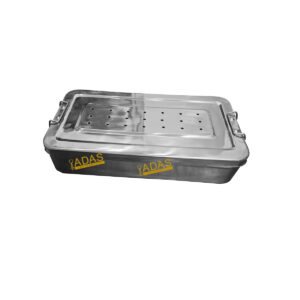
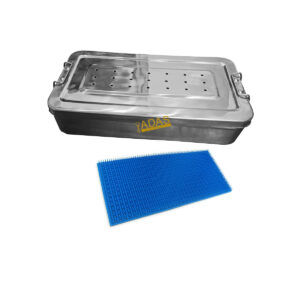


Sterilization Box Stainless Steel, Perforated or Solid Lid, Nine Sizes
Price range: $ 9.00 through $ 55.00
A sterilization box is the steel case a set of instruments goes into before the autoclave and comes out of as a set rather than a pile: the box is not the sterilizer, it is what the sterilizer works through. Nine sizes from 150 x 100 x 40 to 500 x 250 x 100 mm, each with a perforated lid for steam or a solid lid for dry storage, and with or without a silicone mat in the base. Thirty six combinations, and the one you want depends which end of the cycle the box lives at.
Key Features
- Nine sizes, 150 x 100 x 40 mm to 500 x 250 x 100 mm
- Box type: with holes for steam to pass, or without holes for storage
- Silicone mat in the base, with or without, to hold instruments still
- A lid that stays closed while the box is carried
- Footprints that nest, so a shelf laid out for one size takes the smaller ones
- Made from high quality medical grade stainless steel and fully autoclavable
- Three year replacement warranty against manufacturing defects
- Item code AH-03-01

What a sterilization box is
Ask Google what a sterilization box is and it answers with a disambiguation page: three different objects under one name, the steel instrument case that goes in an autoclave, the plastic tray a nail technician soaks tools in, and the consumer ultraviolet box people put a phone in. That is an accurate picture of who is searching, and it is why this page says in its first line which of the three it is.
This is the first one, and the first thing to say about it is that the box is not the sterilizer, it is the tray the instruments sit in while the autoclave does the work. Google is blunt about the second, noting that salon immersion boxes do not heat sterilize tools on their own, and the third never comes near an operating room.
So what does the box do. Three things. It keeps a set together, so whoever opens it on a sterile field gets the instruments laid out instead of tipped. It protects fine tips, because an instrument that cannot slide cannot have its point pushed into something harder. And it carries the set from decontamination to the table in one trip.
The two options on the dropdown are where the real decision is. Box Type is with holes or without, and steam has to reach every surface and then drain off it, so a perforated lid is the difference between an instrument that comes out dry and one that comes out wet. So a box going through a steam cycle takes the perforated lid and a box holding a dry set in a cupboard takes the solid one. The second option is the silicone mat, which sits in the base and stops the contents moving when the box is lifted.
Nine sizes, not evenly spaced, because instrument sets are not. The 180 x 80 x 30 is long and narrow for a row of forceps; the 400 x 250 x 100 is deep enough for a stacked set.
Key design features
Holes or no holes, and it is not a cosmetic choice
A perforated box is an autoclave box; a solid one is a storage box. The perforated lid lets steam in, lets it condense on the instruments and lets the water drain off, and a solid lid does none of that, which is right once the set is dry. Put a solid box through a steam cycle and you get a sealed tin of warm wet air; leave a perforated one in a cupboard and the set is open to the room.
The silicone mat
A sheet of silicone in the base. It raises instruments off the steel so water drains under them, it stops a set sliding into one corner when the box is tilted, and it keeps fine tips off the bottom. It takes a full steam cycle. The dropdown calls it Silicon Mate Option, which is our spelling slip rather than a different part.
A lid that stays on
The lid stays closed while the box is carried, and that is as much as we will say about it. We are not going to tell you it maintains sterility after the cycle: that is a claim about a seal and this is a lid. Our record carries nine sizes, the hole option and the mat option, and no closure detail, so this page describes no closure detail.
Nine sizes that stack
The smaller footprints go inside the larger ones, so a shelf laid out for the 300 x 200 takes two of the 150 x 100 across it. Depths run 30 mm for a single layer to 100 mm for a stacked set.
Which size to order
Nine sizes, every figure off our own size list, in millimeters, length by width by depth. The right hand column is what each one is usually bought for.
| Size in mm | Depth | What it holds |
|---|---|---|
| 180 x 80 x 30 | Shallow | A row of forceps or scissors, one layer |
| 200 x 100 x 30 | Shallow | A small dental or minor procedure tray |
| 150 x 100 x 40 | Shallow | A micro set, burs or drills, in a squarer footprint |
| 260 x 150 x 50 | Medium | A general set, retractors and forceps together |
| 300 x 200 x 50 | Medium | The most ordered size |
| 350 x 200 x 75 | Deep | A rhinoplasty or maxillofacial set with osteotomes |
| 400 x 200 x 70 | Deep | Long instruments, a full ENT set |
| 400 x 250 x 100 | Deep | A stacked set, or a second layer on a mat |
| 500 x 250 x 100 | Deep | The largest we make |
Where it is used
Where the box goes, and which of the two options each use wants. This is the table that answers the question the dropdown asks.
| Setting | Box type | Mat | Usual size |
|---|---|---|---|
| Through a steam autoclave | With holes | With mat | 260 x 150 x 50 upward |
| Dry storage of a sterile set | Without holes | With mat | Any size |
| Dental and minor procedure trays | With holes | With mat | 200 x 100 x 30 |
| Carrying a set between rooms | Without holes | With mat | 300 x 200 x 50 |
| Burs and loose small parts | With holes | Without mat | 150 x 100 x 40 |
What the box does not do
The section that matters most here, because two of the three things people search for under this name are not this box.
| It does not | Why not | What does |
|---|---|---|
| Sterilize anything by itself | No heater, no lamp and no chemical in it. It is a container | A steam autoclave, with this box inside it |
| Disinfect tools by soaking | No strainer basket and no lifting insert | A plastic immersion tray made for it |
| Clean anything with ultraviolet light | Nothing in the box emits anything | A consumer UV box, which is a different product |
| Hold sterility as a sealed package | It is a lid rather than a seal, and there is no filter | A wrapped tray or a filtered container |
How it compares with the other holloware
Four pieces in this category. The two boxes are the ones people confuse, and the difference is metal and weight rather than shape.
| Piece | Material | Lid | What it is for | Our price from |
|---|---|---|---|---|
| Steel sterilization box | Stainless steel | Perforated or solid | The autoclave, or dry storage | 9.00 |
| Aluminum sterilization box | Aluminum | Perforated | Carrying a large set | 75.00 |
| Kidney dish | Stainless steel | None | Catching what comes off a patient | 4.50 |
| Mixing solution bowl | Stainless steel | None | Holding and mixing a fluid | 4.80 |
Materials and finish
Every sterilization box we make is folded from high quality medical grade stainless steel. The steel itself is made to a German specification. We do not publish a grade number. A certificate says nothing about whether a box still closes the way it did after two years of being carried, or whether the base has gone out of true in a washer. The answer to that is in the making rather than in the alloy.
A stainless steel sterilization box cannot be drawn from one piece the way a bowl can, so a box is a fabricated piece where a bowl is a pressed one, and that is the one real difference in how the two are made. We do not publish how the corners are joined. The mat is a separate part and comes out for cleaning.
Caring for it
Take the mat out before washing, every time. Water trapped between silicone and steel is the one place that will not dry, and it is where a stain starts. Wash the box and lid separately, face down, and dry both before the mat goes back in.
Run the first cycle of a new box empty with the lid off. Boxes pick up a film from forming and an empty cycle lifts it before it has instruments to transfer onto. No chlorine, and nothing abrasive inside the corners.
Ordering and wholesale
The box is made by Adas Instruments in our own workshop and sold direct, which is why the price sits where it does against the catalog houses. Order one for a single tray, or in quantity for a hospital list or a distributor line. We do OEM work under your own brand and your own item numbers. Send us a sample and we will hold a run to your pattern rather than ours. Stock items ship from our own workshop. Backorder items take 10 to 12 working days to make. Every instrument carries a three year replacement warranty against manufacturing defects. Production is controlled under an ISO 13485 quality management system.
Frequently asked questions
What is a sterilization box used for?
Holding a set of instruments through the autoclave and afterwards while it is stored or carried. It keeps the set together so whoever opens it gets a laid out tray, it stops fine tips sliding into each other, and with the solid lid it keeps a dry set covered.
Is a sterilization box the same as a sterilizer?
No, and it is the most common confusion under this name. The box is a container with no heater, no lamp and no chemical in it; the sterilizer is the autoclave and the box goes inside it. Searches for sterilization box also return salon soaking trays and consumer ultraviolet boxes, and neither does this job.
Does a steel sterilization box go inside the autoclave?
Yes, if it is the perforated version. Steam has to reach the instruments and the water has to drain afterwards, and the holes let both happen. A box without holes is for storing a set that is already sterile and dry.
What size sterilization box do I need for dental instruments?
One of the two shallow sizes: 150 x 100 x 40 mm for a micro or bur set, or 200 x 100 x 30 mm for a standard tray in one layer. Dental sets are shallow and the mistake is ordering depth, because a deep box stacks and then has to be unstacked on the field.
Is it spelled sterilization box or sterilisation box?
Both, and the two spellings are searched exactly as often as each other. Sterilization with a z is American, sterilisation with an s is British and Commonwealth. Same box, and our listings use the z because our first market is the United States.
Related products and categories
The lighter alternative for a large set is the aluminum sterilization box, for when a full steel box that size is too heavy to carry. For fluid beside the set, the mixing solution bowl, and for soiled dressings off the field, the kidney dish.
The 350 x 200 x 75 size is stocked with the rhinoplasty instruments, because an osteotome set is the usual reason somebody needs that depth. The rest of the range is under holloware and sterilization.
| Weight | 0.4 kg |
|---|---|
| Select Size | 150 X 100 X 40 MM, 180 X 80 x 30 MM, 200 X 100 X 30 MM, 260 X 150 X 50 MM, 300 X 200 X 50 MM, 350 X 200 X 75 MM, 400 X 200 X 70 MM, 400 X 250 X 100 MM, 500 X 250 X 100 MM |
| Silicon Mate Option | With Mate, Without Mate |
| Box Type | Box With Hole, Box Without Hole |
Be the first to review “Sterilization Box Stainless Steel, Perforated or Solid Lid, Nine Sizes”
Shipping & Delivery Policy
Processing Time: In-stock items are dispatched within 24-48 hours. For custom or out-of-stock items, production time is approximately 10-15 days.
Global Delivery Estimates
We partner with world-class couriers (DHL, FedEx) to ensure fast, tracked delivery.
- USA & Canada: 3-5 Business Days
- Europe & UK: 4-6 Business Days
- Rest of World: 5-7 Business Days
*We offer Air Cargo and Sea Freight options for bulk wholesale orders.
Customs & Duties
International buyers are responsible for any customs duties or taxes imposed by their country. Adas Instruments is not responsible for delays caused by customs clearance.
Lost Packages & Insurance
If your package is lost in transit, please contact us immediately. We offer full support and replacements for confirmed lost shipments. Note: You must report non-delivery within 3 weeks to be eligible for an insurance claim.
Related products



Reviews
There are no reviews yet.