
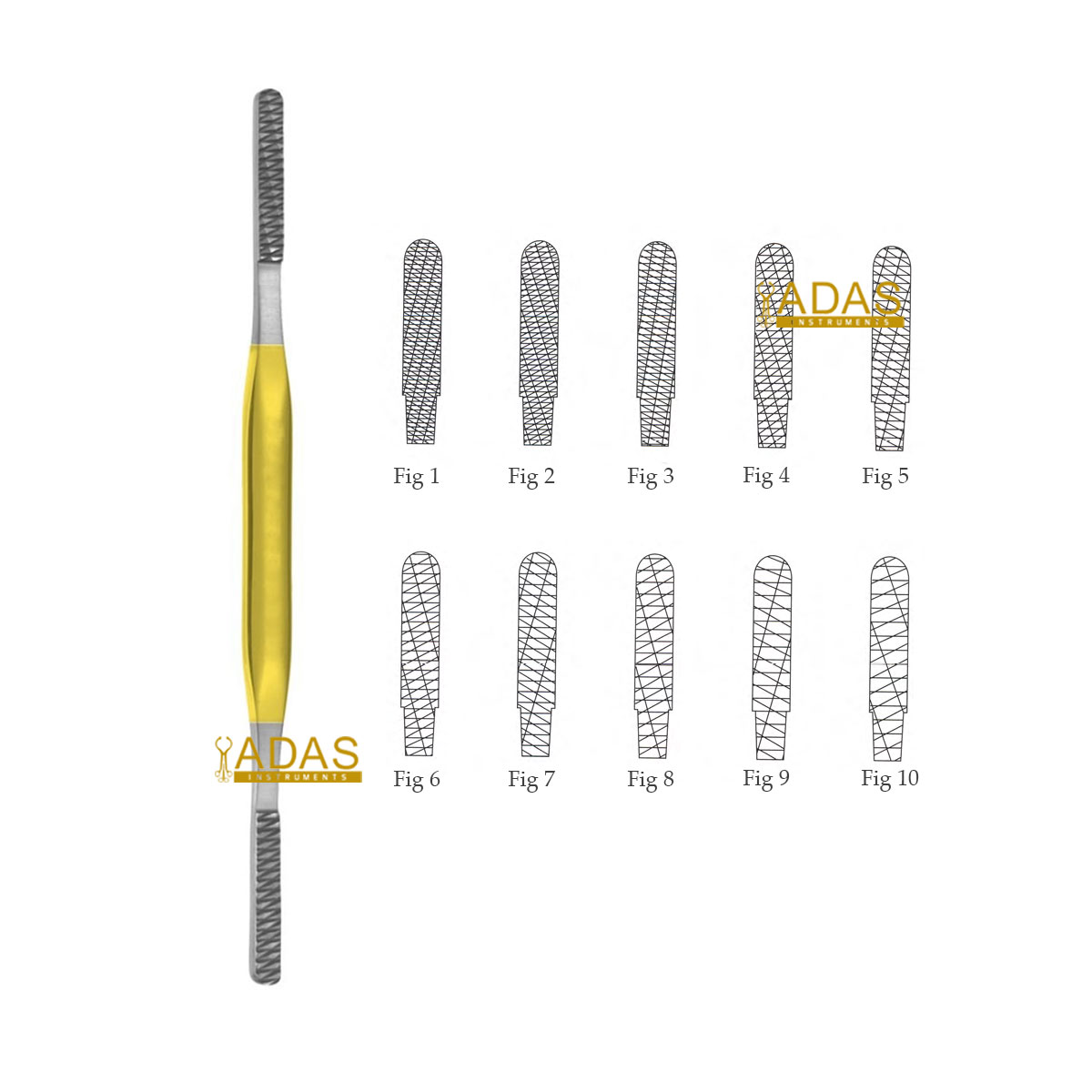
Fomon Nasal Raspatory, Double Ended Tungsten Carbide
$ 65.00
The Fomon nasal raspatory (commonly listed as a Fomon nasal rasp) is a double ended tungsten carbide instrument for reducing and then smoothing the bony dorsum in rhinoplasty, named for Samuel Fomon. Both ends carry a carbide abrading face at a different coarseness, so the surgeon takes bone down with one end and finishes with the other without putting the instrument back on the tray. It is ordered by figure number, from Figure 1/2 at the coarse end to Figure 9/10 at the fine end.
Key Features
- Double ended, with a coarser face at one end and a finer face at the other
- Five grit figures: 1/2 very coarse, 3/4 coarse, 5/6 fine and coarse, 7/8 fine, 9/10 very fine
- Tungsten carbide abrading faces, brazed in rather than coated on
- Center grip handle, so the balance is the same whichever end is working
- Reduces and finishes without an instrument change, which is the point of the pattern
- High quality medical grade stainless steel, fully autoclavable
- Three year replacement warranty against manufacturing defects
- Item code AO-04.03

What a Fomon nasal raspatory is
A Fomon nasal raspatory is two rasps on one handle. Each end carries a tungsten carbide abrading face and the two faces are deliberately a different coarseness, so the sequence a surgeon would otherwise do with two instruments happens by turning one instrument round. On a dorsum that is being reduced and then dressed, that saves an instrument change at the exact moment the field is at its most open.
The pattern is ordered by figure number rather than by a word, and the figures are the part buyers get wrong. On our scale Figure 1/2 is the coarse end and Figure 9/10 is the fine end, which is the ordinary trade convention. Catalogues do not all agree with each other on this, so the figure is worth checking against the description rather than assumed.
Key design features
Two coarsenesses on one handle
The whole argument for the double ended pattern. A single ended rasp forces the surgeon to choose a coarseness before the case starts, and then to swap instruments when the bone is nearly right. Here the coarse face takes the bulk and the fine face dresses what it leaves, and the change is a wrist movement.
The figure scale, and what it means
Figure 1/2 removes bone quickly and leaves ridges a finer face has to take out. Figure 9/10 will not reduce a hump in any reasonable time but leaves a surface that needs nothing after it. Most surgeons buying one instrument buy in the middle, at Figure 5/6, because it carries a fine and a coarse face together and covers the whole sequence on its own.
The center grip handle
A double ended instrument has to balance the same way whichever end is down, or the surgeon relearns the feel of it every time it is turned. The grip sits in the middle and the two ends are matched in mass, so the instrument behaves identically in both directions.
Carbide on both faces
Both ends are carbide, brazed into a machined recess. Nothing is bonded on that could shed under a flap, and neither face goes blunt the way cut steel teeth do. A carbide face wears by polishing, over years rather than months, and it polishes evenly on both ends because both ends are worked.
Which figure to order
These five figures are this product’s own option list. Each one is a pair of faces, coarser at one end and finer at the other; the figure names the pair.
| Figure | Coarseness | Who orders it |
|---|---|---|
| Figure 1/2 | Very coarse | Reducing a large bony hump where the bulk has to come off before anything is dressed. Needs a finer instrument after it |
| Figure 3/4 | Coarse | Standard hump reduction on an ordinary dorsum, with the finer end taking out what the coarse end leaves |
| Figure 5/6 | Fine and coarse together | THE ONE TO ORDER IF YOU ARE ORDERING ONE. Covers reduction and finishing in a single instrument |
| Figure 7/8 | Fine | Dressing and levelling rather than reducing, on a dorsum that has already been taken down |
| Figure 9/10 | Very fine | The finishing pass only, under thin skin where a ridge would show through |
Where it is used
It is the broadest instrument in the carbide group, because one instrument covers two stages of the same job.
| Procedure | What the Fomon raspatory does there |
|---|---|
| Dorsal hump reduction | The main event. Coarse end takes the hump down, fine end dresses it, no instrument change in between |
| Septorhinoplasty | Levels the bony dorsum once the septal work is finished |
| Lateral and medial osteotomy | Smooths the cut margins so the mobilized bone sits down evenly |
| Nasal fracture reduction | Takes down a prominence where a healed fracture set proud |
| Revision rhinoplasty | Removes callus and residual bone, where a carbide face is safer than teeth on an unpredictable healed surface |
What it abrades, and what it must leave alone
Two working faces means two chances to touch the wrong thing, so the second half of this table matters more here than on a single ended instrument.
| Tissue | What this instrument does with it |
|---|---|
| Nasal bones and the bony dorsum | Removes. The working tissue for both faces |
| Bony septum and nasal spine | Removes, in short passes with the finer end. Thin bone and easy to overrun with a coarse face |
| Dense cartilage | Files it with the fine end. A very coarse face loads with cartilage and stops working |
| Periosteum | MUST BE LEFT ALONE. Raise the flap first, and remember the idle end is still an abrasive face sitting in the field |
| Skin and the nostril rim | Never. On a double ended instrument the end not in use is the one that catches a rim, so it is kept clear |
How it compares with the other finishing surfaces
Against the other abrasive faces, the Fomon pattern competes on the instrument change rather than on the cut.
| Surface | Rate of removal | Where it belongs |
|---|---|---|
| Tungsten carbide, two figures, as here | Moderate at both ends, and unchanged for years | Cases where reduction and finishing happen in one pass and an instrument change costs visibility |
| Tungsten carbide, single face | Moderate | A tray that already carries a separate finishing instrument. See the McIndoe carbide pattern |
| Cut steel teeth | Fastest of the four, and the first to blunt | Bulk removal where rate matters more than working life |
| Diamond coating | Slowest by design, a few microns a stroke | The last pass under thin skin, finer than anything on this instrument |
Materials and finish
Every Fomon nasal raspatory we make is cut from high quality medical grade stainless steel. The steel itself is made to a German specification. We do not publish a grade number, because the number on a certificate tells a surgeon nothing about how an abrasive face holds up after fifty autoclave cycles, and the answer to that is in the finish rather than in the alloy.
Both faces are brazed carbide in a machined recess, so there is nothing sprayed on either end to shed into a wound. The two ends wear at different rates, because the coarse end does more of the work, and that is normal rather than a fault: the instrument reaches the end of its life when the coarse face starts sliding instead of biting, which on a weekly list is a matter of years.
Caring for it
Rinse it before the case is cleared, and clean both ends even though only one of them worked. Bone dust sets hard in a carbide face and a packed face slides instead of cutting, which reads as a worn instrument when it is a dirty one.
Soft nylon brush along each face, never wire, because wire polishes carbide and that is what actually ruins it. Enzymatic cleaner, ultrasonic cycle, deionized water rinse, dry fully, autoclave at 134 degrees Celsius. Store it so neither face is pressed against another instrument, which on a double ended rasp means laying it in a rack rather than a pile.
Ordering and wholesale
The Fomon nasal raspatory is made in our own workshop and sold direct, which is why the price sits where it does against the catalogue houses. Order one for a single set, or in quantity for a hospital list or a distributor line; we do OEM work under your own brand and your own item numbers, and we will hold a run to your pattern rather than ours if you send a sample. Stock items ship from our own workshop. Backorder items take 10 to 12 working days to make. Every instrument carries a three year replacement warranty against manufacturing defects. Production is controlled under an ISO 13485 quality management system.
Frequently asked questions
What is a Fomon nasal raspatory used for?
Reducing and then smoothing the bony dorsum in rhinoplasty and septoplasty. Because both ends carry an abrading face at a different coarseness, one instrument takes the hump down and dresses what it leaves without going back to the tray.
What is the main purpose of a bone rasp in surgery?
To remove bone in small controlled amounts and leave a smooth surface behind. A chisel or an osteotome takes bone away in pieces; a rasp works across the surface a fraction of a millimeter at a time, which is what the last stage of any bone contouring needs.
What do the Fomon rasp figure numbers mean?
They name a pair of grits. On our scale Figure 1/2 is very coarse and Figure 9/10 is very fine, with 3/4, 5/6 and 7/8 between them. Catalogues do not all number the scale the same way round, so read the coarseness in the description rather than trusting the figure alone.
Which Fomon raspatory figure should I order if I only order one?
Figure 5/6. It carries a fine face and a coarse face on the same instrument, so it covers reduction and finishing on an ordinary dorsum. Figure 1/2 and Figure 9/10 are both specialists and neither works well on its own.
Is a raspatory the same thing as a rasp?
Not quite, and this instrument is genuinely both. A rasp abrades a surface. A raspatory is built to be pushed under the periosteum and lift it first. The Fomon pattern carries a raspatory shank with abrading faces on it, which is why catalogues list it under either word.
Related products and categories
The rest of the carbide and raspatory group: Fomon rasp, flat and convex double ended where the two ends differ in shape rather than in grit, Gallaher bone and nasal rasp with finger ring for a stroke that needs a finger ring behind it, and glabella nasal raspatory in tungsten carbide for the nasal root, where a straight face cannot sit flat.
The full range is in raspatories and saws, and the tray this belongs to is in rhinoplasty instruments.
| Weight | 0.9 kg |
|---|---|
| Tip options | 1/2 Very Coarse Grits, 3/4 Coarse Grits, 5/6 Fine & Coarse Grits, 7/8 Fine Grits, 9/10 Very Fine Grits |
Be the first to review “Fomon Nasal Raspatory, Double Ended Tungsten Carbide”
Shipping & Delivery Policy
Processing Time: In-stock items are dispatched within 24-48 hours. For custom or out-of-stock items, production time is approximately 10-15 days.
Global Delivery Estimates
We partner with world-class couriers (DHL, FedEx) to ensure fast, tracked delivery.
- USA & Canada: 3-5 Business Days
- Europe & UK: 4-6 Business Days
- Rest of World: 5-7 Business Days
*We offer Air Cargo and Sea Freight options for bulk wholesale orders.
Customs & Duties
International buyers are responsible for any customs duties or taxes imposed by their country. Adas Instruments is not responsible for delays caused by customs clearance.
Lost Packages & Insurance
If your package is lost in transit, please contact us immediately. We offer full support and replacements for confirmed lost shipments. Note: You must report non-delivery within 3 weeks to be eligible for an insurance claim.
Related products

Reviews
There are no reviews yet.