
Types of Needle Holders: Mayo Hegar to Castroviejo (and Why Americans Say Needle Driver)
Sep
Types of needle holders are the ratcheted, scissor-like instruments that drive a curved suture needle through tissue and then hold it still while the surgeon takes the next bite. The family splits three ways: ring-handled ratchet patterns, specialty patterns that add scissors or a palm ratchet, and spring-handled micro patterns. Adas Instruments makes 20 needle holder patterns, from the 27.5 cm Mayo Hegar down to a 12 cm Castroviejo, in high quality medical grade stainless steel with tungsten carbide jaw options.
Key takeaways
- Jaw size follows suture size. A 2-0 suture in a 12.5 cm Webster splays the jaws, and a 7-0 in a 27.5 cm Mayo Hegar flattens the needle.
- Three instruments cover most work: a Mayo Hegar for deep layers, a Webster for skin, a Castroviejo for anything finer than 6-0.
- Gold rings are not decoration. They are the trade’s marker for brazed tungsten carbide jaw inserts, and they tell whoever services the instrument not to put it on a steel wheel.
- Needle driver and needle holder are the same instrument. The first is what American operating rooms say, and both words appear across our plastic surgery needle holders range.
The ratcheted ring patterns
Most of the types of needle holders in daily use sit in this group, and it is where almost every tray starts. A box joint, serrated jaws and a ratchet lock on the shanks, so the needle stays clamped without the hand holding pressure.
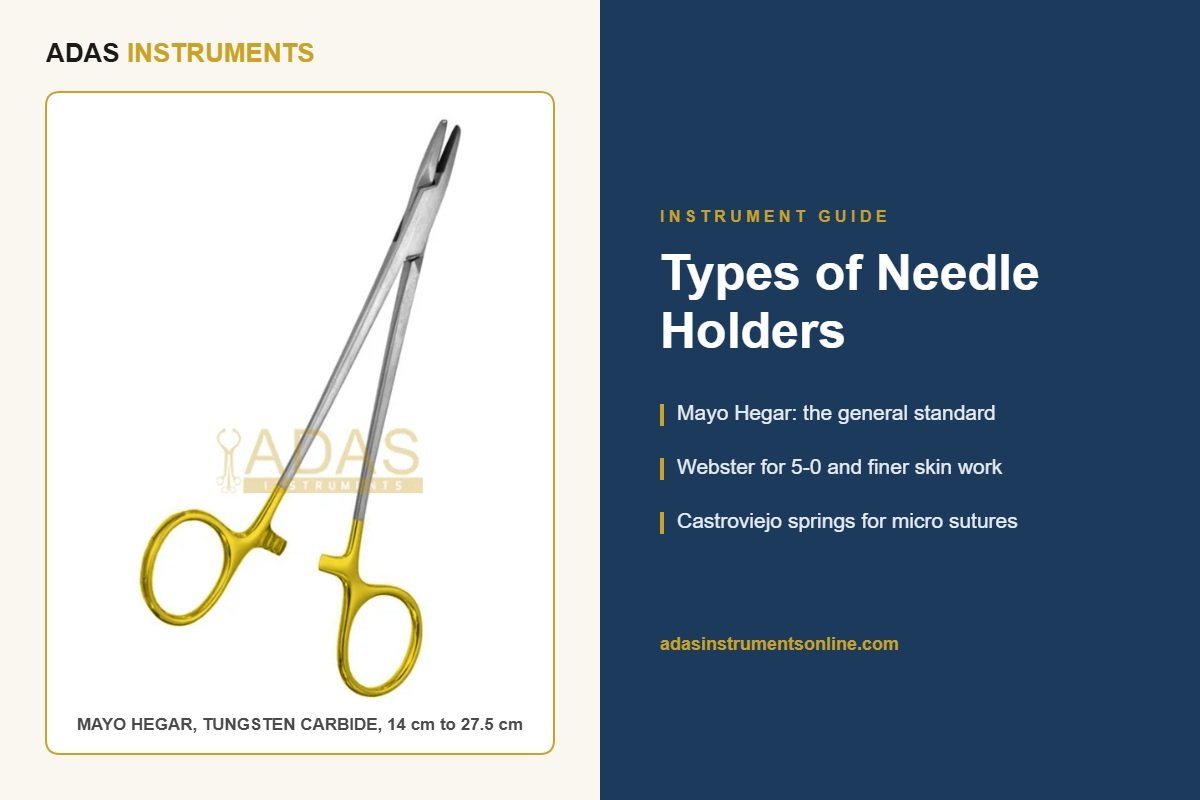
The Mayo Hegar needle holder is the general purpose pattern, and we make it in seven lengths from 14 cm to 27.5 cm. Length is about reach, not strength: the 14 cm is a skin and hand instrument, the 23 cm and longer ones exist to work at the bottom of an abdomen without the surgeon’s knuckles in the field.
The Crile Wood is the slimmer sibling, 15 cm to 23 cm, with a narrower jaw for finer needles. The Derf and the Halsey shorten the frame further for hand, face and skin closure. The Halsey is also where we keep the left handed builds, in both plain and serrated tips, because a right handed ratchet closes the wrong way round in a left hand and the surgeon ends up releasing it with two hands.
The Webster is the pattern most plastic surgeons ask for by name. It is 12.5 cm, with narrow smooth or extra delicate smooth jaws, and smooth matters here: serrations that grip a 4-0 needle will chew the coating off a 6-0 suture.
The specialty patterns
These solve a specific problem rather than covering a range.
The Olsen Hegar needle holder builds suture scissors into the jaws, so one instrument drives and cuts. It is the obvious choice for office procedures and for anyone closing without an assistant, and we make it in 12.5 cm, 14 cm, 17 cm and 19 cm. The trade is that the scissor blades sit where the jaw would otherwise be, so a surgeon who is used to a Mayo Hegar will cut a suture by accident once or twice while learning it.
The Mathieu replaces the shank ratchet with a palm ratchet that releases on a further squeeze, which keeps the hand closed and the eyes on the field. We stock it in 14 cm, 17 cm and 20 cm. The Ryder is the fine tipped pattern for cardiovascular and other small needle work, 12 cm to 20 cm, and the Heaney is the curved one for deep pelvic work where the needle has to be presented at an angle the wrist cannot reach.
Micro and spring handles
Below 6-0, a ratchet is a liability. The click travels up the instrument as a small shock, and on an eyelid or a vessel that shock is the whole margin for error.
The Castroviejo micro needle holder answers with spring handles, in 12 cm, 15 cm and 18 cm, with straight or curved jaws, serrated or smooth, and with or without a lock. The no lock build is worth understanding rather than skipping: a surgeon working at 9-0 often wants the needle held by finger pressure alone, because a lock that engages while the needle is half through is a bent needle. Where a lock is wanted, the Castroviejo needle holder with ratchet lock runs from 14 cm to 23 cm, with a diamond dust coated jaw option as well as carbide. Our micro vascular pattern takes the same feel out to 18 cm for depth.
Matching the holder to the suture
Suture gauge runs the opposite way to intuition, as the NIH’s StatPearls chapter on sutures and needles sets out: more zeroes means a thinner strand, from 1-0 down to 12-0. The jaw has to match it. This is what most trays settle on.
| Suture size | Pattern that usually suits it | Typical length |
|---|---|---|
| 2-0 and heavier | Mayo Hegar, serrated jaws | 18 cm to 27.5 cm |
| 3-0 to 4-0 | Mayo Hegar or Crile Wood | 15 cm to 20 cm |
| 4-0 to 5-0 | Crile Wood, Derf or Halsey | 12.5 cm to 15 cm |
| 5-0 to 6-0 | Webster, smooth jaws | 12.5 cm |
| 6-0 to 8-0 | Castroviejo, spring handle | 12 cm to 18 cm |
| 8-0 and finer | Micro vascular, smooth jaws | 18 cm |
Across all the types of needle holders above, the jaw material is a separate decision from the pattern, and each product page names whether the jaws are plain steel or tungsten carbide. The failure is usually at the fine end, and it is quiet. A needle held in jaws that are too coarse does not break, it distorts, and the surgeon spends the case wondering why the bites are going in slightly wrong.
Shop needle holders direct from the maker
All 20 patterns on this page are ours, with tungsten carbide jaw options across the range and left handed builds in stock. Mayo Hegar from 15 dollars, Castroviejo from 14 dollars. Wholesale pricing for clinics and distributors, branded or plain.
Why Americans say needle driver
Nothing separates the two words. Needle holder is the British and European term and the one most catalogues index under; needle driver is what most American operating rooms and scrub techs say out loud. The same pattern, the same instrument, two vocabularies. It matters commercially rather than clinically: a buyer searching for a needle driver and a buyer searching for a needle holder are looking for the same thing, and a supplier who only names one of them is invisible to half the market.
Tungsten carbide jaws, and the gold rings
A plain stainless jaw wears smooth. It does not fail suddenly, it just stops gripping, and the surgeon compensates with more closing force until a needle rotates in the jaws at the wrong moment.
Tungsten carbide inserts are brazed into the jaw and are several times harder than surgical stainless, so they hold their bite far longer. The gold finished rings are the trade signal that the inserts are there, and the practical reason for the signal is service: a wheel set up for steel will lift a carbide insert clean off. If a pair goes out for sharpening, whoever does it needs to be told it is carbide.
What Adas Instruments makes
All the types of needle holders named here are ours, made in high quality medical grade stainless steel, passivated and boil tested, and marked to a customer reference on request. The part worth asking about is the carbide: an insert that is poorly brazed can separate from the jaw in service, so ours are brazed, ground and then load tested before packing. If you are assembling a suture station rather than replacing one instrument, ask for an evaluation set of the three that cover most cases and keep them through a few reprocessing cycles before deciding.
Frequently Asked Questions
What are the main types of needle holders?
The types of needle holders divide into three groups. Ratcheted ring patterns such as the Mayo Hegar, Crile Wood, Derf, Halsey and Webster; specialty patterns such as the Olsen Hegar with built in scissors and the palm ratchet Mathieu; and spring handled micro patterns such as the Castroviejo and micro vascular.
What is the difference between a needle holder and a needle driver?
Nothing at all. Needle driver is the common American term for the same instrument, and catalogues list identical patterns under both names. If a quote says needle driver and your tray list says needle holder, you are talking about the same thing.
Which needle holder is best for plastic surgery?
A 12.5 cm Webster with smooth jaws for 5-0 and 6-0 skin closure, a Castroviejo for anything finer, and a Mayo Hegar for deep layers. That trio covers nearly every plastic surgery case, which is why most trays carry exactly those three.
Why do some needle holders have gold handles?
Gold rings mark brazed tungsten carbide jaw inserts. They grip a needle harder than plain steel and last several times longer, and the colour exists so that anyone servicing the instrument knows not to sharpen it on a wheel meant for steel.
Do left handed needle holders actually matter?
Yes, because the ratchet is handed. A left handed surgeon using a standard pattern has to release the lock awkwardly, often with the other hand. We hold left handed Halsey and Crile Wood builds in stock for that reason.
Related reading
For the instruments that cut the suture rather than drive it, see our guide to types of surgical scissors. For the jaw material in more depth, see tungsten carbide surgical instruments.
