
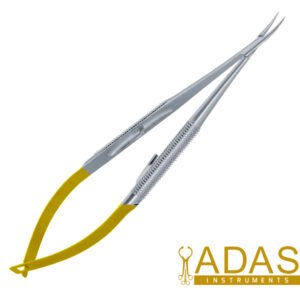
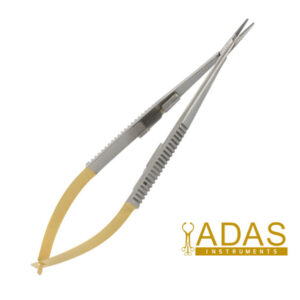
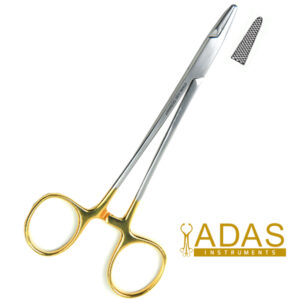
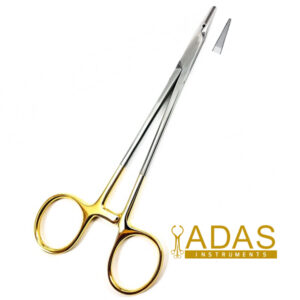
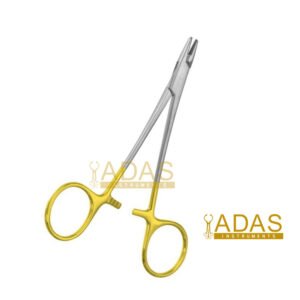
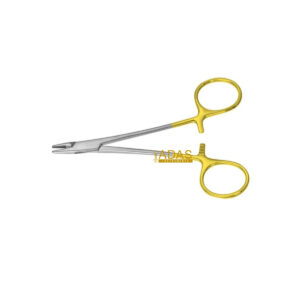
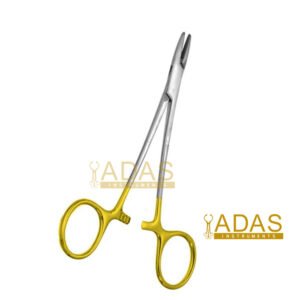
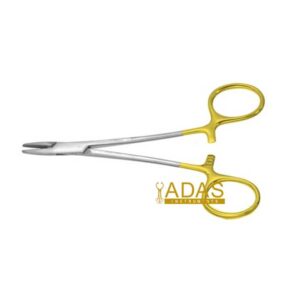


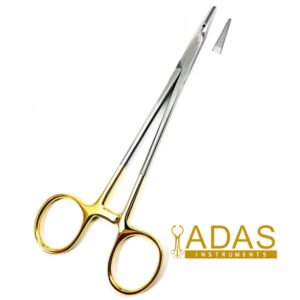

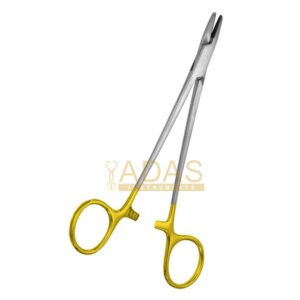
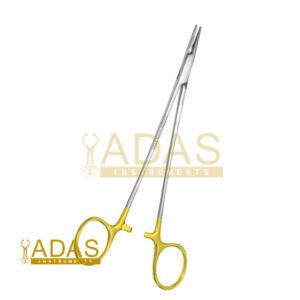
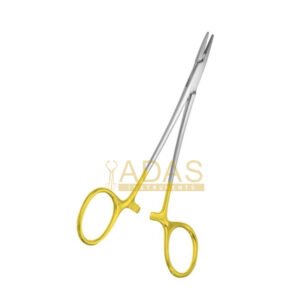


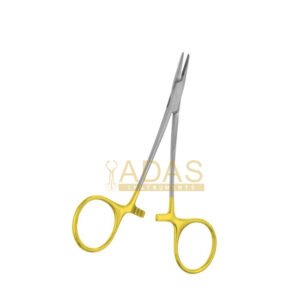
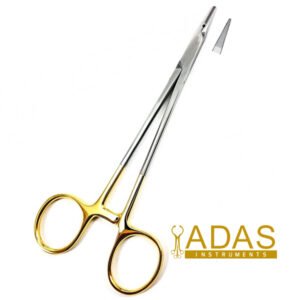
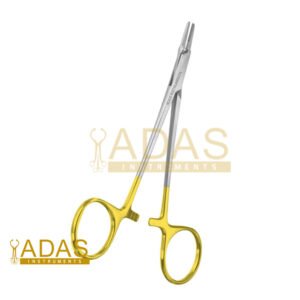
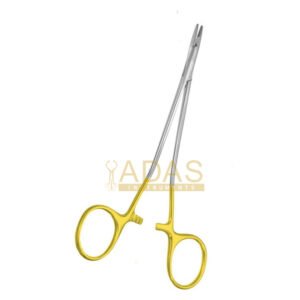

Surgical needle holders are the ratcheted instruments that drive a curved suture needle through tissue and hold it still between bites, and American operating rooms usually call the same instrument a needle driver. Adas Instruments makes 20 patterns of plastic surgery needle holders, from a 27.5 cm Mayo Hegar for deep abdominal layers down to a 12 cm Castroviejo for the finest suture, in high quality medical grade stainless steel with tungsten carbide jaw options and left handed builds held as standard.
How to choose a needle holder
Choose by suture size first and length second. Heavier sutures from 2-0 upward want the serrated jaws of a Mayo Hegar or Crile Wood; 5-0 and 6-0 skin work wants the smooth 12.5 cm jaws of a Webster; anything finer belongs in a spring handled Castroviejo. Length is about reach, not strength: take a short pattern for the eyelid, the mouth and the hand, and a long one so the knuckles stay outside a deep cavity.
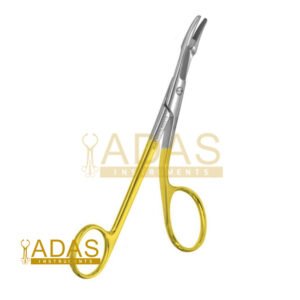
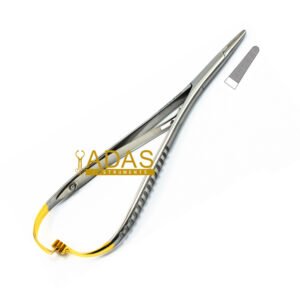
Two patterns solve a working problem rather than a tissue problem. The Olsen Hegar builds suture scissors into the jaws for anyone closing without an assistant, which is why it is the common choice in dental, outpatient and veterinary practice. The Mathieu moves the ratchet into the palm so the hand never leaves the field. Gold finished rings mark brazed tungsten carbide inserts, which hold their bite several times longer than plain steel.
The five patterns ordered most
| Pattern | Jaw | Suture | Length | Reach for it when |
|---|---|---|---|---|
| Mayo Hegar | Broad, cross serrated | 1-0 to 4-0 | 14 to 27.5 cm | The tissue is medium to thick: fascia, muscle, abdominal closure |
| Crile Wood | Narrow, tapered, serrated | 4-0 to 6-0 | 15 to 23 cm | General closure where the site is tight |
| Olsen Hegar | Serrated tip with scissor blades behind | 3-0 to 5-0 | 12.5 to 19 cm | You cut your own suture and want one instrument |
| Webster | Smooth, two grades of delicacy | 4-0 to 6-0, down to 10-0 | 12.5 cm | Fine thread a serrated jaw would score |
| Halsey | Plain or serrated, left handed builds | 3-0 to 6-0 | 13 cm | Eyelid, nasal and facial closure, or a left handed surgeon |
The full range of 20
For fine and micro work: Castroviejo micro, Castroviejo with ratchet lock, micro vascular, Derf and Par. For facial, nasal and oral surgery: Gillies, Neivert, Baumgartner and Mathieu. For deeper and specialty fields: Heaney, Senning and Ryder. Left handed and plain tip builds: left handed Mayo Hegar, left hand Crile Wood and plain tip Crile Wood.
Frequently asked questions
What are the different types of needle holders?
They divide by jaw and by handle. Serrated jaw patterns such as the Mayo Hegar and Crile Wood grip by biting and suit heavier thread. Smooth jaw patterns such as the Webster hold by flat pressure and protect fine suture. Combination patterns such as the Olsen Hegar add scissor blades behind the jaw. Palm ratchet patterns such as the Mathieu move the lock off the finger rings, and spring handled micro patterns such as the Castroviejo have no ratchet at all.
What is the difference between a needle holder and a needle driver?
Nothing. They are two names for the same instrument. Needle holder is the older British term and needle driver is what most American surgeons and buyers say, so both appear across this range and in our product names.
How much does a needle holder cost?
It depends on three things: the pattern, the length, and whether the jaw carries brazed tungsten carbide inserts. A carbide jaw costs more than plain steel and lasts several times longer, so it pays back on any instrument used more than a few times a week. Prices are shown on each product page, and we quote for quantity and tender orders.
Guides and care
Types of needle holders, the patterns compared, with a table matching suture size to jaw and length. Tungsten carbide surgical instruments, what the gold rings mean and when carbide is worth the difference. Sharpening and servicing, including why a carbide instrument must never go on a wheel set up for steel.