
Breast Augmentation Instruments: The Tray, Step by Step
Sep
Breast augmentation instruments are the hand tools a surgeon uses to mark the breast, make a short incision, open a pocket behind the breast or the muscle and place an implant in it. The core of the tray is a set of long, blunt dissectors and lighted retractors. Adas Instruments lists 125 products in its breast surgery instruments range, from a 22 dollar Engler retractor to a 46 cm Wieslander dissector.
Key takeaways
- The incision picks the dissector. Transaxillary needs length, up to 46 cm. Inframammary needs width and a short reach.
- Every dissector in this work is blunt. The pocket is opened by pressure, not cut.
- Light matters more than in most trays. The pocket is deep and the incision is small, so a fiber optic retractor earns its place.
- If cautery is used inside the pocket, the retractor holding tissue should be insulated.
What goes on a breast augmentation tray
Most of the tray is general plastic surgery: scalpel handles, fine forceps, scissors, needle holders. What makes it a breast augmentation instrument set is the short list below, in the order a case uses them.
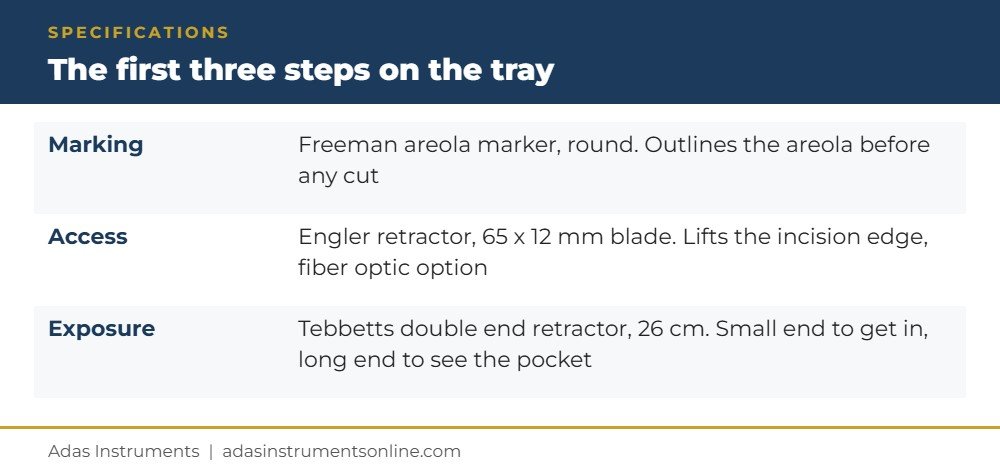
| Step | Instrument | What it does | From |
|---|---|---|---|
| Marking | Freeman areola marker, round | Outlines the areola before any cut | 22 dollars |
| Access | Engler retractor, 65 x 12 mm blade | Lifts the incision edge, fiber optic option | 22 dollars |
| Exposure | Tebbetts double end retractor, 26 cm | Small end to get in, long end to see the pocket | 49 dollars |
| Blunt breast dissector, 30 to 46 cm | Opens the plane for the implant | 35 dollars | |
| Hemostasis | Insulated C circular retractor | Holds tissue while cautery is live | 95 dollars |
| Holding | Mammostat breast elevator, 28 cm | Lifts the breast so the plane stays in view | 180 dollars |
The table is one of each. Real trays carry two or three dissectors and two retractors, because one surgeon on one side of the table and an assistant on the other both need to see.
Choosing a dissector by incision
This is the decision that changes the tray most. The ASPS guide to breast augmentation lists the usual incisions: under the breast fold, around the areola and in the armpit. Each one puts the pocket at a different distance from your hand.
Inframammary. The pocket is right above the incision, so reach is short and width is useful. The 32 cm Penn breast dissector holds a flat plane across the chest wall. The 34 cm Silverstein breast dissector is made for work close to the incision.
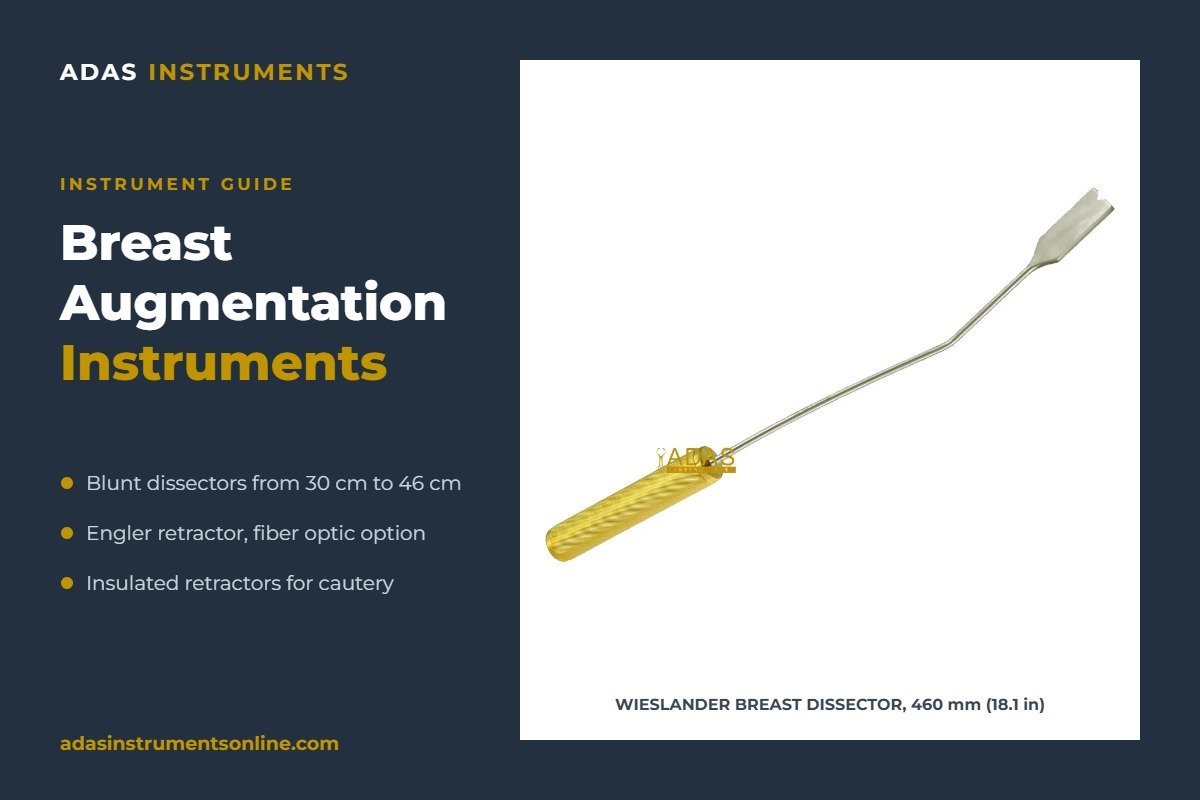
Transaxillary. Now the pocket is a long way off, and length is everything. The Agris Dingman dissector comes in 35 cm and 40 cm. The Reynolds transaxillary dissector is 15.5 in with a 38 mm blade. The longest wide blade we make is the Wieslander breast dissector at 460 mm, or 18.1 in.
Periareolar. The opening is small, so a narrow blade that does not stretch it is the better choice. The 30 cm MacCollum Dingman submammary pattern, with a 20 mm blade, suits a tight pocket.
Buy breast augmentation instruments from the maker
Dissectors from 35 dollars, retractors from 22 dollars, and the full breast range in one place. Made by Adas Instruments in high quality medical grade stainless steel. Wholesale and private label pricing for clinics and distributors.
Retractors and light
A pocket you cannot see is a pocket you cannot check for bleeding. The Engler breast retractor has a 65 x 12 mm blade and a fiber optic option, which puts light where the headlight does not reach. The Tebbetts double end retractor is 26 cm with serrated tips: the small end gets you in, the long blade holds the view open once you are there.
If the surgeon runs cautery inside the pocket, a bare steel retractor touching tissue is a path for current. The insulated C circular retractor has a non conductive coating for that reason. We also make insulated builds of the angulated and spatulated blade dissectors.
Atraumatic dissection and holding
Some surgeons want less force at the tip than a standard dissector gives. The Solz atraumatic dissector has a fully rounded spatula end in 34 cm and 37 cm that glides along the plane. The Iconoclasts breast spreaders work the other way: blunt blades on a scissor action that turn grip into outward pressure.
The Mammostat breast elevator is not a dissector at all. At 28 cm it holds and lifts the breast so the plane underneath stays in view, which saves an assistant a tiring job.
Marking and measuring
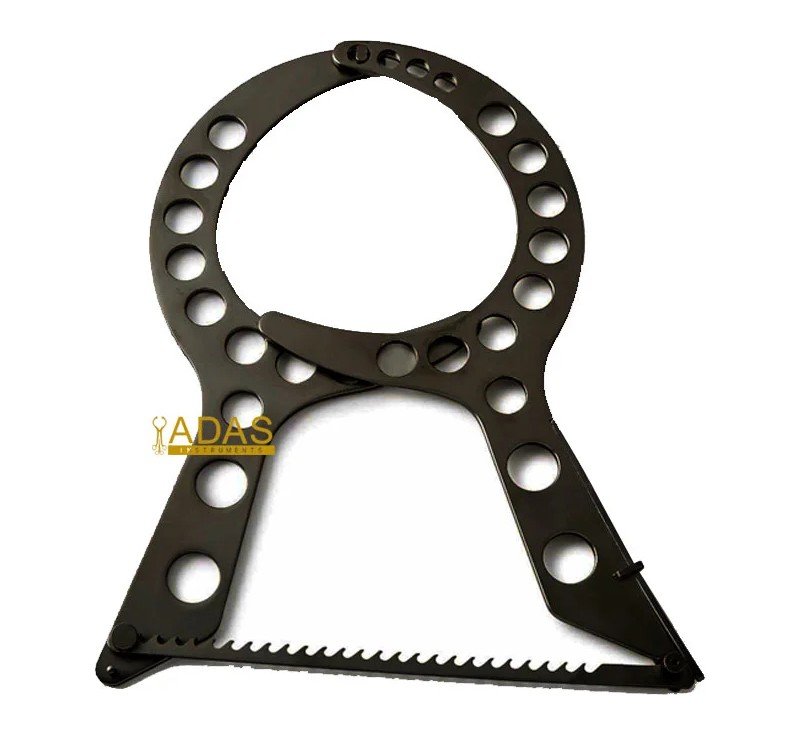
The case starts with a pen and a marker. The Freeman areola marker outlines the areola before incision, and it is used in reduction and lift as well as augmentation. For reduction and lift planning, mammaplasty instruments add a caliper such as the McKissock mammaplasty caliper to mark the skin flaps.
If the practice also does abdominoplasty, the abdominoplasty and mammaplasty set covers both on one tray.
Care between cases
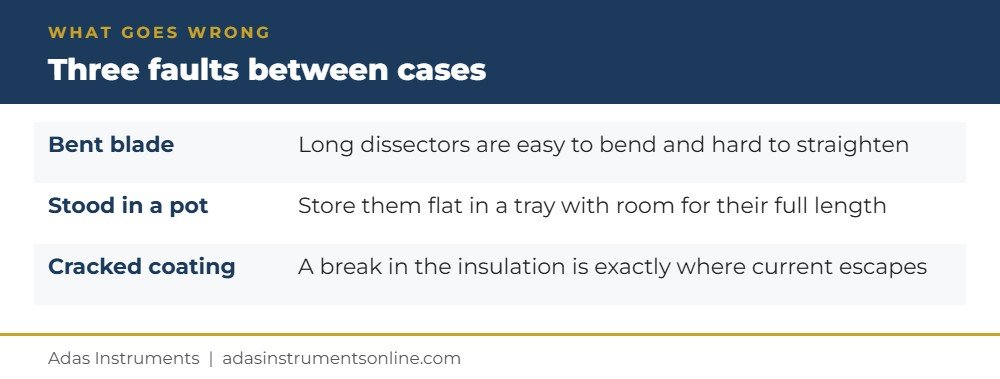
Long dissectors are easy to bend and hard to straighten. Store them flat in a tray with room for their full length, not stood in a pot. Check insulated instruments for cracks or bare spots in the coating before each case, because a break in the coating is exactly where current escapes. Rinse, clean with a neutral pH detergent and autoclave at 134 degrees Celsius.
Frequently Asked Questions
What instruments are used in breast augmentation?
A skin marker, a scalpel, retractors such as the Engler or Tebbetts, one or more long blunt breast dissectors to open the pocket, cautery with insulated retractors, and the usual closing instruments. The dissectors and retractors are what make the tray specific.
Which breast dissector is best for a transaxillary approach?
Length comes first, because the pocket is far from the armpit incision. The Agris Dingman at 35 cm or 40 cm, the Reynolds at 15.5 in and the Wieslander at 18.1 in are all made for it. A curved shaft pattern such as the Jacobs follows the path.
Why are breast dissectors blunt?
The pocket is opened along a natural plane between tissue layers. A blunt end separates that plane by pressure without cutting vessels or muscle fibers, so there is less bleeding and a cleaner pocket for the implant to sit in.
What is in a breast augmentation instrument set?
A typical set holds an areola marker, two retractors, two or three blunt dissectors of different length and width, an insulated retractor for cautery, and general instruments for the incision and the closure. Surgeons add patterns to suit the incision they use.
