
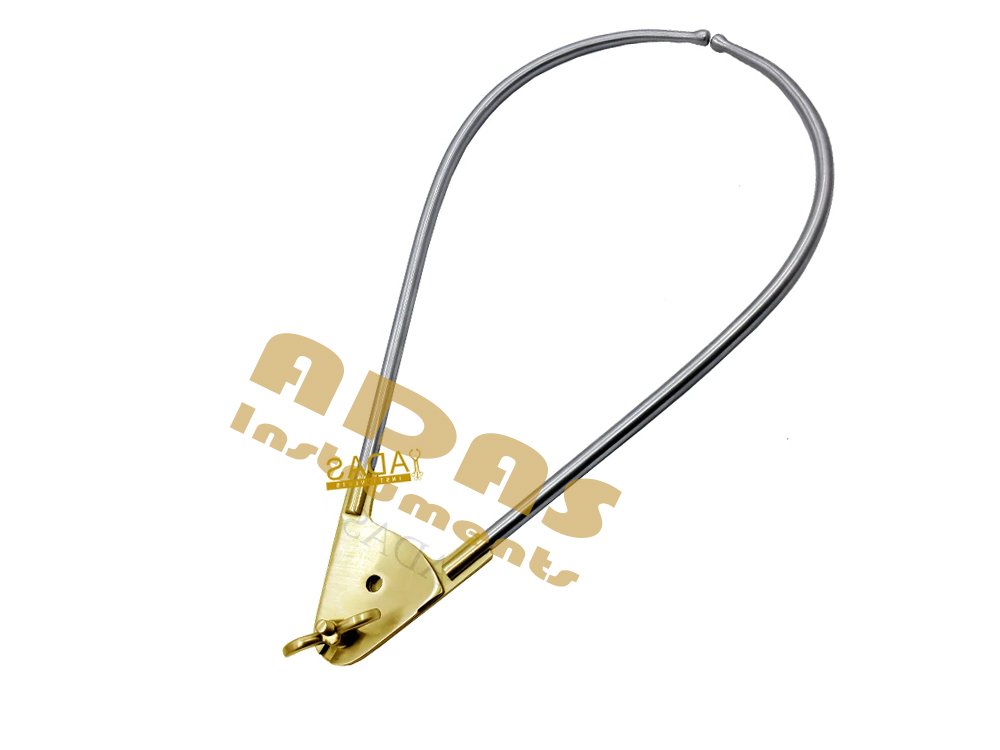
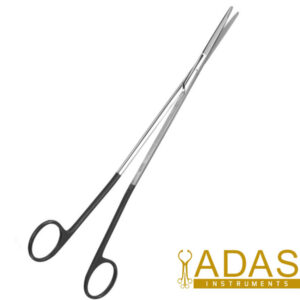
McKissock Mammaplasty Caliper | Surgical Breast Reduction Marker
$ 55.00
The McKissock mammaplasty caliper measures the distance from the notch at the top of the breastbone down to where the new nipple will sit, which is the first number a breast reduction or a lift is planned from. Its frame is curved rather than straight, so the arms follow the chest and the breast instead of bridging across them the way a flexible ruler does. The same instrument then maps the vertical and horizontal limbs of a T or L shaped pattern, so both sides are set out from readings rather than from an impression.
Key Features
- Curved frame that follows the chest wall and the breast
- Measures the sternal notch to new nipple distance
- Maps the vertical and horizontal limbs of a T or L pattern
- Gold plated finish for visibility on a crowded tray
- Cut from high quality medical grade stainless steel and fully autoclavable
- Reusable, with nothing to replace or recharge
- Three year replacement warranty against manufacturing defects
- Item code AA-31.14
Available on backorder

What a McKissock mammaplasty caliper is
Every breast reduction starts with one measurement, and it is not a measurement of the breast. It is the distance from the sternal notch, the dip you can feel at the top of the breastbone, down to the point where the nipple is going to end up. Get that number right on both sides and the operation has a chance of being symmetric. Get it from a tape held across a curve and it is a guess with a number attached.
This caliper is an instrument that carries the measurement, so the surgeon brings the judgement and the steel holds the number. Two curved arms wrap around the breast and the chest, and the reading comes off the frame. It is the instrument that goes on before the keyhole template, and it is the reason the template lands in the right place.
Paul McKissock gave his name to both. The technique, described in 1972, keeps a vertical bridge of tissue beneath the nipple so its blood supply survives the reduction, and the instruments that plan it carry his name because they were cut to suit that geometry. The caliper is the first of the two to touch the patient.
As a breast reduction caliper it does one measurement before any other: the suprasternal notch to nipple measurement, taken on a planned position rather than an existing one. It is a curved breast caliper for the reason the next section explains, which is that the distance runs around the tissue and not across it.
Key design features
The curved frame, which is the whole idea
A flexible ruler laid against a breast either sinks into it or bridges over it, and neither gives you the distance you wanted. The arms on this caliper are formed to go around the tissue, so the two points sit where you put them and the steel between them does not touch the patient at all.
It measures a plan, not an object
The second point of this measurement is a place that does not exist yet. The surgeon is measuring down to where he intends the nipple to be, which is why the instrument has to hold its setting while he looks at it, steps back, and looks again.
Mapping the limbs
Once the nipple position is set, the same caliper takes the vertical and horizontal limbs of the pattern. On a T shaped or L shaped resection those two lengths decide the scar, and they are the figures most worth having on both sides rather than on one.
Gold plated
The plating is there to be seen. A long curved instrument lying among long straight ones is slow to find, and this is an instrument that gets picked up, put down and picked up again several times during a single marking.
What to order it with
There is one version of this caliper, so the decision is about what sits beside it on the tray.
| What it works with | Why | Our price |
|---|---|---|
| A keyhole pattern template | The caliper places the ring, the template draws the resection | Sold separately |
| An areola marker | The ring diameter is a separate decision from the nipple position | Sold separately |
| A surgical ruler | For the short straight measurements the caliper is too big for | Sold separately |
| The caliper alone | For a surgeon who marks the pattern free hand from the one reading | 55 dollars |
Where it is used
It is a breast planning instrument and it works at the start of the case, before anything is drawn.
| Procedure | What it measures there | Why it matters |
|---|---|---|
| Breast reduction | Sternal notch to new nipple, then both resection limbs | The number the whole pattern hangs on |
| Mastopexy, the breast lift | The new, higher nipple position on both sides | Nipple height asymmetry is the commonest complaint |
| Breast reconstruction | The remaining side, then the same distance on the new one | Matching rather than planning |
| Gynecomastia correction | Nipple position on a flattened chest | Smaller distances, same method |
What it measures, and what it must not do
A caliper that holds a setting can be relied on for things it was never meant to do, and the last row is the one worth reading twice.
| The task | What the caliper does | What it must not do |
|---|---|---|
| Notch to nipple | Spans the distance around the tissue rather than across it | The arms are not pressed into the breast to shorten the reading |
| Limb lengths | Takes the vertical and horizontal limbs of the pattern | It does not set the limbs. The plan does |
| Symmetry | Gives the same reading on both sides | It cannot correct a difference in chest wall shape |
| Holding a setting | Keeps a reading while the surgeon steps back and looks again | It is never used to grip, clamp or hold tissue |
How it compares with the rest of the family
Four instruments in this category measure a distance, and they are different shapes because they measure across different things.
| Instrument | What it spans | Our price |
|---|---|---|
| McKissock mammaplasty caliper | A curved path around a breast, notch to nipple | 55 dollars |
| Martin mammaplasty caliper | The same path, gold plated, with a 0-10 cm scale | 65 dollars |
| Jameson caliper | Millimeter distances in an eye socket | 32 dollars |
| Surgical ruler | Short straight distances anywhere | 12 dollars |
Materials and finish
Every McKissock mammaplasty caliper we make is cut from high quality medical grade stainless steel. The steel itself is made to a German specification. We do not publish a grade number. The number on a certificate tells a surgeon nothing about whether two arms still close on the same reading after two hundred autoclave cycles, and the answer to that is in the making rather than in the alloy.
The curve is formed, not bent to shape afterwards, which is why the two arms close on each other evenly rather than crossing at the tips. A caliper whose points miss each other reads short on small distances and nobody notices until two sides disagree.
The frame is finished smooth on the inside of the curve, because that is the surface that passes closest to the patient when the instrument is swung into place.
Caring for it
Clean around the hinge area and dry it properly. This is the one instrument on a marking tray with two arms that move against each other, and a joint that is washed but not dried is a joint that stiffens.
Check the points against each other every few cycles. Hold the arms closed and look at where the tips meet. If one is sitting past the other, the instrument is reading short on small distances and it should come back to us rather than go onto the next list.
Autoclave with the rest of the tray. Store it so the arms are not loaded against another instrument, because a formed curve that is leaned on for a year is a formed curve that has changed, and the reading changes with it.
Ordering and wholesale
The McKissock mammaplasty caliper is made in our own workshop and sold direct, which is why the price sits where it does against the catalogue houses. Order one for a single tray, or in quantity for a hospital list or a distributor line. We do OEM work under your own brand and your own item numbers. Send us a sample and we will hold a run to your pattern rather than ours. Stock items ship from our own workshop. Backorder items take 10 to 12 working days to make. Every instrument carries a three year replacement warranty against manufacturing defects. Production is controlled under an ISO 13485 quality management system.
Frequently asked questions
What is a McKissock mammaplasty caliper used for?
Measuring the distance from the sternal notch to the planned new nipple position before a breast reduction or a lift, and then mapping the vertical and horizontal limbs of the resection pattern. It is the first measurement of the case and the one both sides are planned from.
Why is a mammaplasty caliper curved instead of straight?
Because the distance it measures runs around a curved surface. A straight ruler either bridges across the breast or sinks into it, and both give a reading that is not the one you wanted. The curved arms go around the tissue so the steel never touches it.
Is the McKissock mammaplasty caliper the same as a breast reduction template?
No. The caliper gives you the measurement, the template draws the shape. The caliper goes on first to place the new nipple position, and the keyhole template is then set out from it.
How does it compare with the Martin mammaplasty caliper?
They do the same job. Ours are 55 dollars and 65 dollars respectively, and the difference is the finish and the scale: the Martin is gold plated throughout and carries a 0-10 cm scale on the frame.
What does a mammaplasty caliper cost?
This one is 55 dollars, made in our own workshop and sold direct. Catalogue houses list the same instrument from about 87 dollars to over 200 dollars, which is a difference in distribution rather than in steel.
Related products and categories
The gold plated alternative with a scale on the frame is the Martin mammaplasty caliper gold. Once the nipple position is set, the McKissock keyhole pattern draws the resection from it. For the short straight measurements this caliper is too large for, the surgical ruler graduated in mm and inches sits on the same tray.
The rest of the family sits under marking and measuring instruments, and the wider set for this operation is under breast surgery instruments.
| Weight | 0.2 kg |
|---|
Be the first to review “McKissock Mammaplasty Caliper | Surgical Breast Reduction Marker”
Shipping & Delivery Policy
Processing Time: In-stock items are dispatched within 24-48 hours. For custom or out-of-stock items, production time is approximately 10-15 days.
Global Delivery Estimates
We partner with world-class couriers (DHL, FedEx) to ensure fast, tracked delivery.
- USA & Canada: 3-5 Business Days
- Europe & UK: 4-6 Business Days
- Rest of World: 5-7 Business Days
*We offer Air Cargo and Sea Freight options for bulk wholesale orders.
Customs & Duties
International buyers are responsible for any customs duties or taxes imposed by their country. Adas Instruments is not responsible for delays caused by customs clearance.
Lost Packages & Insurance
If your package is lost in transit, please contact us immediately. We offer full support and replacements for confirmed lost shipments. Note: You must report non-delivery within 3 weeks to be eligible for an insurance claim.
Related products

Reviews
There are no reviews yet.