
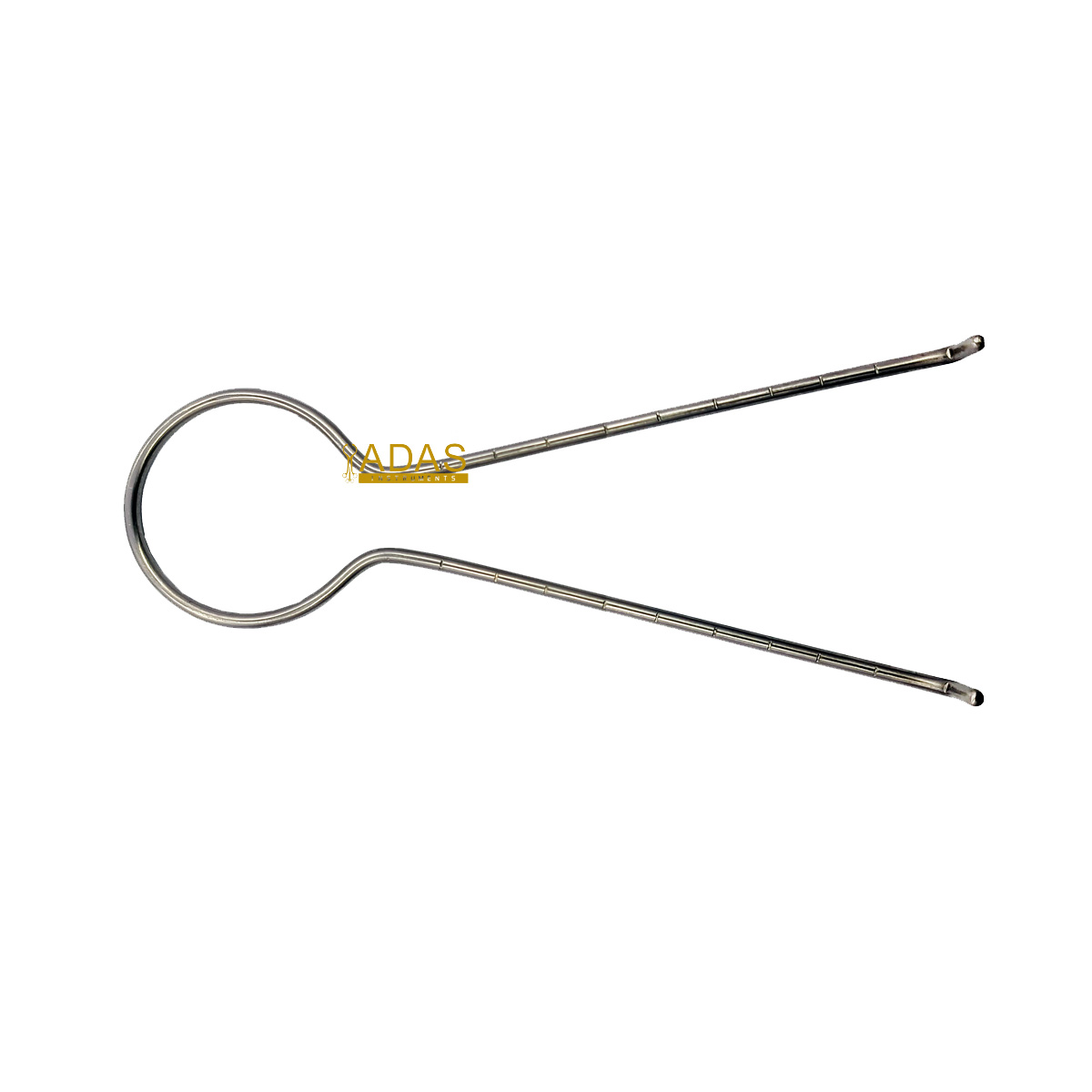
McKissock Keyhole Pattern with CM Mark | Breast Reduction Template
Price range: $ 14.50 through $ 18.00
The McKissock keyhole pattern is a steel template that sets out a whole breast reduction in one placement: a ring at the top for the new nipple position and two graduated limbs running down from it to the fold beneath the breast. The limbs are marked in centimeters, so the surgeon reads the amount of skin he is removing off the instrument instead of measuring it afterwards. We make the ring in 38, 42 and 45 mm, the three sizes that match our Freeman areola markers, so the areola and the resection are drawn from the same number.
Key Features
- Ring plus two graduated limbs on one template
- Limbs marked in centimeters and read directly off the instrument
- Ring diameters: 38, 42 and 45 mm
- Ring sizes match our Freeman areola markers
- Finish options: gold plating or satin
- Cut from high quality medical grade stainless steel and fully autoclavable
- Three year replacement warranty against manufacturing defects
- Item code AA-31.51

What a McKissock keyhole pattern is
Paul McKissock described his breast reduction in 1972. The technique keeps a vertical bridge of tissue under the nipple so the blood supply to the nipple-areola complex is never cut, and the skin that comes off is taken from around that bridge in the shape of an inverted T. The template is how the shape gets onto the patient.
It is an instrument that carries the measurement, so the surgeon brings the judgement and the steel holds the number, and it carries two of them at once: a diameter at the top and a length down each limb. That is what makes it different from everything else in this category. Most marking instruments answer one question. This one answers the areola question and the resection question in the same placement.
Catalogues call it several things and they all mean this. A McKissock keyhole breast reduction marker, a McKissock breast marker, or simply a breast reduction keyhole template. What ours carries that a plain template does not is the keyhole pattern cm scale down both limbs.
That is also why it is the instrument people get wrong. A template this complete invites a surgeon to treat it as the plan rather than as a way of writing the plan down. The geometry it draws is only as good as the two numbers he chose before he put it on the skin, and the template has no opinion about either of them.
Key design features
The ring, and why its size matters twice
The ring at the top of the keyhole sets where the new nipple goes and how wide the new areola will be. We cut it at 38, 42 and 45 mm, which are three of the diameters our Freeman markers are made in, so a surgeon who marks the areola at 42 mm can draw the keyhole from a 42 mm ring and the two marks agree.
Graduated limbs
The two arms running down from the ring are marked in centimeters. The surgeon reads the vertical limb length straight off the template, which is the figure the operation turns on, and he reads the same figure on the second side. Nothing is transferred with a ruler and nothing is remembered.
It reaches the fold
The limbs are long enough to run from the new nipple position down to the crease under the breast, because that crease is where the horizontal part of the scar hides. A template that stops short leaves the surgeon joining up the last stretch by hand, which is exactly the part of the mark that has to match on both sides.
Two finishes
Gold plating on the frame makes a flat template findable among flat instruments. Satin kills the reflection under an overhead light, which matters on a surface that is being read rather than just used.
Which ring size to order
One decision, and it is the same decision as the areola marker, which is the point.
| Ring | Pairs with | Typically chosen for |
|---|---|---|
| 38 mm | Our 38 mm Freeman marker | The most ordered size on a reduction list |
| 42 mm | Our 42 mm Freeman marker | Larger reductions and mastopexy |
| 45 mm | Our 45 mm Freeman marker | Mastopexy on a fuller breast |
| Any of the three | The double ended Freeman pairings | A list that moves between two sizes |
Where it is used
This is a reduction and lift instrument. It is not a general purpose template and it does not pretend to be.
| Procedure | What the template sets out | Note |
|---|---|---|
| Breast reduction | The new areola and both resection limbs in one placement | The operation it was designed for |
| Mastopexy, the breast lift | The new nipple position and the skin to be taken up | Less tissue removed, same geometry |
| Breast reconstruction | A symmetry pattern against the remaining side | Used with the larger ring sizes |
| Revision of a previous reduction | A repeat of the original geometry on a scarred breast | The limb figures matter more than usual |
What it marks, and what it must not do
A template that sets out a whole operation can be trusted too far, and the right hand column is where that happens.
| The task | What the template does | What it must not do |
|---|---|---|
| Setting the areola | Holds one ring diameter and repeats it on the second side | It does not decide the diameter. The surgeon does |
| Setting the limbs | Gives a readable centimeter figure for each limb | It does not decide how much skin comes off |
| Reaching the fold | Runs down to the crease under the breast | It is not bent to make it reach further |
| Symmetry | Gives both sides the same two numbers | It cannot correct a difference in breast position or nipple height |
How it compares with the rest of the family
Four instruments on a reduction tray plan the same operation, and each answers a different part of it.
| Instrument | What it answers | When it is the right choice |
|---|---|---|
| McKissock keyhole pattern | The areola and both resection limbs, together | Setting out the whole pattern in one placement |
| Freeman areola marker | The areola diameter only | When the resection is already drawn |
| McKissock mammaplasty caliper | The distance from the sternal notch to the new nipple | Before the template goes on, to place the ring |
| Martin mammaplasty caliper | The same distance, on a gold plated frame | The alternative to the above, with a 0-10 cm scale |
Materials and finish
Every McKissock keyhole pattern we make is cut from high quality medical grade stainless steel. The steel itself is made to a German specification. We do not publish a grade number. The number on a certificate tells a surgeon nothing about whether the centimeter marks on the limbs are still readable after two hundred autoclave cycles, and the answer to that is in the making rather than in the alloy.
The centimeter graduations are etched rather than printed, which is the only way a scale survives repeated sterilization. A printed scale on a template fades, and a faded scale on this instrument means the limb figure is being guessed.
The limbs carry a slight give on purpose. A template that is dead rigid cannot be settled onto the curve of a breast, and one that flexes freely is not a template any more. The amount of give is set in the forming, not in the alloy.
The frame is finished with no sharp external corners. A template is handled with wet gloves and pressed against skin, and a square corner on a flat instrument finds a glove sooner or later.
Caring for it
Clean the etched scale, not just the frame. Dried surgical ink sits in a graduation and the mark stops being readable long before the instrument wears out. Warm water, a soft brush, nothing abrasive along the graduations.
Autoclave with the rest of the tray. There is nothing to lubricate and nothing to trap moisture. Store it flat, because a flat template stored on edge against other instruments is a template that slowly stops being flat, and the shape is the instrument.
Ordering and wholesale
The McKissock keyhole pattern is made in our own workshop and sold direct, which is why the price sits where it does against the catalogue houses. Order one for a single tray, or in quantity for a hospital list or a distributor line. We do OEM work under your own brand and your own item numbers. Send us a sample and we will hold a run to your pattern rather than ours. Stock items ship from our own workshop. Backorder items take 10 to 12 working days to make. Every instrument carries a three year replacement warranty against manufacturing defects. Production is controlled under an ISO 13485 quality management system.
Frequently asked questions
What is the McKissock keyhole pattern used for?
Setting out a breast reduction or a mastopexy: the ring marks the new areola position and diameter, and the two graduated limbs mark the skin to be removed down to the fold beneath the breast. It is the McKissock vertical bipedicle technique, described in 1972.
What ring sizes does the McKissock keyhole pattern come in?
38, 42 and 45 mm. Those are the three sizes our Freeman areola markers are also cut in, so the areola mark and the keyhole mark come from the same number.
Why is the keyhole limb graduated in centimeters?
Because the vertical limb length is the figure the reduction turns on, and reading it off the template is both faster and more repeatable than measuring it afterwards with a ruler. It also means the second side is marked from a number rather than from memory.
What scar shape does this pattern produce?
An inverted T, often called an anchor: a circle around the areola, a vertical line down the lower pole, and a horizontal line hidden in the crease under the breast. The template sets out the first two and places the third.
Does the McKissock keyhole pattern replace the areola marker?
No, and the two are usually used together. The template places the ring and draws the resection; a separate areola marker is often preferred for scoring the areola itself, because a dedicated ring is easier to settle squarely on the nipple.
Related products and categories
Order the ring size to match your Freeman areola marker round shape, which runs from 34 to 50 mm. Before the template goes on, the McKissock mammaplasty caliper sets the distance from the sternal notch down to the new nipple position, and the Martin mammaplasty caliper gold does the same job with a 0 to 10 cm scale read off the frame.
The rest of the family sits under marking and measuring instruments, and the wider set for this operation is under breast surgery instruments.
| Weight | 0.03 kg |
|---|---|
| Select Color Option | Gold Plating, Satin finish |
| Select Diameter | 38mm, 42mm, 45mm |
Be the first to review “McKissock Keyhole Pattern with CM Mark | Breast Reduction Template”
Shipping & Delivery Policy
Processing Time: In-stock items are dispatched within 24-48 hours. For custom or out-of-stock items, production time is approximately 10-15 days.
Global Delivery Estimates
We partner with world-class couriers (DHL, FedEx) to ensure fast, tracked delivery.
- USA & Canada: 3-5 Business Days
- Europe & UK: 4-6 Business Days
- Rest of World: 5-7 Business Days
*We offer Air Cargo and Sea Freight options for bulk wholesale orders.
Customs & Duties
International buyers are responsible for any customs duties or taxes imposed by their country. Adas Instruments is not responsible for delays caused by customs clearance.
Lost Packages & Insurance
If your package is lost in transit, please contact us immediately. We offer full support and replacements for confirmed lost shipments. Note: You must report non-delivery within 3 weeks to be eligible for an insurance claim.
Related products


Reviews
There are no reviews yet.