
Bayonet Cannulas: When the Offset Shaft Matters
Aug
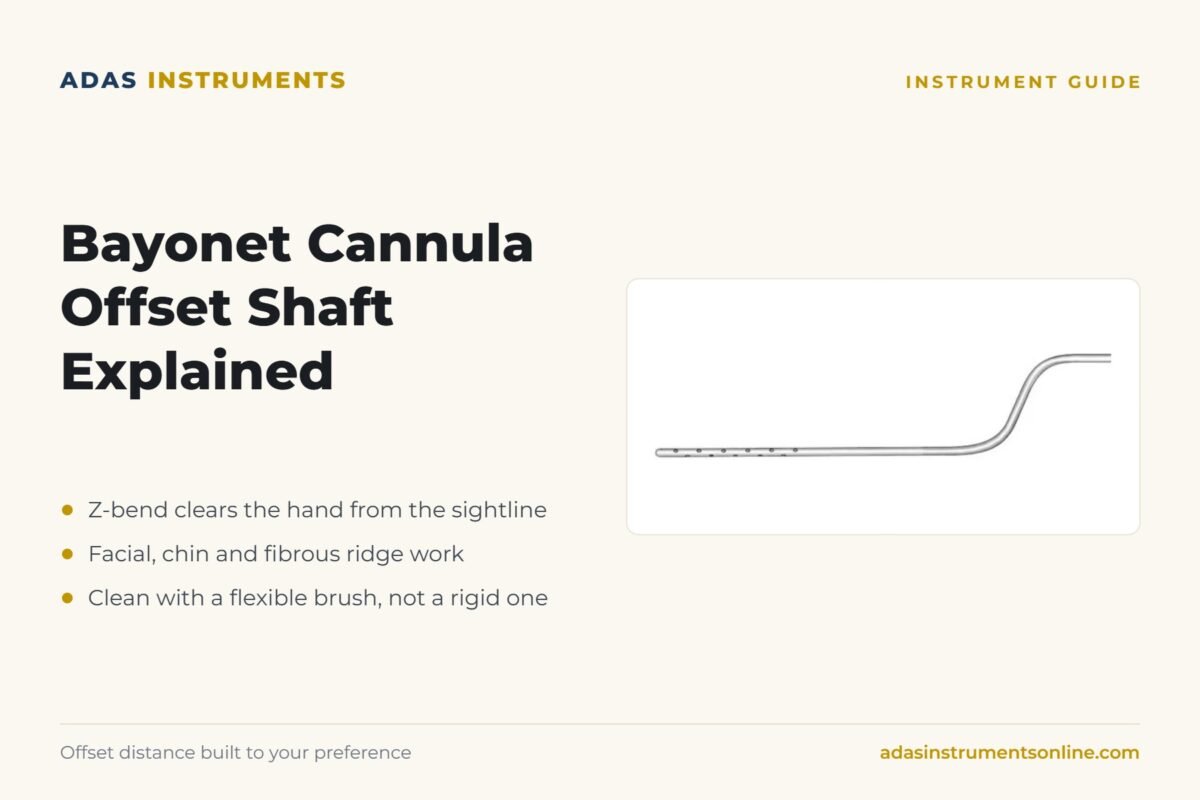
In this guide: bayonet cannula. Offset cannulas for constrained surgical approaches.
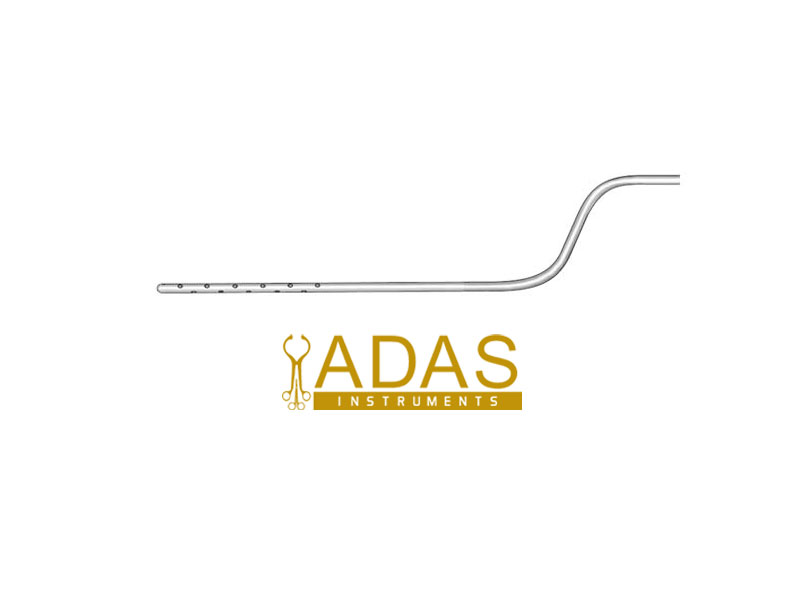
The bayonet cannula carries a Z-shaped double bend near the hub, offsetting the working shaft from the handle line, and that odd silhouette solves a real problem: the surgeon’s hand blocking the surgeon’s view. Borrowed from ENT instrument design, the bayonet offset earns specific places on the liposuction and infiltration tray. Here is where and why.
What the Offset Actually Does
With a straight cannula, hand, hub and tip line up, and in shallow angled work the knuckles ride exactly in the sightline. The bayonet drops the working shaft below the grip line, so the hand floats above while the shaft runs flat along the plane, the same logic that puts bayonet handles on nasal forceps and micro bipolar patterns. Angle of attack flattens without the wrist cocking.
Where Bayonet Cannulas Are Used
Facial and submental infiltration first: our bayonet-shaped infiltrators from the infiltration range keep the hand out of the marked field while wetting the chin and jawline per the facial guide. Fibrous ridge work under the chin, periumbilical finishing where the abdomen curves, and any zone where the surgeon works toward themselves: the offset trades a little push-line power for clean sight and flat approach.
The Trade-Offs, Honestly
Force transmission bends slightly around the offset, so bayonets stay in fine bores and low-force jobs; nobody debulks a back through a Z-bend. Cleaning asks one extra beat of attention where the lumen turns, standard flush-and-brush discipline handles it.
Buying Notes
Match hub standard as always (luer for infiltration and syringe work), check the bends are smooth swept curves rather than sharp angles (sharp internal corners trap debris and stress-crack), and treat the bayonet as a complement: one or two in the fine sizes covers the sightline problem for a whole practice.
Bayonet Cannula Geometry at a Glance
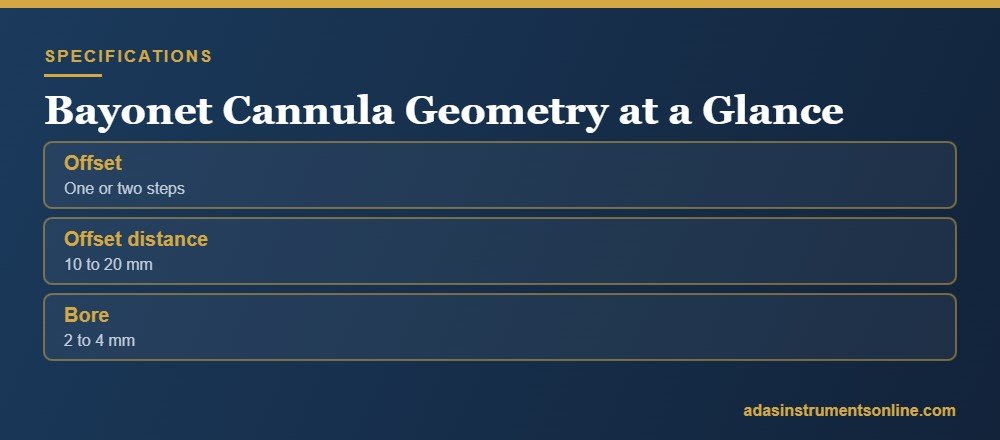
A bayonet cannula has a step in the shaft that moves the handle out of the line of sight and out of the way of the working hand. The tip does the same job as a straight cannula, the offset simply changes what the surgeon can see and reach.
| Feature | Typical value | What it gives | What to check |
|---|---|---|---|
| Offset | One or two steps | Handle clears the field | Steps are smooth, no stress marks |
| Offset distance | 10 to 20 mm | Line of sight past the hand | Enough clearance for your grip |
| Bore | 2 to 4 mm | Matches the area treated | Same bore family as your straight tips |
| Working length | 15 to 25 cm | Reach past the step | Measured from tip, not from hub |
| Shaft stiffness | Heavier wall at the bend | Resists flex at the step | No spring when loaded by hand |
| Tip pattern | Mercedes, spatula or single port | Job specific | Chosen the same way as a straight tip |
| Finish | Satin or matte | Low glare in lit fields | Even finish through the bend |
Common Mistakes With Offset Shafts
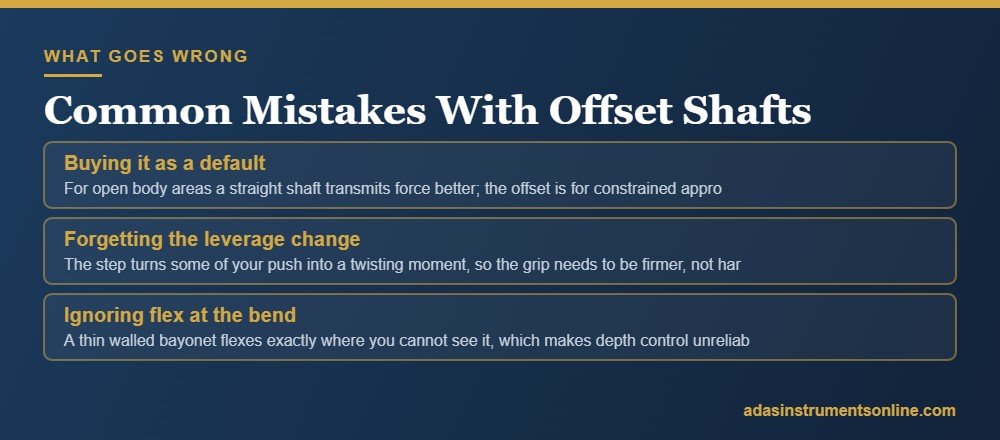
The offset solves a real problem and introduces two of its own. Five points cover both.
- Buying it as a default. For open body areas a straight shaft transmits force better; the offset is for constrained approaches.
- Forgetting the leverage change. The step turns some of your push into a twisting moment, so the grip needs to be firmer, not harder.
- Ignoring flex at the bend. A thin walled bayonet flexes exactly where you cannot see it, which makes depth control unreliable.
- Cleaning it like a straight shaft. Brushes skip the inside of the step; use a flexible brush and confirm flow after washing.
- Mixing hub standards. A bayonet bought outside your usual family will not fit the handle and tubing you already own.
Specifying a Bayonet Cannula That Suits Your Hand
Offset distance is personal, because it depends on grip and on where the assistant stands. Name the offset, the working length measured from the tip and the tip pattern, and the instrument can be built in high quality medical grade stainless steel with OEM or white label marking. Production time on custom work is 10 to 15 working days, normally 15 working days depending on order size.
Offset and bayonet geometry appear across surgical instrument design wherever a hand blocks a view, and the surgical literature indexed on PubMed is the usual starting point for reading how those approaches developed. On the buying side, keep the bayonet in the same hub family as the rest of your liposuction cannula set.
Where a Bayonet Cannula Earns Its Place on the Tray
Most trays hold one or two bayonet shafts rather than a full range, kept for approaches where the handle would otherwise sit in the surgeon line of sight. Everything else stays straight, drawn from the aspiration cannula range in the bores that area needs.
If your objection to a bayonet is comfort rather than geometry, the answer is often the handle rather than the shaft. A better grip from the fix handle range changes the feel of a straight cannula more than most surgeons expect, and it costs less than rebuilding the set.
Hand in your sightline? Bayonet infiltrators and fine patterns with swept bends.
Frequently Asked Questions
Where are bayonet cannulas most useful?
Facial and submental infiltration, chin and jawline finishing, and any shallow plane worked toward the surgeon, wherever a straight shaft puts the hand in the view.
Do bayonet bends weaken the cannula?
Well-made swept bends in fine bores hold up fine at the low forces these zones use; bayonets simply are not built or chosen for heavy debulking work.
What is a bayonet cannula?
A cannula with a stepped or offset shaft, so the handle sits out of the direct line between the surgeon eye and the tip. The offset is a visibility and access feature; the working tip functions exactly as a straight cannula does.
When is a bayonet shaft better than a straight one?
In constrained approaches where the hand or handle would block the view or collide with the patient, an assistant or a retractor. In open body areas a straight shaft is stiffer and transmits force more directly, so it stays the default.
Does the offset make the cannula weaker?
It can if the wall is thin. A well made bayonet uses a heavier wall through the step so the shaft does not flex where the surgeon cannot see it, which is one of the details worth confirming before ordering.
How do you clean a bayonet cannula properly?
Use a flexible brush that follows the step rather than a rigid one that stops at it, then confirm flow with fluid before sterilization. The inside of the bend is the place debris collects and the place a straight brush misses.
Adas Instruments machines the bayonet pattern at our Sialkot factory, in the diameters and working lengths shown on the bayonet infiltration cannula page. Tell us the offset distance you want and we build to it.
