
Embryotomy Instrument Set, 8 Pieces
$ 340.20
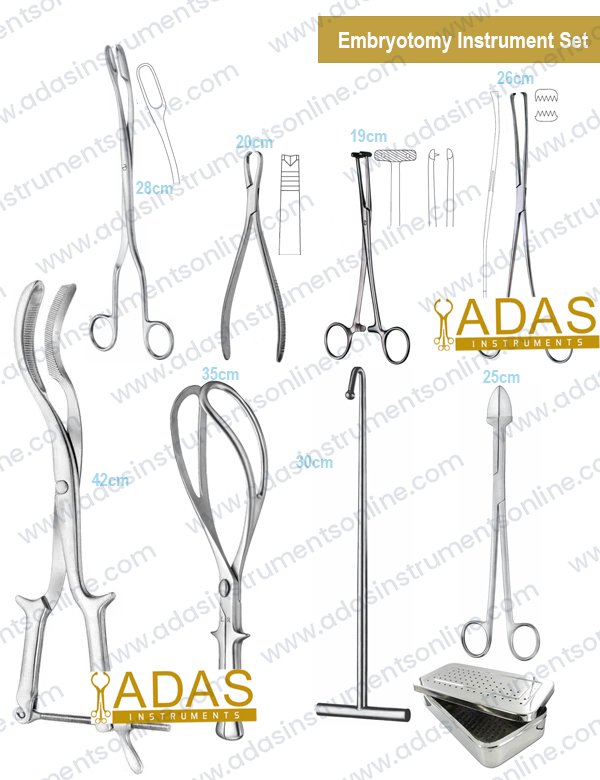
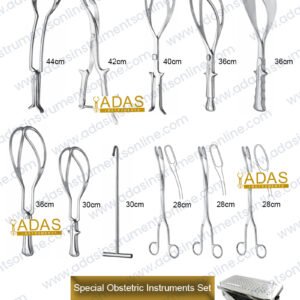
Our embryotomy instrument set is the eight piece obstetric tray for a delivery that cannot happen any other way: obstructed labor after the baby has died, where a cesarean is not possible or would put the mother at greater risk. It carries the Smellie and Naegele perforators, the 42 cm Braun cranioclast and the Braun hook, for hospitals and field programs that still need this human obstetric set.
Key Features
- 8 pieces across 8 patterns, in a stainless steel instrument box
- Smellie perforator 25 cm and Naegele perforator 25 cm
- Braun cranioclast 42 cm and Braun decapitating hook 30 cm
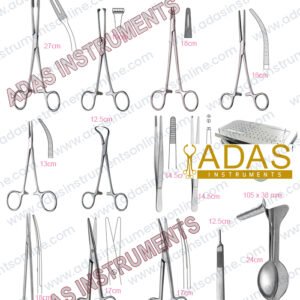
- Willet-Martel scalp flap forceps, 19 cm, upwards
- Iowa tenaculum forceps for the amnion 26 cm, bone holding forceps 20 cm, Winter ovum forceps 28 cm
- Made from high quality medical grade stainless steel, fully autoclavable
- Three year replacement warranty against manufacturing defects
- Item code AD-95611
Available on backorder

What an embryotomy instrument set is
An embryotomy instrument set is a group of heavy obstetric instruments used to reduce the size of a baby who has already died in the birth canal, so that the baby can be delivered vaginally when labor is obstructed. Google’s own summary describes it as a specialized kit for rare emergency scenarios, used to manage severe obstructed labor while minimizing trauma to the mother. That last part is the whole purpose. The operation is done for the mother’s safety.
It is rare where cesarean section is quick and safe. It is not rare everywhere. In regions where a woman may arrive after days of obstructed labor, with the baby already dead and the uterus infected or close to rupture, an embryotomy procedure can be the safer route than opening the abdomen. Obstetric teams in those hospitals, and the programs that equip them, are the people who order this tray.
One thing must be clear, because search results blur it. This is the human obstetric set. Much of what turns up for embryotomy online is veterinary: wire saws and knives for calves. None of that is here, and this embryotomy set is not suited to veterinary work.
Google lists a pair of Dubois scissors and sponge forceps in some versions of this tray. Ours carries neither. Sponge forceps will be on any labor ward already, and the scissors can be added when you order.
Why keep a complete tray for something so rare? Because the case does not wait. When a woman arrives with obstructed labor and a baby who has died, the team needs every instrument in one box, checked and sterile, not a search through the store room for a perforator nobody has seen in a year. With any rare tray, an incomplete set tends to be treated as no set at all, and the patient is referred onward, often over a long road. A complete embryotomy instrument set on the shelf keeps that decision in the hospital where the woman already is.
Key design features
Two perforators
The Smellie and the Naegele, both 25 cm. A perforator opens the skull of the dead baby so that the head can collapse and pass. The Smellie has scissor-like handles; the Naegele is the other classic pattern. Two are carried because obstetricians trained in different schools reach for different ones.
Braun cranioclast
42 cm, upwards, the heaviest instrument in the tray. Once the skull is opened, the cranioclast grips it firmly so that traction can be applied without the instrument slipping, which is what protects the mother’s tissues.
Braun decapitating hook
30 cm. It is used in a neglected transverse lie after fetal death, the situation in which no other vaginal delivery is possible. It is the instrument in this set that is used least, and it is carried for the case that needs nothing else.
Holding and retrieval forceps
The Willet-Martel scalp flap forceps, 19 cm, upwards, holds the scalp. The Iowa tenaculum forceps, 26 cm, recorded for the amnion, grips the membranes. A straight bone holding forceps, 20 cm, and a curved Winter ovum forceps, 28 cm, Fig.1, lift out fragments and retained tissue.
What is in the tray, piece by piece
Read off our own pattern record for item AD-95611. Eight pieces, eight patterns, the box counted separately.
| Instrument | Size or pattern | Qty |
|---|---|---|
| Smellie perforator | 25 cm, straight | 1 |
| Naegele perforator | 25 cm | 1 |
| Braun cranioclast | 42 cm, upwards | 1 |
| Braun decapitating hook | 30 cm | 1 |
| Willet-Martel scalp flap forceps | 19 cm, upwards | 1 |
| Iowa tenaculum forceps for amnion | 26 cm | 1 |
| Bone holding forceps | 20 cm, straight | 1 |
| Winter ovum forceps | 28 cm, curved, Fig.1 | 1 |
| Stainless steel instrument box | Holds the full set | 1 |
Where the set is used
Every use below is after fetal death has been confirmed, and only when a vaginal delivery is safer for the mother than surgery.
| Situation | What the set does | Pieces doing the work |
|---|---|---|
| Obstructed labor, cephalic, after fetal death | Reduces the head so it can pass | Perforator, cranioclast |
| Neglected transverse lie after fetal death | Allows a vaginal delivery | Braun decapitating hook |
| Hydrocephalus with obstructed labor | Decompresses the head | Perforator |
| After the delivery | Removes fragments and retained tissue | Bone holding forceps, Winter ovum forceps |
| District and field hospitals | Equips teams far from a theater for cesarean | The whole tray |
What it does, and what it must not be asked to do
The limits on this tray are absolute, and they are the first thing an obstetric team checks.
| Instrument | What it does | What it must not do |
|---|---|---|
| Perforators | Open the skull of a baby who has died | Be used before fetal death is confirmed. Never |
| Braun cranioclast | Holds the head firmly for traction | Be pulled hard without the cervix fully dilated |
| Braun decapitating hook | Allows delivery in a neglected transverse lie | Be used where a cesarean is safe and available |
| Bone holding and ovum forceps | Remove fragments after the delivery | Close on the vaginal or uterine wall |
| The set as a whole | Delivery for the mother when the baby has died | Serve veterinary work. It is the human obstetric set |
How it compares with the other obstetric sets
Our obstetric trays go from the everyday to the rare. This is the rarest.
| Set | Pieces | What it carries | Buy it when |
|---|---|---|---|
| Embryotomy, this page | 8 | Two perforators, cranioclast, Braun hook, holding forceps | The unit needs the full destructive set |
| Special obstetric instruments | 11 | Six obstetrical forceps, Braun hook and cranioclast | Assisted birth is the main need, with two destructive pieces held in reserve |
| Delivery | 5 | Two umbilical scissors, Kocher forceps, kidney bowl | Every normal birth |
| Uterine evacuation | 16 | Hegar dilators, blunt curettes, tenacula | Retained tissue needs clearing afterward |
Materials and finish
Every piece in this embryotomy instrument set is made from high quality medical grade stainless steel. The steel itself is made to a German specification. We do not publish a grade number. These instruments carry more force than anything else we make for gynecology, so the question that matters is whether the cranioclast jaws stay aligned under load for years. That comes from the forging and the fitting, not from a number on paper.
The cranioclast and the hook are forged heavier than the obstetrical forceps, because they are pulled on harder. The perforator points are left sharp, so they should be guarded in storage. Everything has a satin finish so nothing glares under a field lamp in a district hospital.
The box itself matters more than usual. This tray may sit unopened for a long time, so it is packed in a closed steel box rather than an open rack, and the contents table on this page makes a missing piece easy to spot at a glance.
Caring for it
Clean the set completely after every use, even if it may not be needed again for months. Tissue left in the cranioclast serrations is the thing that ruins this tray in storage. Open all joints for washing and the autoclave.
Cover the perforator points before the tray goes back on the shelf. Check the set over every six months, when nobody is in a hurry, because when this box is next opened nobody will have time to look for a missing piece.
Ordering and wholesale
Every piece of the embryotomy instrument set is made by Adas Instruments in our own workshop and sold direct, which is why the price sits where it does against the catalog houses. Order one for a single tray, or in quantity for a hospital list or a distributor line. We do OEM work under your own brand and your own item numbers. Send us a sample and we will hold a run to your pattern rather than ours. Stock items ship from our own workshop. Backorder items take 10 to 12 working days to make. Every instrument carries a three year replacement warranty against manufacturing defects. Production is controlled under an ISO 13485 quality management system.
Frequently asked questions
What does embryotomy mean?
In human obstetrics it means an operation that reduces the size of a baby who has died, so that the baby can be delivered through the birth canal when labor is obstructed. It is done to protect the mother.
When is an embryotomy procedure used?
After fetal death, in obstructed labor, when a cesarean section is not possible or would carry more risk for the mother. It is most common where women reach care late after a long labor.
Is this the veterinary embryotomy set?
No. Our embryotomy instrument set is the human obstetric set. Veterinary embryotomy uses wire saws and knives and is a different range.
Does the set include Dubois scissors?
No. Some versions of this tray carry Dubois scissors and sponge forceps. Ours does not, and either can be added to the order.
What instruments are used for fetotomy?
Fetotomy is another name for the same operation. In the human set: perforators, a cranioclast, a decapitating hook and holding forceps, which is what this tray carries.
Related products and categories
The special obstetric instruments set carries six obstetrical forceps plus the Braun hook and cranioclast. The delivery instrument set is the cord tray for every normal birth, and the uterine evacuation instrument set clears retained tissue.
All of our trays for this specialty sit under gynecology and obstetrics instrument sets, and the full range of procedure trays is under surgical instrument sets.
| Weight | 0.59 kg |
|---|
Be the first to review “Embryotomy Instrument Set, 8 Pieces”
Shipping & Delivery Policy
Processing Time: In-stock items are dispatched within 24-48 hours. For custom or out-of-stock items, production time is approximately 10-15 days.
Global Delivery Estimates
We partner with world-class couriers (DHL, FedEx) to ensure fast, tracked delivery.
- USA & Canada: 3-5 Business Days
- Europe & UK: 4-6 Business Days
- Rest of World: 5-7 Business Days
*We offer Air Cargo and Sea Freight options for bulk wholesale orders.
Customs & Duties
International buyers are responsible for any customs duties or taxes imposed by their country. Adas Instruments is not responsible for delays caused by customs clearance.
Lost Packages & Insurance
If your package is lost in transit, please contact us immediately. We offer full support and replacements for confirmed lost shipments. Note: You must report non-delivery within 3 weeks to be eligible for an insurance claim.

Reviews
There are no reviews yet.