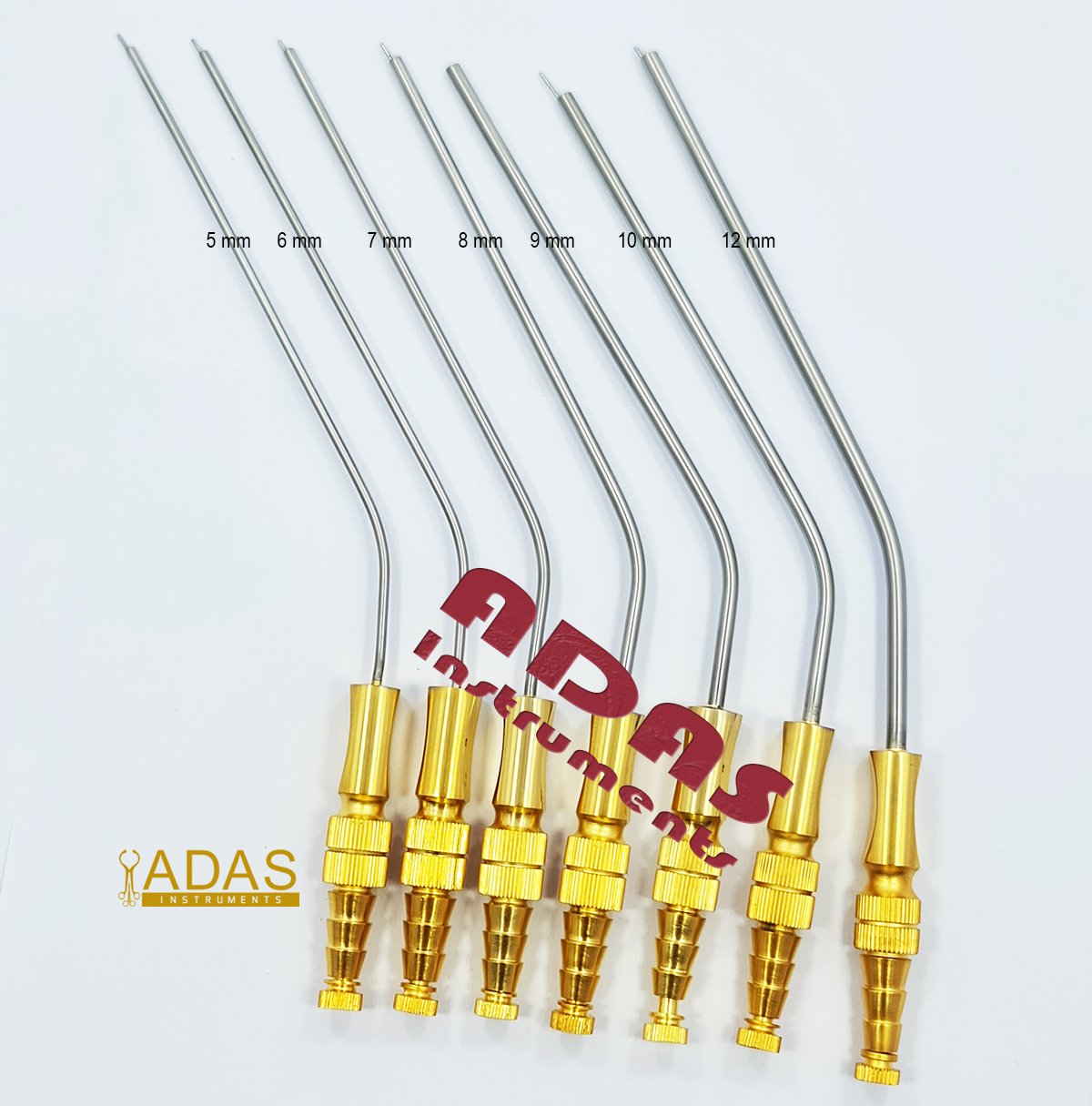
Frazier Suction Tube Set of 7 Pieces, 5 Fr to 12 Fr
$ 95.00
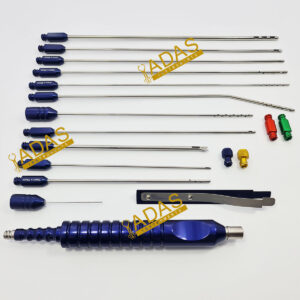
Frazier suction tube sets put a range of bores in one case, so a wider or a finer tip can be handed over without anyone leaving the field. Ours is seven angled steel tubes across 5 Fr to 12 Fr, each with the thumb hole cut off that sets the pull by being covered or uncovered, and each with its own wire stylet for clearing the bore. A set is how this pattern is usually bought for ENT, dental, neurosurgical and plastic surgery trays, because the bore you need depends on the operation rather than on the surgeon.
Key Features
- Seven angled tubes covering the French gauge range 5 Fr to 12 Fr
- Thumb hole cut off on every tube, for full pull or an instant vent
- A wire stylet with each tube, for clearing bone dust and clot
- French gauge sizing, so 12 Fr is about 4mm across and 5 Fr under 2mm
- One piece steel, no joint and no seal anywhere that can fail
- Satin finish, so no tube flashes endoscope light into the field
- Reusable, fully autoclavable, and every part replaceable singly
- Item code AB-500.55
1 in stock (can be backordered)

What a Frazier suction tube set is
A frazier suction tube set is a group of angled steel suction tubes in graded bores, each with a thumb hole in the handle and a wire stylet of its own. The pattern comes from Charles Frazier, a neurosurgeon who needed to take fluid out of a hole that was deep, narrow and lined with things he could not touch, and the whole design follows from that: a small bore, a bend so your hand is not in your own line of sight, and a hole instead of a valve.
Sets differ in two ways only, the number of pieces and the range of bores. Ours is seven tubes across 5 Fr to 12 Fr. Frazier sizes are counted in French gauge rather than in millimeters, which is the one thing that confuses buyers coming to this pattern new, and it is covered in the table below.
Key design features
The range, which is the reason to buy a set
A surgeon rarely needs one bore. The same operation can want a 7 Fr while the field is nearly dry and an 11 Fr twenty minutes later, and a tray with one tube on it means waiting. Buying the range at once also costs less than buying bores singly, which is why most hospital lists order this pattern as a set and keep singles as replacements.
The thumb hole on every tube
Each tube has a plain hole drilled through the flat of the handle, and that is the only control on it. Covered, the whole vacuum goes to the tip; thumb lifted, air comes in through the hole and the pull drops to almost nothing. No valve, no tap, nothing to strip down for cleaning and nothing to seize after two hundred cycles.
A stylet for each tube, not one for the set
A 2mm bore blocks, and it blocks at the worst moment. Every tube in this set comes with its own wire, because a shared stylet is the one that is always in the other tube. The wire goes in at the handle and pushes the plug out of the tip in a second.
One piece, with nothing to come apart
Handle, shaft and tip are one piece of steel on every tube: no brazed joint behind the tip, no threaded collar, no gasket. A suction instrument spends its working life full of blood and its cleaning life full of detergent, and a seam is somewhere for protein to sit where no brush reaches.
What is in the set, and how Frazier sizes are counted
The seven tubes sit inside this range. French gauge is three times the diameter in millimeters, so the numbers climb faster than the bore does.
| Size | Bore across the tip | What it suits |
|---|---|---|
| 5 Fr | about 1.7mm | Pediatric work, tightest ethmoid corners |
| 6 Fr | about 2.0mm | Fine septal work, a nearly dry field |
| 7 Fr | about 2.3mm | General nasal and ear surgery |
| 8 Fr | about 2.7mm | The most ordered single size |
| 9 Fr | about 3.0mm | Rhinoplasty and septal surgery |
| 10 Fr | about 3.3mm | Spinal corridors, oral quadrants |
| 11 Fr | about 3.7mm | Heavier bleeding, bone dust in suspension |
| 12 Fr | about 4.0mm | The largest, for volume not reach |
Where it is used
The set crosses specialties because the problem it solves is a shape problem rather than a tissue one: narrow and deep.
| Where the set is used | What it is doing there |
|---|---|
| ENT and sinus surgery | A field the width of a pencil, with an endoscope filling most of it |
| Rhinoplasty and septal work | Ooze from raised mucoperiosteal flaps, without snagging them |
| Neurosurgery and spine | A deep narrow corridor, the job Frazier designed the tube for |
| Oral and dental surgery | Clearing a quadrant without filling the mouth |
| Plastic and reconstructive surgery | Brow, eyelid and ear work a wider cannula cannot reach |
What the set handles, and what it is not for
A 2mm bore is the character of the instrument in both directions. It reaches where nothing wider reaches, and blocks on what a wider tube swallows.
| The set handles | The set is not for |
|---|---|
| Free blood and serous fluid | Volume suction in an open mouth, which wants a Yankauer |
| Irrigation and saline wash | Bone chips you intend to keep, which need a trap |
| Bone dust in suspension | Thick purulent matter, where a wider bore waits less |
| Smoke and plume from cautery | Gauze or suture ends, which block a 2mm lumen |
Buying the set against buying tubes singly
There are five sensible ways to stock this part of the tray, and the right one depends on how often the list runs.
| How you buy it | What you get | When it makes sense |
|---|---|---|
| This set of seven | The range 5 Fr to 12 Fr, a stylet with each tube | A new tray, a hospital list, or a distributor line |
| A single tube | One bore, one length, one stylet | Replacing a lost or bent tube, or stocking the one size you always use |
| An Adson suction tube | Slimmer and plainer, for a tight opening | A tight opening where a Frazier is more tube than it needs to be |
| A suction elevator | An elevator with suction built through it | When the job is lifting tissue as well as clearing it |
| A disposable set | Plastic tips, thrown away after one case | High turnover lists. Steel works out cheaper over a few hundred cases |
Materials and finish
Every frazier suction tube we make is cut from high quality medical grade stainless steel. The steel itself is made to a German specification. We do not publish a grade number, because the number on a certificate tells a surgeon nothing about whether a 2mm lumen still runs clear after two hundred autoclave cycles, and the answer to that is in the bore and the finish rather than in the alloy.
Every bore is finished from both ends, which is the part of making a suction tube that nobody sees and everybody feels. A burr at the tip pulls mucosa into itself; a ridge halfway down holds a clot no flushing shifts. The outside gets a satin finish rather than a mirror one, because a mirror shaft throws endoscope light back at the camera, and on a set of seven that would mean seven of them doing it.
Caring for it
Flush each tube while it is still wet. A syringe of warm water in at the handle and out at the tip does more for a suction tube than anything later in the day, and its stylet should go through once too. Dried blood in a 2mm lumen is why suction tubes get thrown away, and it is almost always avoidable.
Then ultrasonic cleaning with the stylets out, a neutral pH enzymatic detergent, a rinse in deionized water and full drying before the set is packed. Autoclave at 134 degrees Celsius. Do not leave tubes soaking in saline, which pits steel faster than blood does, and keep steel bristle brushes out of the bores: they score them and give the next clot a hold.
Ordering and wholesale
Every Frazier suction tube set we sell is made in our own workshop and sold direct, which is why the price sits where it does against the catalogue houses. Order one for a single set, or in quantity for a hospital list or a distributor line; we do OEM work under your own brand and your own item numbers, and we will hold a run to your pattern rather than ours if you send a sample. Stock items ship from our own workshop. Backorder items take 10 to 12 working days to make. Every instrument carries a three year replacement warranty against manufacturing defects. Production is controlled under an ISO 13485 quality management system.
Frequently asked questions
What is a Frazier suction tube set used for?
Clearing blood, irrigation fluid and debris out of fields too narrow or too deep for a wider sucker, with a choice of bore to hand. In practice that means ENT and sinus surgery, septal and rhinoplasty work, neurosurgical and spinal corridors, and oral surgery quadrants.
How are Frazier suction tubes sized?
In French gauge, written Fr, not in millimeters. The French number is three times the outside diameter in millimeters, so 12 Fr is about 4mm across, 9 Fr is 3mm and 5 Fr is under 2mm. That is the convention the whole trade uses and it is what our own size attribute carries, so an order for an 8mm Frazier almost always means 8 Fr. A tube 8mm across would be nearer a Yankauer than a Frazier.
What are the three types of suction?
Buyers usually mean the three ways suction is applied rather than three instruments: continuous, where the vacuum runs the whole time; intermittent, where it is let on and off; and vented or regulated, where a hole in the handle lets the operator bleed the pull away without touching the machine. A Frazier tube does the third, which is why it has the hole in the handle at all.
Which Frazier sizes does this set include?
Seven bores inside the range 5 Fr to 12 Fr. Our single tube is offered in eight sizes across that same range, so the set leaves out one of them. If your list needs a particular Fr number in the set, say which when you order and we will confirm it from the workshop rather than guess for you.
Are these suction tips reusable or disposable?
Reusable. These are one piece steel tubes meant for hundreds of autoclave cycles, and every part of the set can be replaced singly if one tube is bent or lost. Disposable plastic Frazier tips exist and suit very high turnover work, but over a few hundred cases steel works out cheaper and does not change feel between cases.
Related products and categories
If you only need one bore, the Frazier suction tube is sold singly in eight sizes and two lengths. For a tighter opening, the Adson suction tube is slimmer and plainer. Where tissue has to be lifted as well as cleared, the Daniel endoscopic suction scalp elevator does both in one pass. The whole family sits in suction instruments, and the tray sets are listed under plastic surgery instrument sets.
| Weight | 0.3 kg |
|---|
Shipping & Delivery Policy
Processing Time: In-stock items are dispatched within 24-48 hours. For custom or out-of-stock items, production time is approximately 10-15 days.
Global Delivery Estimates
We partner with world-class couriers (DHL, FedEx) to ensure fast, tracked delivery.
- USA & Canada: 3-5 Business Days
- Europe & UK: 4-6 Business Days
- Rest of World: 5-7 Business Days
*We offer Air Cargo and Sea Freight options for bulk wholesale orders.
Customs & Duties
International buyers are responsible for any customs duties or taxes imposed by their country. Adas Instruments is not responsible for delays caused by customs clearance.
Lost Packages & Insurance
If your package is lost in transit, please contact us immediately. We offer full support and replacements for confirmed lost shipments. Note: You must report non-delivery within 3 weeks to be eligible for an insurance claim.
Related products