

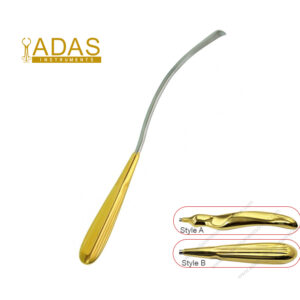
Daniel Endoscopic Suction Scalp Elevator, 8mm Blade, 23.5cm
$ 45.00
The Daniel endoscopic suction scalp elevator lifts the scalp off the skull and clears the blood from under it at the same time, through one instrument on one pass. Suction runs down the inside of the shaft and opens at the working end, so the plane you have just raised stays clear enough for an endoscope to see into without a second instrument crowding the port. That is why it belongs to endoscopic brow and forehead lift sets rather than to a general tray, and ours carries an 8mm blade on a 23.5cm shaft.
Key Features
- 8mm flat blade with rounded edges, to open a plane without tearing it
- Suction channel through the shaft, opening at the working end
- 23.5cm overall, long enough to reach the occiput through a small port
- Half curved shaft, so the blade follows the curve of the skull
- Hollow one piece shaft, with no joint for blood to sit in
- Satin finish, so it does not flash light back at the endoscope
- Reusable and fully autoclavable
- Item code ADE-04.26
1 in stock (can be backordered)

What a Daniel endoscopic suction scalp elevator is
A daniel endoscopic suction scalp elevator is a hollow steel elevator with a flat blade at one end and a suction channel running through it. It does two jobs at once, and that is the entire reason it exists. In an endoscopic brow or forehead lift there is one small incision, the endoscope occupies most of it, and the plane being opened bleeds steadily enough to hide itself within a minute. Elevating with one instrument and clearing with another means swapping them, and swapping them means working blind in between.
Our version has an 8mm blade on a 23.5cm half curved shaft, which is the size most brow and forehead sets are built around. The pattern is named for Rollin Daniel, whose work on endoscopic forehead surgery is where this shape of instrument came from.
Key design features
The blade, which is an elevator first
The working end is a flat 8mm blade with rounded edges, and it is shaped to find a plane rather than to cut one. Pushed along the skull under the scalp it separates the layers by spreading them apart, which is why the edges are rounded. An edge sharp enough to cut would make a hole in the flap the first time it met a ridge of bone.
The suction channel, which is what makes it a Daniel
The shaft is hollow and the channel opens at the working end, so the blood that follows the dissection is taken away as the dissection happens. In endoscopic work that is not a convenience. There is one small port, the endoscope is already in it, and every extra instrument you have to pass is time with a fogged view and a filling pocket.
The curve and the length
Ours is half curved over 23.5cm. The skull is not flat, so a straight shaft lifts the blade off the bone as it goes back, and the plane you want follows the bone. Half curved is the pattern most brow and forehead sets carry; straight, quarter curved and full curved all exist, and we will make the one your set already uses if you tell us which.
Hollow and one piece
The channel is formed in one piece with the shaft. There is no tube bonded into a groove and no collar behind the blade, which matters on a hollow instrument more than on a solid one: a seam inside a channel you cannot see is somewhere for protein to sit where no brush reaches, and nothing you do at the sink will shift it.
Which pattern to order
Five things vary across this pattern. The middle column is what we make and what the product name carries; the right hand column is what the pattern comes in elsewhere, so you can match a set you already own.
| What varies | What ours is | What else the pattern comes in |
|---|---|---|
| Blade width | 8mm | The pattern is made from about 7mm up to about 12mm |
| Overall length | 23.5cm | Commonly 23.5cm up to about 26cm |
| Shaft curve | Half curved | Straight, quarter curved, half curved and full curved |
| Finish | Satin | A non reflective finish is standard on endoscopic work |
| Marking | Our item code ADE-04.26 | OEM runs carry your own catalogue number |
Where it is used
This is a one operation instrument that has spread to the operations next to it, rather than a tray instrument that goes everywhere.
| Where it is used | What it is doing there |
|---|---|
| Endoscopic brow lift | Raising the forehead flap and keeping the pocket clear to see into |
| Endoscopic forehead lift | The same plane, taken further back towards the crown |
| Temporal dissection | Working out towards the temple where the plane changes depth |
| Subgaleal dissection | Separating the layer the whole operation depends on finding |
| Revision and secondary cases | A scarred plane, where seeing clearly matters most |
What it opens, and what it must leave alone
An elevator that spreads a plane is safe in that plane and dangerous outside it, which is the one thing to be clear about before buying one.
| What it is for | What it must leave alone |
|---|---|
| The subgaleal plane, opened by spreading | Nerve branches, which are found by seeing not feeling |
| Blood and ooze in the pocket just raised | Vessels that need a cautery, not a sucker |
| Loose fibrous bands in the plane | Dense scar, which is released under direct vision |
| Flap elevation over bone | Periosteum you intend to keep down |
Against doing it with two instruments
Everything this instrument does can be done with two others. What follows is what you give up by doing it that way.
| The alternative | What it gives you | What it costs you |
|---|---|---|
| This instrument | Elevation and suction in one hand, one pass | One more pattern on the set |
| A plain elevator plus a separate sucker | Two familiar instruments | Two instruments through one small port, and an assistant holding one |
| A septum suction elevator | The same idea, built for the nose | Too short and too fine for a scalp flap |
| A Frazier suction tube | Fine suction anywhere | It will clear the pocket but it will not lift anything |
| An Adson suction tube | Suction on a slim plain shaft | Tight openings only, and again no elevation |
Materials and finish
Every suction scalp elevator we make is cut from high quality medical grade stainless steel. The steel itself is made to a German specification. We do not publish a grade number, because the number on a certificate tells a surgeon nothing about whether a suction channel still runs clear after two hundred autoclave cycles, and the answer to that is in the bore and the finish rather than in the alloy.
The channel is the difficult part to make and the difficult part to clean, so it is bored and then finished through, not drilled and left. A ridge inside a channel you cannot inspect is where a clot stops, and a clot there stops the suction at the moment it is needed. The outside gets a satin finish rather than a mirror one, because an endoscope puts its own light on the instrument and a polished shaft hands that light straight back to the camera.
Caring for it
Flush the channel while it is still wet, with a syringe of warm water in at the suction port and out at the blade. On a hollow instrument this is not optional: nothing later in the cycle reaches the inside of a channel that already has dried blood in it, and a blocked channel on a brow lift set is an instrument that gets opened and then put back.
Then ultrasonic cleaning with a lumen adapter if your washer has one, a neutral pH enzymatic detergent, a rinse in deionized water and full drying before it is packed. Autoclave at 134 degrees Celsius. Do not leave it soaking in saline, which pits steel faster than blood does, and check the blade edge for nicks each time, because a nick on a rounded edge is what tears a flap.
Ordering and wholesale
Every suction scalp elevator we sell is made in our own workshop and sold direct, which is why the price sits where it does against the catalogue houses. Order one for a single set, or in quantity for a hospital list or a distributor line; we do OEM work under your own brand and your own item numbers, and we will hold a run to your pattern rather than ours if you send a sample. Stock items ship from our own workshop. Backorder items take 10 to 12 working days to make. Every instrument carries a three year replacement warranty against manufacturing defects. Production is controlled under an ISO 13485 quality management system.
Frequently asked questions
What is the Daniel endoscopic scalp elevator used for?
Raising the scalp off the skull in endoscopic brow and forehead lift surgery, while clearing the blood out of the pocket it has just raised. It is also used for temporal and subgaleal dissection and in revision cases where the plane is scarred. The point of it is that both jobs happen through one port on one pass.
Why is suction built into a scalp elevator?
Because the view is the whole operation. Endoscopic forehead work is done through a small incision with the camera already filling it, and the plane bleeds enough to hide itself quickly. Pulling the elevator out to pass a sucker, then pulling the sucker out to pass the elevator back, is time spent not seeing. Building the channel into the shaft removes that exchange entirely.
What plane does an endoscopic scalp elevator work in?
The subgaleal plane, between the galea and the periosteum, which separates by spreading rather than by cutting. That is why the blade is flat with rounded edges rather than sharp. Where the dissection goes down to bone the periosteal layer is taken as well, and over the temple the plane changes depth, which is where a half curved shaft earns its shape.
Is the blade straight or curved, and which should I order?
Ours is half curved, which is what most brow and forehead sets carry, because the skull curves and a straight shaft lifts the blade away from the bone as it travels back. Straight, quarter curved and full curved patterns all exist. The practical answer is to match whatever your set already has, and if you tell us which we will make that one.
Is it only used for brow lifts?
No, though that is where it started and still where most of them go. Any operation that raises a scalp or forehead flap through a small opening has the same problem, so the same instrument turns up in temporal lifts, in hairline and crown work, and in secondary cases. What it is not is a general tray instrument; outside endoscopic work a plain elevator and a separate sucker do the job for less.
Related products and categories
For the same idea built for the nose, the Gorney septum suction elevator puts a suction channel through a septal elevator. Where the job is only clearing fluid, the Frazier suction tube is the fine angled tube this family is built on, and the Frazier suction tube set of 7 covers its whole bore range in one case. The rest of the family sits in suction instruments, and the endoscopic patterns are listed under endoscopic forehead instruments.
| Weight | 0.1 kg |
|---|
Be the first to review “Daniel Endoscopic Suction Scalp Elevator, 8mm Blade, 23.5cm”
Shipping & Delivery Policy
Processing Time: In-stock items are dispatched within 24-48 hours. For custom or out-of-stock items, production time is approximately 10-15 days.
Global Delivery Estimates
We partner with world-class couriers (DHL, FedEx) to ensure fast, tracked delivery.
- USA & Canada: 3-5 Business Days
- Europe & UK: 4-6 Business Days
- Rest of World: 5-7 Business Days
*We offer Air Cargo and Sea Freight options for bulk wholesale orders.
Customs & Duties
International buyers are responsible for any customs duties or taxes imposed by their country. Adas Instruments is not responsible for delays caused by customs clearance.
Lost Packages & Insurance
If your package is lost in transit, please contact us immediately. We offer full support and replacements for confirmed lost shipments. Note: You must report non-delivery within 3 weeks to be eligible for an insurance claim.
Related products

Reviews
There are no reviews yet.