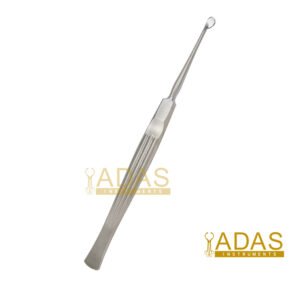
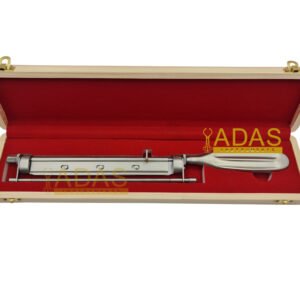
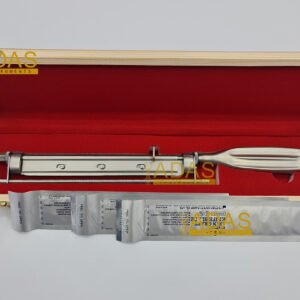
Humby Skin Graft Knife, Adjustable Roller, Split Thickness Grafts
Price range: $ 90.00 through $ 170.00
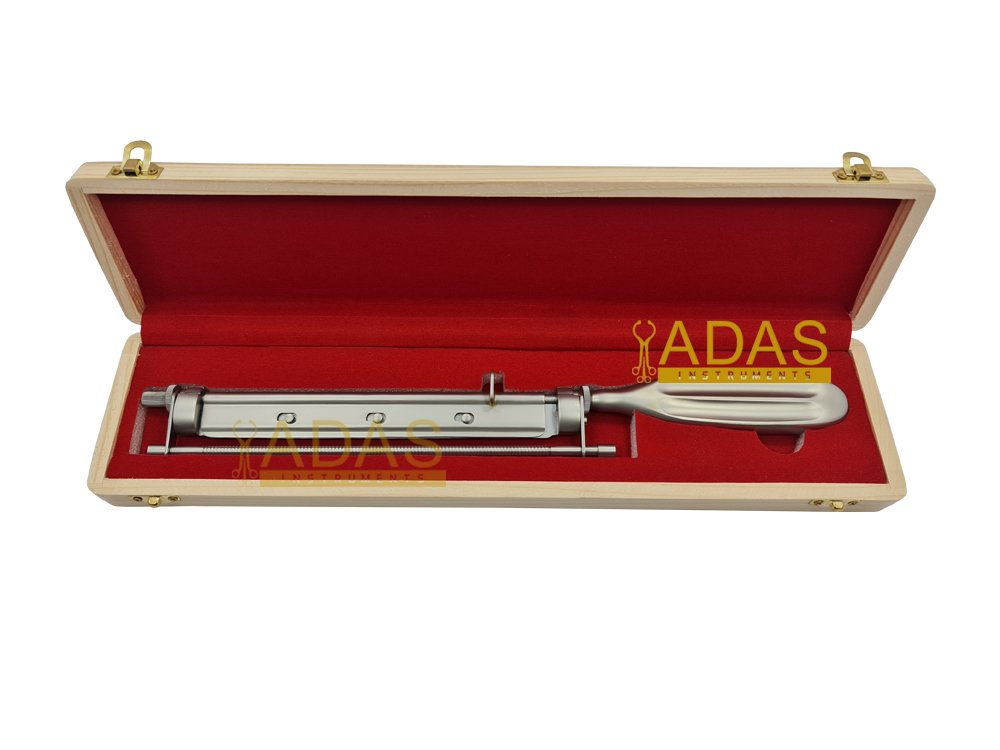
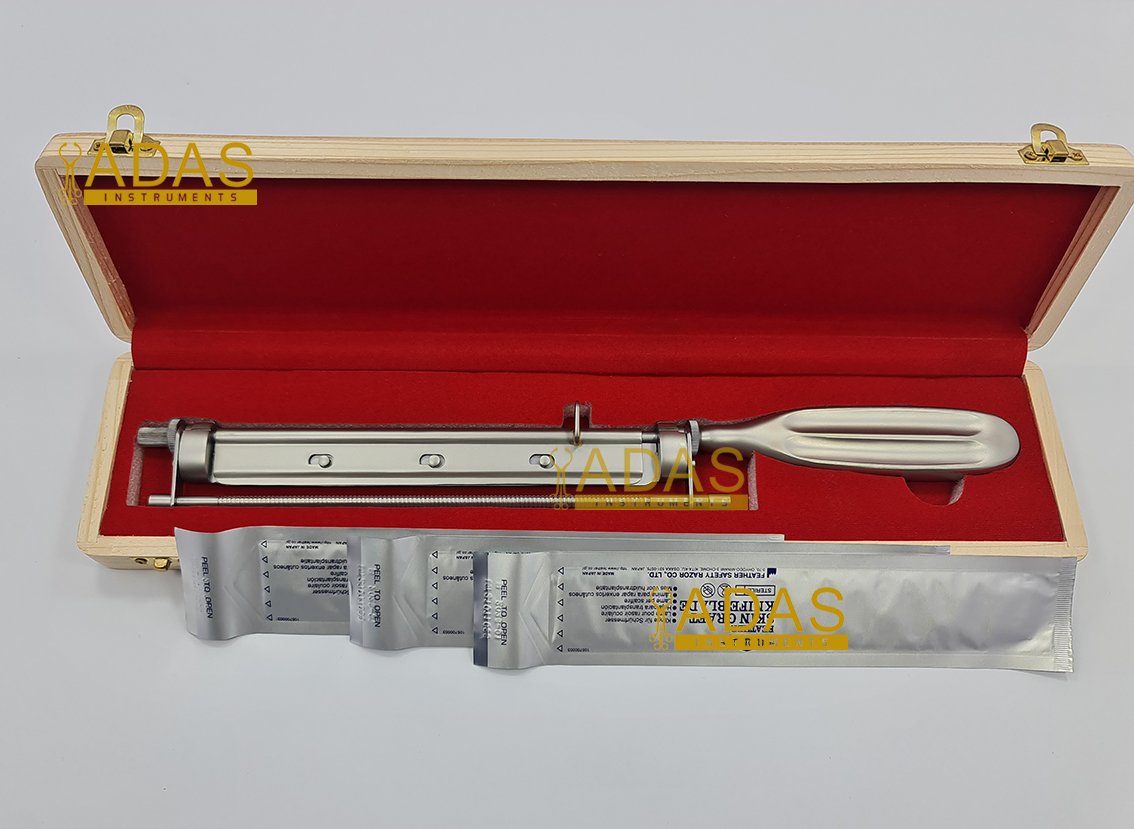
A Humby skin graft knife is a hand held knife that shaves a split thickness sheet of skin off a donor site, usually the thigh, to lay over a burn or an open wound. A roller bar runs parallel to the blade and a thumb screw at each end sets the gap between the two, and that gap is the thickness of the graft: it is the setting, not the surgeon’s hand, that decides how deep the cut runs. Catalogues also list it as the Humby dermatome, and it is still on burn and reconstructive trays because it needs no power, no cable and no suction, only a steady pull and a hand keeping the skin taut.
Key Features
- Adjustable roller bar, set with a thumb screw at each end of the frame
- The gap between blade and roller is what sets the graft thickness
- Takes replaceable single use blades, so the edge is new for every case
- Handle is fully reusable and autoclavable
- Order it bare, with 5 blades or with 10 blades
- Needs no power, no cable and no suction line
- Non glare satin finish on the frame
- Item code AA-50.01

What a Humby skin graft knife is
A Humby skin graft knife is a hand knife for taking split thickness skin grafts. The frame carries a long replaceable blade and, parallel to it, a roller bar whose distance from the edge is set by a thumb screw at each end. Skin passes under the bar, is lifted by the gap, and the blade takes a sheet of that thickness. Catalogues list it as the Humby knife, the Humby dermatome and the Humby skin grafting knife, and all three are the same instrument.
The honest summary of why it is still bought in 2026: a powered dermatome is faster and more consistent in a theater that has one, and a Humby works everywhere else. It has no motor to service, no cable, no air line and nothing to fail except the blade, which is thrown away after every case anyway.
Key design features
The roller bar is the instrument
Everything else on a Humby holds the roller bar in a fixed relationship to the blade. Turn the thumb screws and the bar moves closer to the edge or further from it, and skin passing under the bar is lifted by exactly that much before the blade reaches it. That is why a Humby gives an even sheet: the thickness is set in metal before the cut starts, not judged by feel halfway through.
Two screws, not one, and why that matters
There is a screw at each end of the frame. Both have to be set to the same mark or the gap is wider at one end than the other, and a graft taken on a skewed bar comes off thick on one side and thin on the other. It is the first thing to check when a sheet comes away uneven, before anyone blames the blade.
A new edge every time
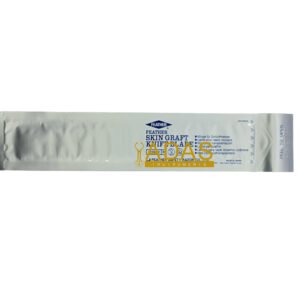
The blade is a separate, single use part. Nothing is resharpened, which on a graft knife matters more than on most instruments: a dull edge does not cut shallower, it drags, and drag is what tears a sheet instead of shaving it. Order the handle bare if you already stock blades, or with 5 or 10 to start.
No power, and that is a feature
A powered dermatome needs a supply and a handpiece that has to be serviced. A Humby needs a flat donor site, a hand to keep the skin taut and a steady pull. That is why it is still the instrument in field hospitals and in training.
What to tell us when you order one
This product carries one option on our site, which is how many blades come with it. Everything else worth saying before you order is here.
| What to tell us | Why it matters | If you do not know |
|---|---|---|
| Bare handle, or with blades | The handle is reusable; the blades are not | Handle with 10 blades is the usual starting order |
| How many handles | Burn lists often run two, so one is always clean and set | One to try, then a quantity once the fit is confirmed |
| Screw feel | Some units want the screws free, others want them stiff so a setting holds through a case | We ship them free and even |
| Humby or Watson | Both are on this site. The difference is the front bar and it is the whole decision | Read the comparison table below, then ask us |
| Your own item number | We mark an OEM run to your catalogue rather than ours | Leave it blank and the run carries our code |
Where it is used
It is chosen for what it does to SKIN, a thin even sheet lifted off a flat donor site, which is why the list runs from burns to debridement.
| Where it is used | What the knife is doing there |
|---|---|
| Burn surgery | Taking split thickness sheets to cover a deep or extensive burn |
| Trauma and tissue loss | Resurfacing an area lost to injury or infection |
| Chronic wound and ulcer cover | Grafting a clean bed that will not close on its own |
| Wound debridement | Shaving away dead tissue in thin, controlled passes |
| Reconstructive surgery | Harvesting a donor sheet for a planned repair |
| Teaching and field surgery | The pattern that works with no power supply |
What it is used on, and what it must not be used for
A graft knife is a shallow instrument. The second column is where people reach for it and should not.
| It is used on | It must not be used for |
|---|---|
| A flat, firm donor site such as thigh, buttock or upper arm | A full thickness graft, which is cut with a scalpel and closed, not shaved |
| Skin held taut by an assistant or a board | Loose, mobile skin that cannot be held flat |
| A single long pull in one direction | Sawing back and forth, which scallops the edge |
| A blade fitted and checked before the case | A blade that has already cut once |
| Thin, even passes for debridement | Cutting down to fascia, a different operation |
How it compares with the other graft knives
Four hand patterns and one powered class. We make two of them and the blades for both.
| Pattern | What is different about it | Do we make it |
|---|---|---|
| Humby | The original. The front roller bar rolls. This page | Yes |
| Watson | The Humby with the front bar FIXED instead of rolling, so the sheet cannot wrap around it | Yes, on this site |
| Braithwaite | A Humby modified around faster blade changing | No |
| Cobbett | A later hand knife, longer, for larger single sheets | No |
| Powered dermatome | Electric or air driven, needs a supply and servicing | No |
| Spare blades | Single use, and they fit both the Humby and the Watson | Yes |
Materials and finish
Every Humby knife we make is cut from high quality medical grade stainless steel. The steel itself is made to a German specification. We do not publish a grade number, because the number on a certificate tells a surgeon nothing about whether the blade still seats without rock after two hundred autoclave cycles, and the answer to that is in the making rather than in the alloy.
Two surfaces decide whether a Humby works: the blade seat and the roller. The seat must hold the blade without rock, because a blade that lifts even slightly takes a ragged sheet, and the roller must stay straight along its length or the gap is wrong at one end. Both are machined and then finished by hand. The frame is satin, not mirror, so nothing reflects back under theater lights.
Caring for it
Take the blade off first, and dispose of it as a sharp. Nothing else on the instrument needs to come apart. Back both thumb screws fully off so the roller sits at its widest, because a gap screwed shut traps tissue and blood against the blade seat and that is exactly the surface that must stay true.
Brush the seat, the roller and both screw threads, then ultrasonic in a neutral pH enzymatic detergent. Rinse in deionized water, dry fully, and autoclave at 134 degrees Celsius with the screws open. Lubricate the threads after drying, never before. Before the next case, set both screws to the same mark and sight down the roller against the seat. An uneven gap means the instrument needs attention, and we replace it inside the three years.
Ordering and wholesale
Every Humby skin graft knife we sell is made in our own workshop and sold direct, which is why the price sits where it does against the catalogue houses. Order one for a single tray, or in quantity for a hospital list or a distributor line. We do OEM work under your own brand and your own item numbers, and we will hold a run to your pattern rather than ours if you send us a sample. Stock items ship from our own workshop. Backorder items take 10 to 12 working days to make. Every instrument carries a three year replacement warranty against manufacturing defects. Production is controlled under an ISO 13485 quality management system.
Frequently asked questions
What is a Humby knife used for?
Taking split thickness skin grafts, and shaving dead tissue off a wound. In practice that means burn surgery, trauma, chronic wounds and reconstruction. The surgeon sets the gap between the blade and the roller bar, holds the donor skin taut, and draws the knife in one steady pass to lift a sheet of that thickness.
What are the differences between the Humby knife and the Watson knife for skin grafting?
The front bar. On a Humby it rolls; on a Watson it is fixed. A fixed bar stops the harvested sheet wrapping itself around the guard as the knife moves, which is the thing that goes wrong most often on a long pull. That is why the Watson is described everywhere as a modification of the Humby rather than as a different instrument. Everything else, the blade, the thumb screws, the job, is the same. We make both, and the spare blades fit either.
What is the name of the Humby knife blade used for skin grafting?
It is simply called a Humby knife blade, or a skin graft knife blade, and the same blade is sold for the Watson. It is a long, thin, single use blade rather than a numbered scalpel blade, so a number 10 or a number 15 from a scalpel tray does not fit. Ours is listed separately as a spare blade and comes as a single blade or a box of ten.
What is the price of a Humby knife?
Ours is 90 dollars for the handle, and the same instrument from the catalogue houses runs from about 1,575 dollars to just over 2,000. The difference is not the steel, it is that we make it in our own workshop and sell it direct instead of through two layers of distribution. Blades are priced separately so you only pay for what a case uses.
Is a Humby knife still used, or has the powered dermatome replaced it?
Both are in use. A powered dermatome is quicker where there is one, with a service contract behind it. The Humby needs none of that, so it stays on burn trays as the instrument that always works, and it is still what most surgeons learn on.
Related products and categories
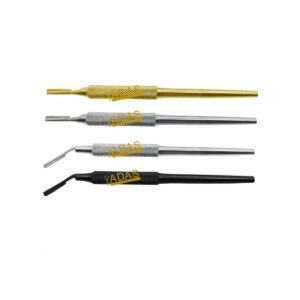
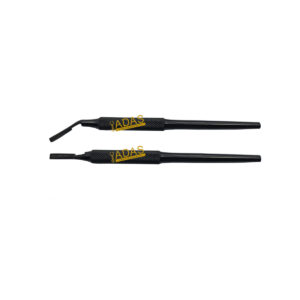
The Watson skin grafting knife is the same knife with the front bar fixed instead of rolling, and the spare blade for the Humby and the Watson fits both. If you are looking at a plain blade handle rather than a graft knife, the number 3 scalpel handle is the standard small pattern. Everything in this family sits in scalpel handles and skin grafting tools, and the wider reconstructive range is under breast surgery instruments.
| Weight | 0.2 kg |
|---|---|
| More Option | Handle With 10 Blades, Handle With 5 Blades, Only Skin Grafting Handle |
Shipping & Delivery Policy
Processing Time: In-stock items are dispatched within 24-48 hours. For custom or out-of-stock items, production time is approximately 10-15 days.
Global Delivery Estimates
We partner with world-class couriers (DHL, FedEx) to ensure fast, tracked delivery.
- USA & Canada: 3-5 Business Days
- Europe & UK: 4-6 Business Days
- Rest of World: 5-7 Business Days
*We offer Air Cargo and Sea Freight options for bulk wholesale orders.
Customs & Duties
International buyers are responsible for any customs duties or taxes imposed by their country. Adas Instruments is not responsible for delays caused by customs clearance.
Lost Packages & Insurance
If your package is lost in transit, please contact us immediately. We offer full support and replacements for confirmed lost shipments. Note: You must report non-delivery within 3 weeks to be eligible for an insurance claim.
Related products