
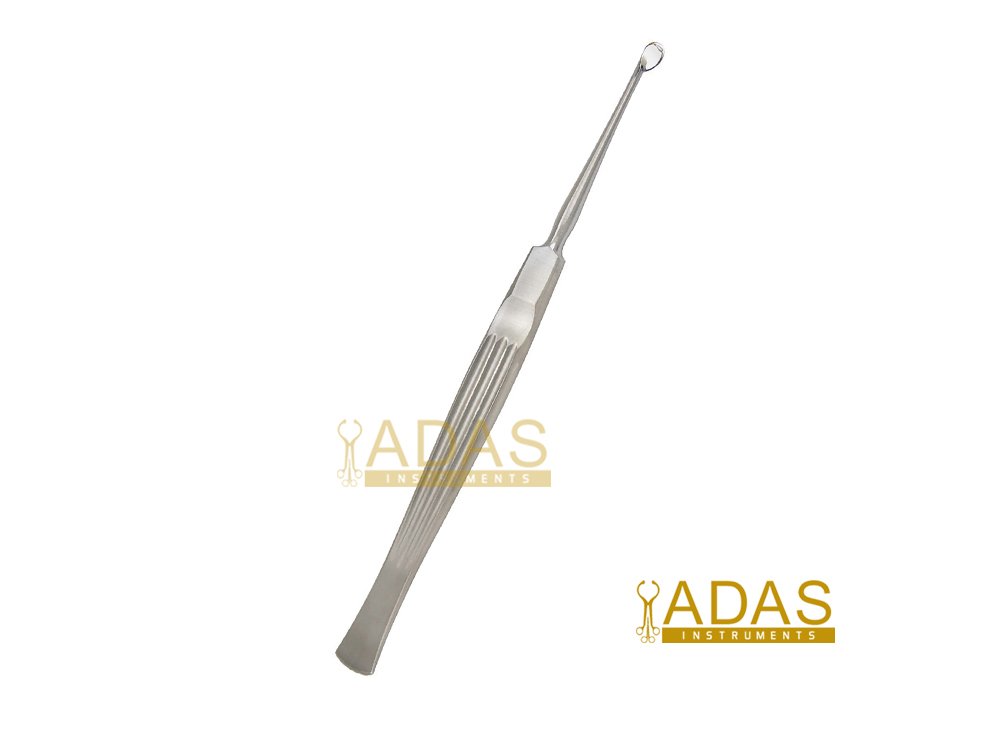
Freer D Knife, Nasal Mucosa and Septal Cartilage
$ 18.00
A Freer D knife is a fixed blade ENT knife with a small, flat, D shaped cutting edge, used to score and cut nasal mucosa and septal cartilage. The D profile is the whole point of it: a straight edge of known length with a blunt back, so a scoring cut goes exactly as deep as the surgeon intends and no deeper, which in a septum perforated by an over deep cut is the difference that matters. Catalogues list it as the Freer D knife, the Freer septum knife and the Freer mucosa knife.
Key Features
- D shaped flat cutting profile, for controlled scoring
- Fixed blade, not a handle that takes a disposable one
- Long slim straight shaft, to work down a narrow nasal field
- Flat grooved handle, for a steady hold in one plane
- Reusable, autoclavable and resharpenable
- One piece steel, nothing jointed and nothing to loosen
- Item code AA-80.05
Available on backorder

What a Freer D knife is
A Freer D knife is a fixed blade knife for nasal work, named for Otto Freer, with a small flat D shaped cutting edge at the end of a long slim shaft. It is used to cut nasal mucosa and to score septal cartilage, and it is also listed as the Freer septum knife and the Freer mucosa knife. Our own catalogue has carried it as a Ferre D knife, which is the same instrument under a misspelling we have now corrected.
What makes a D profile worth having is that it turns a judgement into a measurement. A pointed blade cuts as deep as you push it. A D shaped edge is a short straight edge with a blunt back, so it is laid on and drawn, and the depth of the cut is the depth of the edge. In septal scoring, where going through the far side is the thing you are trying not to do, that is the entire argument for the pattern.
Key design features
The D is the instrument
Most knives taper to a point, which means the depth of a cut depends on how far the point has gone in and that is judged by feel. A D profile does not taper: it presents a short straight edge with a blunt back, so the blade can be laid on the tissue and drawn, and the cut is the depth of the edge. For scoring cartilage so it will bend without breaking, that predictability is the whole requirement.
Scoring is not cutting through
Septal cartilage is scored on one side so that it relaxes and takes a new shape, and the skill is in going deep enough to release the spring without going through into the mucosa on the far side. A pointed blade makes that a judgement; a D shaped blade makes it a geometry. That is why this pattern is on septoplasty trays that also carry two other knives.
A long slim shaft
The blade sits at the end of a long straight shaft, because everything in the nose is reached through an opening the width of a nostril and the hand has to stay outside it. The shaft is slim so the line of sight to the blade is not blocked by the instrument carrying it, which is the same reasoning behind our number 7 scalpel handle.
A note about the name on this page
Our catalogue has listed this knife as a Ferre D knife, and the instrument is properly the FREER D knife, named for Otto Freer. We have corrected the name and kept the web address exactly as it was, so an old link still works. If your list says Ferre, it means this product, and we also make four other Freer instruments: the septum gouge, the septum chisel, the septum elevator and the Obwegeser Freer periosteal elevator.
What to tell us when you order one
This product carries NO attributes on our site, and the Freer name is on five of our instruments, so the first row matters most.
| What to tell us | Why it matters | If you do not know |
|---|---|---|
| Which Freer you mean | We make five Freer instruments and four of them are not knives | Send us the wording from your list |
| Overall length your list specifies | We hold no length attribute on this product | Tell us the operation and we will advise |
| Blade size | D profile blades are made in more than one width | Tell us the operation rather than a figure |
| How many | A septal tray often carries two so one is always clean | One to try, then a quantity once the fit is confirmed |
| Your own item number | We mark an OEM run to your catalogue rather than ours | Leave it blank and the run carries our code |
Where it is used
Every use is a controlled cut in a narrow field, and most of them are scoring rather than cutting through.
| Where it is used | What the knife is doing there |
|---|---|
| Septoplasty | Scoring septal cartilage so it relaxes into a new shape |
| Rhinoplasty | Cutting mucosa and scoring cartilage as part of a reshaping |
| Mucosal flap elevation | Opening the plane so an elevator can lift the flap |
| Mucosal graft harvesting | Freeing a graft cleanly without tearing it |
| Sinus surgery | Controlled cuts in the same narrow field |
| Revision nasal surgery | Scoring cartilage that has already been operated on |
What it is used on, and what it must not be used for
The second row of the second column is the one that matters: scoring exists so that you do not cut through.
| It is used on | It must not be used for |
|---|---|
| Nasal mucosa, cut rather than torn | Nasal bone, which needs an osteotome or a chisel |
| Septal cartilage, SCORED to a known depth | Cutting all the way through the septum, which is the fault scoring exists to avoid |
| The plane an elevator will then work in | Levering or prying, which a fixed blade is not |
| A mucosal graft being freed | Skin incisions, where a disposable blade is better |
How it compares with the rest of the Freer and nasal family
Six instruments get confused with this one and four of them are also called Freer. We make all six.
| Instrument | What it does differently | Do we make it |
|---|---|---|
| Freer D knife | D shaped flat profile, for scoring to a known depth. This page | Yes |
| Freer septum elevator | LIFTS the flap rather than cutting it | Yes |
| Freer septum chisel | Cuts CARTILAGE and bone, not mucosa | Yes |
| Freer septum gouge | A concave blade for scraping nasal bone | Yes |
| Cronin septum knife | A round knurled handle, so it rotates to follow a curve | Yes |
| Cottle nasal knife | A flat handle, used for soft tissue and cartilage shaping | Yes |
Materials and finish
Every Freer D knife we make is cut from high quality medical grade stainless steel. The steel itself is made to a German specification. We do not publish a grade number, because the number on a certificate tells a surgeon nothing about whether a straight edge and a square back stay true through two resharpens, and the answer to that is in the making rather than in the alloy.
On a D profile the two things that matter are the straightness of the edge and the squareness of the back. A back that is not square turns a scoring cut into a wedge, and an edge that is not straight scores unevenly along its length, which defeats the geometry the pattern exists for. Both faces are ground and then hardened so they survive resharpening. The handle is grooved and satin finished, because a lit nasal field reflects straight back at the surgeon.
Caring for it
Rinse the blade before anything dries on it. Blood on a fine straight edge pits it, and a pitted edge on a D profile is worse than on a pointed one because the whole length of it is the working surface. There are no moving parts and nothing comes apart.
Brush along the edge rather than across it, and brush the groove in the handle where a wash cycle leaves residue. Ultrasonic in a neutral pH enzymatic detergent, rinse in deionized water, dry fully and autoclave at 134 degrees Celsius. Store it so the edge touches nothing. Our three year replacement warranty covers manufacturing defects; resharpening a working edge is normal maintenance and not a fault.
Ordering and wholesale
Every Freer D knife we sell is made in our own workshop and sold direct, which is why the price sits where it does against the catalogue houses. Order one for a single tray, or in quantity for a hospital list or a distributor line. We do OEM work under your own brand and your own item numbers, and we will hold a run to your pattern rather than ours if you send us a sample. Stock items ship from our own workshop. Backorder items take 10 to 12 working days to make. Every instrument carries a three year replacement warranty against manufacturing defects. Production is controlled under an ISO 13485 quality management system.
Frequently asked questions
What is a freer in surgery?
Freer is a surgeon’s name, Otto Freer, and it is attached to a family of nasal instruments rather than to one tool. There is a Freer elevator, which lifts the mucosal flap off the septum and is the most familiar of them, a Freer chisel and a Freer gouge for cartilage and bone, and this Freer D knife for cutting mucosa and scoring cartilage. We make all five. If a list just says Freer, it usually means the elevator.
What type of knife is used in surgery?
Two kinds. Most surgery uses a handle with a disposable blade, which is the scalpel. The second kind is the fixed blade knife, where the edge is part of the instrument and is resharpened rather than replaced, and the named nasal knives are all of that kind, this one included. Fixed blades are used where a loose part in a narrow field would be a hazard.
What instruments are used in septoplasty?
A speculum to hold the nostril open, a knife for the incision and for scoring cartilage, an elevator to lift the mucoperichondrial flap, forceps or a crusher to handle and shape the cartilage, scissors, and a chisel or osteotome where bone is involved. This knife is a scoring instrument within that set. We make the knives, the elevators, the chisels, the speculums and the osteotomes.
Is a Freer D knife the same as a Freer elevator?
No, and it is the most common mix up in this family. The D knife CUTS: it has a sharp D shaped edge for scoring cartilage and cutting mucosa. The elevator LIFTS: it is blunt, and it separates the mucoperichondrial flap from the cartilage without cutting it. They are used in sequence in the same operation and they are separate products on this site.
Is this the knife my catalogue calls a Ferre D knife?
Yes. Our own catalogue carried it as a Ferre D knife and the instrument is properly the Freer D knife, after Otto Freer. We have corrected the name and left the web address unchanged, so an old link or bookmark still reaches this page. Nothing about the instrument has changed, only the spelling of the surgeon it is named for.
Related products and categories
The Cronin septum knife rotates in the fingers instead of holding one plane, and the Cottle nasal knife is the flat handled pattern for soft tissue and cartilage shaping. If you want a handle that takes a disposable blade rather than a fixed edge, the round number 3 scalpel handle is the one used for angled work. Everything here is listed in scalpel handles and skin grafting tools, and the nasal range sits under rhinoplasty instruments.
| Weight | 0.05 kg |
|---|
Be the first to review “Freer D Knife, Nasal Mucosa and Septal Cartilage”
Shipping & Delivery Policy
Processing Time: In-stock items are dispatched within 24-48 hours. For custom or out-of-stock items, production time is approximately 10-15 days.
Global Delivery Estimates
We partner with world-class couriers (DHL, FedEx) to ensure fast, tracked delivery.
- USA & Canada: 3-5 Business Days
- Europe & UK: 4-6 Business Days
- Rest of World: 5-7 Business Days
*We offer Air Cargo and Sea Freight options for bulk wholesale orders.
Customs & Duties
International buyers are responsible for any customs duties or taxes imposed by their country. Adas Instruments is not responsible for delays caused by customs clearance.
Lost Packages & Insurance
If your package is lost in transit, please contact us immediately. We offer full support and replacements for confirmed lost shipments. Note: You must report non-delivery within 3 weeks to be eligible for an insurance claim.
Related products
Reviews
There are no reviews yet.