
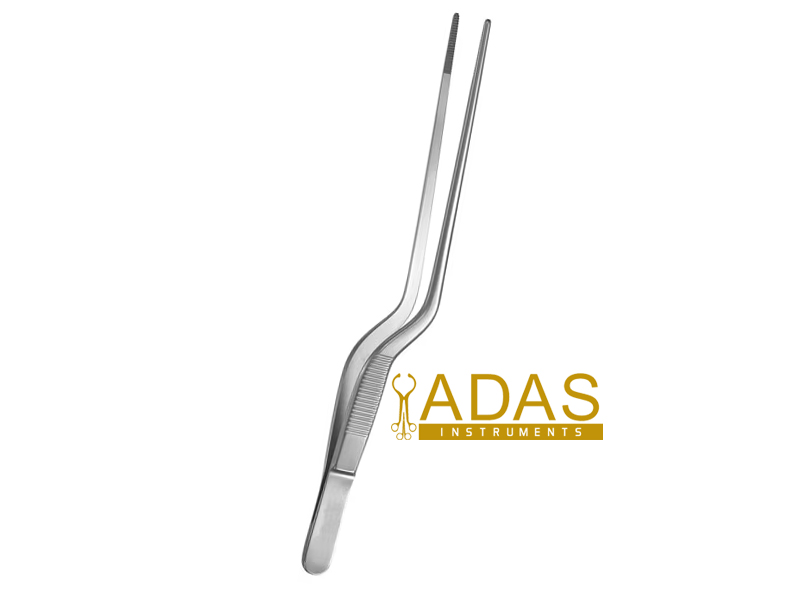
Jansen Ear Dressing Forceps | Bayonet Pattern, 1 x 2 Teeth or Serrated
$ 8.00
Jansen ear dressing forceps are the bayonet pattern: the handles are stepped sideways so they run parallel to the jaws but off to one side, which puts your hand out of the line of sight down a canal or a nostril. Cross serrated tips, or 1 x 2 teeth if you want the surer grip. The work is packing and unpacking: medicated gauze in an ear, a pack in a nose for a nosebleed.
Key Features
- Bayonet shape, with the handles stepped off the axis of the jaws
- Tip choice: 1 x 2 teeth, or cross serrated
- Fine jaws that go down a canal that already has something in it
- Used for ear packs and for nasal packing in epistaxis
- No lock and no cutting edge anywhere on it
- Cut from high quality medical grade stainless steel and fully autoclavable
- Three year replacement warranty against manufacturing defects
- Item code ADE-160.16

What a Jansen ear dressing forceps is
Two dressing forceps in this family solve the same sentence, and it is the sentence that shapes half of this category: the bend puts the hand below the line of sight, so the surgeon looks down the instrument at the tissue instead of past their own knuckles. The Troeltsch solves it with a sharp bend between the handles and the jaws. The Jansen solves it with a bayonet, which is a sideways step rather than a bend, and the gain is the same.
In practice the bayonet feels different rather than better. It keeps the handle on the same axis as the jaws, so what your fingers do and what the tips do stay lined up; an angled pattern trades some of that for a hand further out of the way. People who have worked with one rarely want the other.
What it is for is packing and unpacking. In an ear, placing and taking out medicated gauze and wicks, and pulling a foreign body from the external canal. In a nose, packing the cavity to stop a nosebleed or post operative bleeding, which Google’s own answer names in those words. A dressing forceps for nose and ear is not a compromise: it is one shape that suits two short dark tubes.
The tips are the choice we offer and the one that matters: 1 x 2 teeth, two against one and interlocking, or cross serrations with no teeth at all. Teeth for a pack you cannot afford to drop. Serrations for gauze, and for a canal that is already sore.
What we do not publish is a length. Our record for this product carries the tip choice and nothing else. Rival listings run 160 to 190 mm with jaws of 1.8 to 2.2 mm, and those are their instruments. Ask us and we will measure ours rather than print a borrowed number.
Key design features
The bayonet step
Two sideways offsets, so the handles finish beside the axis of the jaws instead of on it. Catalogs file the shape as a bayonet dressing forceps. Your knuckles sit out of the corridor and the tips still point where your fingers do, which is the argument for a bayonet over an angle: nothing has to be relearned.
Teeth or serrations
1 x 2 teeth: two against one, interlocking, and they will not let go of a wick halfway out of a canal. Cross serrated: a grip along the whole inner face that holds gauze without pulling threads from the weave, and the kinder tip near inflamed skin.
Fine jaws, no lock
Narrow enough to go down a canal that already has a pack in it, and nothing holds them closed for you. A ratchet here would mean something staying gripped while your eye is elsewhere, and in a canal that is how a pack gets torn rather than moved.
It works in a nose as well as an ear
The name says ear and the catalogs file it under otology, but the shape is as useful in a nostril, and nasal packing for epistaxis is one of the jobs it is bought for. Hence its place in this category as well as the ear one.
Which one to order
One choice, and it is ours. The lengths in the last row belong to other makers.
| Choice | Options | How to pick |
|---|---|---|
| Tip | 1 x 2 teeth | Packs, wicks and foreign bodies. The surer grip |
| Tip | Cross serrated | Gauze and sore skin. The gentler grip |
| Both | One of each | What a list doing ears and noses usually settles on |
| Shape | Bayonet only | For the angled pattern, order the Troeltsch instead |
| Length and jaw width | NOT published by us | Our record carries the tip choice and no dimension. Rival listings run 160 to 190 mm with 1.8 to 2.2 mm jaws. Ask us and we will measure ours |
Where it is used
Dressing forceps uses divide neatly in two: things going into a cavity and things coming out of one.
| Procedure | What the forceps does | Tip |
|---|---|---|
| Ear packing | Places medicated gauze or a wick in the canal | 1 x 2 teeth |
| Removing an ear pack | Takes it out whole instead of in pieces | 1 x 2 teeth |
| Nasal packing for epistaxis | Places a pack to control a nosebleed | 1 x 2 teeth |
| Post operative nasal packing | The same, after surgery in the nose | Either |
| Foreign body in the ear canal | Grips something small and smooth at depth | 1 x 2 teeth |
| Dressing an inflamed canal | Holds cotton against skin that is already sore | Serrated |
What it holds, and what it must not do
The limits are the same on every dressing forceps, and they are worth printing rather than assuming.
| The task | What this forceps does | What it must not do |
|---|---|---|
| Gauze, packs and wicks | Holds them at depth and releases on command | It must NOT be used to drag a pack that has dried in place. Soften it first: a dry pack tears, and the remnants are a second procedure |
| Living tissue | It will hold it, and it should not | This is a dressing forceps. The jaws are not shaped to hold mucosa without marking it, and the canal it marks is usually already sore |
| A polyp or a specimen | Nothing useful | A growth needs a polypus forceps or a snare, and a specimen needs a cup tip. A dressing jaw either slips or flattens |
| Needles and wire | It will, and every pass blunts the serrations | Use a needle holder. A dressing tip used on steel stops holding gauze, and it fails silently |
How it compares with the other dressing and grasping patterns
Row one against row two is the only real decision, and it is a decision about your own hand.
| Instrument | How it clears the view | Tips | Buy it when |
|---|---|---|---|
| Jansen, this page | Bayonet, stepped sideways | 1 x 2 teeth or cross serrated | You want the handles on the same axis as the tips |
| Troeltsch | A sharp bend between handle and jaws | 1 x 2 teeth or serrated | You want the hand further out of the way, or you need a 14 cm reach |
| Fraenkel laryngeal forceps | A curve shaped to the airway | Oval cup | You are taking a specimen rather than placing a dressing |
| Hartmann speculum | It is not in the way, it opens the nostril | Cone blades | You need the nose open before any of the above |
Materials and finish
Every Jansen ear dressing forceps we make is cut from high quality medical grade stainless steel. The steel itself is made to a German specification. We do not publish a grade number. A certificate says nothing about whether two fine serrated faces still meet along their whole length after a year in an autoclave, because a dressing forceps that grips only at the tip drops a wick halfway out of a canal. The answer to that is in the making rather than in the alloy.
Both offsets are formed and then stress relieved. A bayonet carries its load as a twist across two bends rather than one, so a shaft that was bent cold and never relieved goes out of line at whichever bend was worked hardest, and the tips stop meeting squarely.
The jaws are ground as a matched pair before the serrations are cut, so the faces already meet when the grip goes on them. On the toothed version the teeth are dressed by hand to interlock without standing proud. A tooth that sits high turns a whole jaw into one point of contact, which is what a dressing slides off.
Caring for it
Clean it open and dry it open. On a bayonet the water sits in the two steps, and both of them are on the side you cannot see with the handles closed.
Brush the serrations along their length and flush. Autoclave with the tray. Hold the jaws closed against a light every so often: the faces should meet from tip to heel with no daylight between them. Daylight means one of the steps has moved, and that is a warranty conversation rather than something to work around.
Ordering and wholesale
Every Jansen ear dressing forceps is made by Adas Instruments in our own workshop and sold direct, which is why the price sits where it does against the catalog houses. Order one for a single tray, or in quantity for a hospital list or a distributor line. We do OEM work under your own brand and your own item numbers. Send us a sample and we will hold a run to your pattern rather than ours. Stock items ship from our own workshop. Backorder items take 10 to 12 working days to make. Every instrument carries a three year replacement warranty against manufacturing defects. Production is controlled under an ISO 13485 quality management system.
Frequently asked questions
What are Jansen ear dressing forceps used for?
Placing and removing medicated gauze, wicks and packs in an ear canal, pulling a foreign body out of the canal, and packing a nose to control a nosebleed or post operative bleeding. The bayonet step keeps your hand clear of the view at depth.
What does bayonet mean on a dressing forceps?
The handles are stepped sideways and then run parallel to the jaws, so they sit beside the axis of the instrument rather than on it. Your hand is out of the view but your fingers and the tips still point the same way, which is the difference between a bayonet and an angled pattern.
Can it be used in the nose?
Yes. Google’s own answer for this pattern names packing the nasal cavity to control epistaxis as one of its uses, and that is why we list it in the nasal category as well as the ear one. The jobs are the same: something goes in, or something comes out, down a short narrow passage.
Teeth or serrated?
1 x 2 teeth for packs, wicks and foreign bodies, because the tip will not let go of them. Cross serrated for gauze and for a canal that is already inflamed, because the grip is spread along the face instead of concentrated on two teeth. A list doing both ears and noses usually buys one of each.
What length is it?
We do not publish one. Our own record for this product carries the tip choice and no dimension at all, and we will not copy a figure off a rival listing. Ask us, and we will measure the instrument and give you the real number for your tray paperwork.
Related products and categories
The angled pattern doing the same job is the Troeltsch ear dressing forceps, which also comes in two lengths. For taking a specimen rather than placing a dressing, the Fraenkel laryngeal polypus forceps, and to open the nostril first, the Hartmann nasal speculum.
This pattern also sits with the ear instruments, and the rest of the nasal family is under nasal speculum and polypus instruments.
| Weight | 0.04 kg |
|---|---|
| Tip options | 1 X 2 tooth, serrated |
Be the first to review “Jansen Ear Dressing Forceps | Bayonet Pattern, 1 x 2 Teeth or Serrated”
Shipping & Delivery Policy
Processing Time: In-stock items are dispatched within 24-48 hours. For custom or out-of-stock items, production time is approximately 10-15 days.
Global Delivery Estimates
We partner with world-class couriers (DHL, FedEx) to ensure fast, tracked delivery.
- USA & Canada: 3-5 Business Days
- Europe & UK: 4-6 Business Days
- Rest of World: 5-7 Business Days
*We offer Air Cargo and Sea Freight options for bulk wholesale orders.
Customs & Duties
International buyers are responsible for any customs duties or taxes imposed by their country. Adas Instruments is not responsible for delays caused by customs clearance.
Lost Packages & Insurance
If your package is lost in transit, please contact us immediately. We offer full support and replacements for confirmed lost shipments. Note: You must report non-delivery within 3 weeks to be eligible for an insurance claim.
Related products
Reviews
There are no reviews yet.