

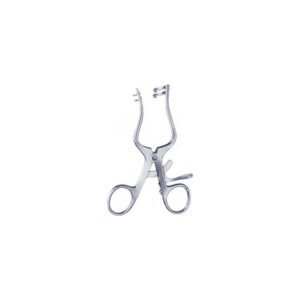
Fraenkel Laryngeal Polypus Forceps | 18 cm, Oval Cup Tip
$ 90.00
Fraenkel laryngeal polypus forceps are 18 cm forceps with an oval cup tip, made for taking polyps, mucosal growths and vocal cord lesions out of a larynx. The shaft is curved rather than straight, because the route to a larynx is a curve and a straight instrument cannot see round it. The cup takes a specimen whole, which is what a laboratory wants.
Key Features
- Oval cup tip, which lifts a specimen out whole rather than crushing it
- Curved shaft shaped to the airway, not to the bench
- 18 cm, the one working length we make on this pattern
- Non locking handle, so the grip is released as fast as it is taken
- Used for laryngeal polyps, mucosal growths and vocal cord lesions
- Cut from high quality medical grade stainless steel and fully autoclavable
- Three year replacement warranty against manufacturing defects
- Item code ADT-138.18
Available on backorder

What a Fraenkel laryngeal polypus forceps is
This is the only laryngeal forceps we make, and it sits among nasal instruments for one reason: a polypus forceps is defined by what it does to a growth rather than by which cavity the growth is in.
What it does is take hold of something and bring it out intact. The tip is an oval cup, sometimes called spoon shaped, and a cup is a different idea from a jaw. A jaw squeezes tissue between two faces; a cup encloses it, so the specimen reaches the laboratory looking like what was removed. That is the whole argument for a laryngeal biopsy forceps over anything that crushes.
The shaft is curved, and the curve is the other half of the design: the bend puts the hand below the line of sight, so the surgeon looks down the instrument at the tissue instead of past their own knuckles. The route into a larynx bends twice before it arrives, so the instrument has to bend as well. Google’s own answer describes a sickle curve, a 110 degree angled shaft and a downward curved geometry across the variants it found, all for the same reason: navigating the upper airway.
Our record is thin on this one and it is worth saying so. It carries no attribute set at all, so the only numbers we publish are the 18 cm in its own name and the item code. Aesculap and Sklar quote 265 mm overall, 170 mm working and a 12 mm cup on their versions. Ask us for a length and you will get ours measured rather than borrowed.
One correction worth making in public. This product’s old title carried two phrases, an apex hold specimen anchor and a clear path oropharyngeal shield. Neither appears in any rival listing or clinical source we can find. They are not trade vocabulary and not features of this instrument, so they are gone.
Key design features
An oval cup, not a flat jaw
The tip encloses rather than squeezes. On a polyp going for histology that is the difference between a sample and a smear, and on a vocal cord lesion it is the difference between taking the lesion and taking the cord with it.
A shaft curved to the airway
A larynx sits round a corner from the mouth. A straight forceps long enough to reach it would come in along the line of your own view, which is the one place it cannot be. The curve moves the handle out of that line and leaves the tip where it needs to be.
No lock
Nothing holds the cup closed for you. On an airway instrument that is right: you take hold, you feel what you have, you let go if it is wrong, and nothing stays clamped on a cord while you are looking elsewhere.
One length, 18 cm
We make this pattern in one working length and we would rather say so than imply a range we do not stock. 18 cm reaches a larynx through a mouth without becoming unwieldy, and it is in the product name because it is the only dimension on our record.
What to order, and what we do not publish
The shortest size table in this category, and the most honest one, because 8627 carries no attribute set on our record at all.
| What | Ours | Note |
|---|---|---|
| Working length | 18 cm, in the product name | The one length we make on this pattern |
| Tip | Oval cup | Takes a specimen whole rather than crushing it |
| Shaft | Curved for the upper airway | Not available straight |
| Overall length and cup width | NOT published by us | No attributes on our record. Rival listings quote 265 mm overall and a 12 mm cup. Ask us and we will measure ours |
| Item code | ADT-138.18 | The last word on which instrument you are ordering |
Where it is used
Laryngeal forceps uses make a short list, and every one of them is upper airway.
| Procedure | What the forceps does | Why the cup matters |
|---|---|---|
| Laryngeal polypectomy | Takes a polyp off the cord or the mucosa | The polyp arrives whole and the cord is not squeezed |
| Vocal cord lesions | Lifts and removes a lesion on the cord | A cup holds without flattening, which a cord will not forgive |
| Laryngeal biopsy | Takes a sample for histology | A crushed sample can be unreadable, and a second visit is the cost |
| Mucosal growths | Removes granulation and small masses in the airway | Encloses tissue that is too soft to grip between flat faces |
| Foreign body in the upper airway | Reaches and holds it | The curve gets round the corner a straight instrument cannot |
What it holds, and what it must not do
Everything here follows from the tip being a cup and the patient having an airway.
| The task | What this forceps does | What it must not do |
|---|---|---|
| A laryngeal polyp | Encloses it in the cup and lifts it out | It must NOT be used to tear a base that will not give. If the lesion is held and will not come, change the plan and not the force |
| A specimen for histology | Takes it intact, which is the point of the pattern | Do not crush a sample to get a surer grip. A cup grips by enclosing and an over gripped biopsy reads badly |
| Cartilage or bone | Nothing. A cup tip is not a cutting tip | This is not a biting forceps. Do not use it on anything that needs cutting |
| A nose | It will reach, but the curve is wrong for a nostril | For nasal polyps use the Hartmann polypus forceps or a snare. A laryngeal curve fights a nostril the whole way in |
How it compares with the other grasping instruments
All four of these are on this page of the catalog for the same reason: they all take hold of something down a corridor.
| Instrument | Tip | Where it works | Buy it when |
|---|---|---|---|
| Fraenkel laryngeal polypus forceps, this page | Oval cup | Larynx and upper airway | The growth is on a cord or in the airway and the specimen must stay whole |
| Hartmann polypus forceps | Fenestrated oval jaws | Nose | The growth is nasal, stalked or sessile |
| Troeltsch ear dressing forceps | Fine toothed or serrated | Ear canal and nose | You are placing or removing a dressing, not a specimen |
| Jansen ear dressing forceps | Fine toothed or serrated, bayonet | Ear canal and nose | The same job, in the bayonet pattern |
Materials and finish
Every Fraenkel laryngeal polypus forceps we make is cut from high quality medical grade stainless steel. The steel itself is made to a German specification. We do not publish a grade number. A certificate says nothing about whether a curved shaft still puts the cup where your hand expects it after two years of operating room work, because a laryngeal forceps that has moved a degree is pointing at something other than what you are looking at. The answer to that is in the making rather than in the alloy.
The curve is formed and then stress relieved, and on this pattern that step is not optional. A long curved shaft carries every load as a bending load, and a cold bend that was never relieved will relax a little each year until the tip no longer sits where the handle says it does.
The two halves of the cup are ground as a matched pair so the rim meets all the way round rather than closing at the front first. A cup that touches at the front and gapes at the back lets soft tissue out of the one place it was meant to be held, and that gap is invisible down an airway.
Caring for it
Open it to clean it, and brush the inside of the cup. Tissue stays in a cup in a way it does not on a flat jaw, which is the price of the design.
Warm water, a soft brush, flush and dry open. Autoclave with the tray. Close the cup slowly against a light every few months: the rim should meet along its whole length with no daylight at the back. Check the curve against a flat surface too, because a dropped laryngeal forceps lands on its shaft.
Ordering and wholesale
Every Fraenkel laryngeal polypus forceps is made by Adas Instruments in our own workshop and sold direct, which is why the price sits where it does against the catalog houses. Order one for a single tray, or in quantity for a hospital list or a distributor line. We do OEM work under your own brand and your own item numbers. Send us a sample and we will hold a run to your pattern rather than ours. Stock items ship from our own workshop. Backorder items take 10 to 12 working days to make. Every instrument carries a three year replacement warranty against manufacturing defects. Production is controlled under an ISO 13485 quality management system.
Frequently asked questions
What are Fraenkel laryngeal polypus forceps used for?
Removing polyps, mucosal growths and vocal cord lesions from the larynx, taking laryngeal biopsies, and reaching a foreign body in the upper airway. The oval cup brings a specimen out whole and the curve gets round the corner from the mouth.
What is the difference between a cup forceps and a toothed forceps?
A cup encloses tissue; teeth or flat jaws squeeze it. For a biopsy or a lesion on a vocal cord the cup is the better instrument, because the sample stays readable and the cord is not flattened, and that is why the trade also lists this pattern as a laryngeal cup forceps. For gauze and dressings you want teeth, which is a dressing forceps.
Is it the same as a Fraenkel laryngeal forceps without the word polypus?
Yes. Aesculap and Sklar both list this pattern without the word polypus, and the trade uses both names for the same instrument. We carry the longer name because the instrument’s job is polyps and growths.
What length is it?
18 cm, which is in the product name and is the one working length we make on this pattern. We do not publish an overall length or a cup width, because our own record carries no attribute set for this product and we will not copy figures off somebody else’s listing. Ask us and we will measure.
Can it be used in the nose?
It will reach, but it is the wrong shape for a nostril, because the curve is cut for the airway. For nasal polyps use the Hartmann nasal polypus forceps or one of the two snares, which are built for the straight run into a nose.
Related products and categories
For placing and removing dressings in an ear or a nose, the Troeltsch ear dressing forceps and the Jansen ear dressing forceps. For a growth in the nose rather than the airway, the Hartmann nasal polypus forceps.
The rest of this family sits under nasal speculum and polypus instruments, and this pattern also sits with the tonsillectomy instruments.
| Weight | 0.08 kg |
|---|
Be the first to review “Fraenkel Laryngeal Polypus Forceps | 18 cm, Oval Cup Tip”
Shipping & Delivery Policy
Processing Time: In-stock items are dispatched within 24-48 hours. For custom or out-of-stock items, production time is approximately 10-15 days.
Global Delivery Estimates
We partner with world-class couriers (DHL, FedEx) to ensure fast, tracked delivery.
- USA & Canada: 3-5 Business Days
- Europe & UK: 4-6 Business Days
- Rest of World: 5-7 Business Days
*We offer Air Cargo and Sea Freight options for bulk wholesale orders.
Customs & Duties
International buyers are responsible for any customs duties or taxes imposed by their country. Adas Instruments is not responsible for delays caused by customs clearance.
Lost Packages & Insurance
If your package is lost in transit, please contact us immediately. We offer full support and replacements for confirmed lost shipments. Note: You must report non-delivery within 3 weeks to be eligible for an insurance claim.
Related products
Reviews
There are no reviews yet.