


Hartmann Nasal Polypus Forceps | Alligator Jaws, 13 cm and 19 cm
Price range: $ 23.00 through $ 28.00
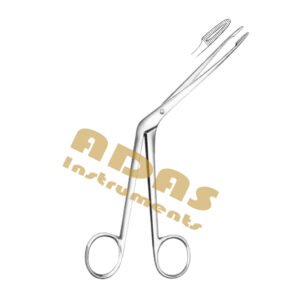
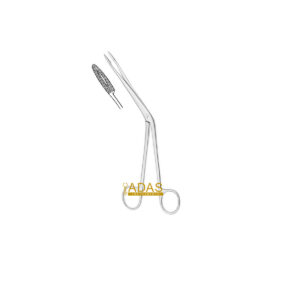
The Hartmann nasal polypus forceps is the grasping answer to a polyp, not the cutting one: two oval jaws with a window through each and serrations inside, on an alligator shaft that angles forward so the jaws stay in view down a nostril. The finger rings do not lock, so the grip is yours the whole time, and the two lengths are 13 cm and 19 cm.
Key Features
- Oval fenestrated jaws with inner serrations and a central groove
- Alligator shaft, angled forward to keep the jaws in direct view
- Non locking finger ring handle
- Two lengths: 13 cm and 19 cm
- Also listed in the trade as Hartmann septum forceps
- Cut from high quality medical grade stainless steel and fully autoclavable
- Three year replacement warranty against manufacturing defects
- Item code ADR-183.11

What a Hartmann nasal polypus forceps is
Two of the four polypus items we make are snares and one is the wire for them. This is the one that is none of those. A snare needs a stalk to tighten behind. A nasal polyp forceps needs nothing: it takes hold of what is in front of it, and that is why it is on the tray even in clinics that own both snares.
The jaws are the part worth describing. Each one is an oval ring rather than a solid blade, with a window through the middle and serrations on the inner face, and there is a groove running down the center of the grip. Google’s own answer describes the same geometry and gives the same reason we would: a fenestrated jaw concentrates the grip where the tissue is and lets the rest of the polyp sit in the window instead of being squeezed out of the jaws. Polyp tissue is wet and it slips, and that window is what stops it.
The shaft is an alligator, angled forward rather than straight: the bend puts the hand below the line of sight, so the surgeon looks down the instrument at the tissue instead of past their own knuckles. On a 19 cm instrument working at the back of a nose that angle is not a nicety. Without it you would be grasping at a shape your own hand is covering.
It does not lock. There is no ratchet on the rings, and on an instrument that goes into an awake or a bleeding nose that is the right answer: you feel how much you have hold of and you can let go in the time it takes to open your fingers.
Our record carries two sizes, 13 cm and 19 cm, and nothing else. The listings Google names run 15 to 20 cm, at up to eight times our price, and one of them lists the same instrument as Hartmann polypus and septum forceps. That is why Hartmann septum forceps is on this page: it is the trade’s own second name for the thing, not a phrase we reached for.
Key design features
Fenestrated oval jaws
A window through each jaw and serrations inside them. The polyp bulges into the window instead of squirting out sideways, and the serrations hold the part that is actually between the faces. It is the difference between gripping slippery tissue and pushing it about.
The alligator angle
The jaws sit forward of the shaft, so they stay visible when the shaft is lined up with a nostril. Everything about working in a nose comes back to the same problem, which is that there is one corridor and the light, the view and the instrument all want it. An angled shaft gives the view back.
No lock, by design
Finger rings with nothing to catch. On a polyp you want to take hold, assess, release and take hold again a little differently, and a ratchet makes all four of those slower. It also means nothing can stay clamped on mucosa while your attention is somewhere else.
Two working lengths
13 cm for the front of the nose and for clinic work, 19 cm when the polyp is further back or the nostril is long. Both are on our own record. If you buy one, buy the 19 cm: it reaches everything the 13 cm reaches, and most people who own only the short one end up ordering the long one within the year.
Which length to order
Two lengths from our own record. The 15 to 20 cm band on rival pages is theirs.
| Length | Usually chosen for | Note |
|---|---|---|
| 13 cm | Anterior polyps, clinic examination, foreign bodies at the front | Lighter in the hand, and enough for most outpatient work |
| 19 cm | Polyps further back, long nostrils, operating room work | The one to buy if you are only buying one |
| Both | A full ENT tray | They are the same jaws on different shafts |
Where it is used
A nasal polypus forceps earns its place twice: once on polyps and once on everything else that has to come out of a nose.
| Procedure | What the forceps does | Length |
|---|---|---|
| Nasal polypectomy | Takes hold of the polyp and removes it, stalk or no stalk | 19 cm |
| Sessile polyps | The case a snare cannot do at all | 13 or 19 cm |
| Foreign body removal | Grips a slippery or rounded object without crushing it flat | 13 cm |
| Biopsy | Takes a sample whole, which a snare does not | 19 cm |
| Septal work | Holding cartilage or mucosa while something else is done | 13 cm |
What it holds, and what it must not do
The jaws are made to grip tissue. Two rows here are about things that are not tissue.
| The task | What this forceps does | What it must not do |
|---|---|---|
| A polyp, stalked or sessile | Grips it through the fenestration and brings it out | It must NOT be twisted to tear a stalk that has not given. If the base will not come, snare it or cut it rather than pulling |
| A specimen for the lab | Takes it whole, which is the argument over a snare | Do not crush the sample to get a better hold. A fenestrated jaw is meant to grip without flattening, and an over gripped biopsy reads badly |
| Bone or cartilage | Nothing. These jaws are not cutting jaws | This is not a crusher and not a cutting forceps. Septal cartilage needs the instruments in the cutting and crusher family |
| Suture or dressings | It will hold them, but that is not its job | Use a dressing forceps. A polypus jaw on gauze wears the serrations for nothing |
How it compares with the snares and the specula
The decision in this category is nearly always forceps against snare, so that is the top of the table.
| Instrument | What it does to the polyp | Locks | Buy it when |
|---|---|---|---|
| Hartmann polypus forceps, this page | Grips it and brings it out whole | No | The polyp is sessile, or you want the specimen intact |
| Krause snare | Crushes through the stalk | No | There is a clear stalk and bleeding is the worry |
| Lange Wilde snare | Crushes through the stalk, longer reach | No | The stalk is further back, in the middle meatus or the choana |
| Thudichum speculum | Nothing. It opens the nostril | No | You need the view before any of the above |
Materials and finish
Every Hartmann nasal polypus forceps we make is cut from high quality medical grade stainless steel. The steel itself is made to a German specification. We do not publish a grade number. A certificate says nothing about whether two fenestrated jaws still meet along their whole serrated face after three years, because a polypus forceps that only meets at the tip will slide off wet tissue every time. The answer to that is in the making rather than in the alloy.
The two jaws are cut and then ground as a matched pair, and the window in each one is machined before the serrations go in, not after. That order matters: fenestrating a finished jaw leaves a burr on the inner edge, and the inner edge is the face that holds the tissue.
The box joint is hand set so the jaws come together along their full length under finger pressure rather than meeting at the tip first. The outside of each ring is serrated, because a nasal instrument is held in a gloved hand that may have blood on it and a smooth ring turns in the grip at the worst moment.
Caring for it
Open the joint and the jaws before you clean. The fenestration is the one place tissue hides on this instrument, and it hides on the side you cannot see with the jaws closed.
Brush through both windows, flush, dry open. Autoclave with the tray. Close the jaws against a light once in a while and look along the serrated faces: you should see no line of daylight between them. Daylight at the heel with the tips touching is a sprung joint, and it is worth telling us about rather than living with.
Ordering and wholesale
Every Hartmann nasal polypus forceps is made by Adas Instruments in our own workshop and sold direct, which is why the price sits where it does against the catalog houses. Order one for a single tray, or in quantity for a hospital list or a distributor line. We do OEM work under your own brand and your own item numbers. Send us a sample and we will hold a run to your pattern rather than ours. Stock items ship from our own workshop. Backorder items take 10 to 12 working days to make. Every instrument carries a three year replacement warranty against manufacturing defects. Production is controlled under an ISO 13485 quality management system.
Frequently asked questions
What are Hartmann nasal polypus forceps used for?
Taking hold of a nasal polyp and removing it, whether or not it has a stalk, plus foreign body removal, biopsy and holding mucosa or cartilage during septal work. The fenestrated oval jaws grip wet tissue without squeezing it out of the jaws.
Are these the same as Hartmann septum forceps?
Yes. It is the same instrument under the trade’s other name, and at least one US catalog lists it as Hartmann polypus and septum forceps on a single line. People also search for it as plain Hartmann nasal forceps. All three names are on this page because all three are genuinely used.
Forceps or snare for a nasal polyp?
Snare if there is a clear stalk, because a tightening wire crushes the vessels as it goes and bleeds less. Forceps if the polyp is sessile, if you want the specimen whole for the lab, or if you want to assess your hold before you commit to it. Most ENT trays carry both for exactly that reason.
Does it lock?
No. The finger rings have no ratchet, and that is deliberate. You feel what you have hold of, and you can release it as fast as you can open your fingers, which is what you want in a nose that is bleeding.
Which length should I buy first?
The 19 cm. It reaches everywhere the 13 cm reaches, and the polyps that are awkward are the ones that sit further back. The 13 cm is the better instrument for clinic work and for foreign bodies at the front of the nose, and most trays end up with both.
Related products and categories
When the polyp has a stalk, the snares are the Krause nasal polypus snare and the Lange Wilde polypus nasal snare. To open the nostril before any of it, the Thudichum nasal speculum.
The rest of this family sits under nasal speculum and polypus instruments, and the cutting and crushing forceps for septal work are under nasal cutting, crusher and septum forceps.
| Weight | 0.065 kg |
|---|---|
| Select Size | 13cm / 5-1/4", 19cm / 7 1/2" |
Be the first to review “Hartmann Nasal Polypus Forceps | Alligator Jaws, 13 cm and 19 cm”
Shipping & Delivery Policy
Processing Time: In-stock items are dispatched within 24-48 hours. For custom or out-of-stock items, production time is approximately 10-15 days.
Global Delivery Estimates
We partner with world-class couriers (DHL, FedEx) to ensure fast, tracked delivery.
- USA & Canada: 3-5 Business Days
- Europe & UK: 4-6 Business Days
- Rest of World: 5-7 Business Days
*We offer Air Cargo and Sea Freight options for bulk wholesale orders.
Customs & Duties
International buyers are responsible for any customs duties or taxes imposed by their country. Adas Instruments is not responsible for delays caused by customs clearance.
Lost Packages & Insurance
If your package is lost in transit, please contact us immediately. We offer full support and replacements for confirmed lost shipments. Note: You must report non-delivery within 3 weeks to be eligible for an insurance claim.
Related products
Reviews
There are no reviews yet.