
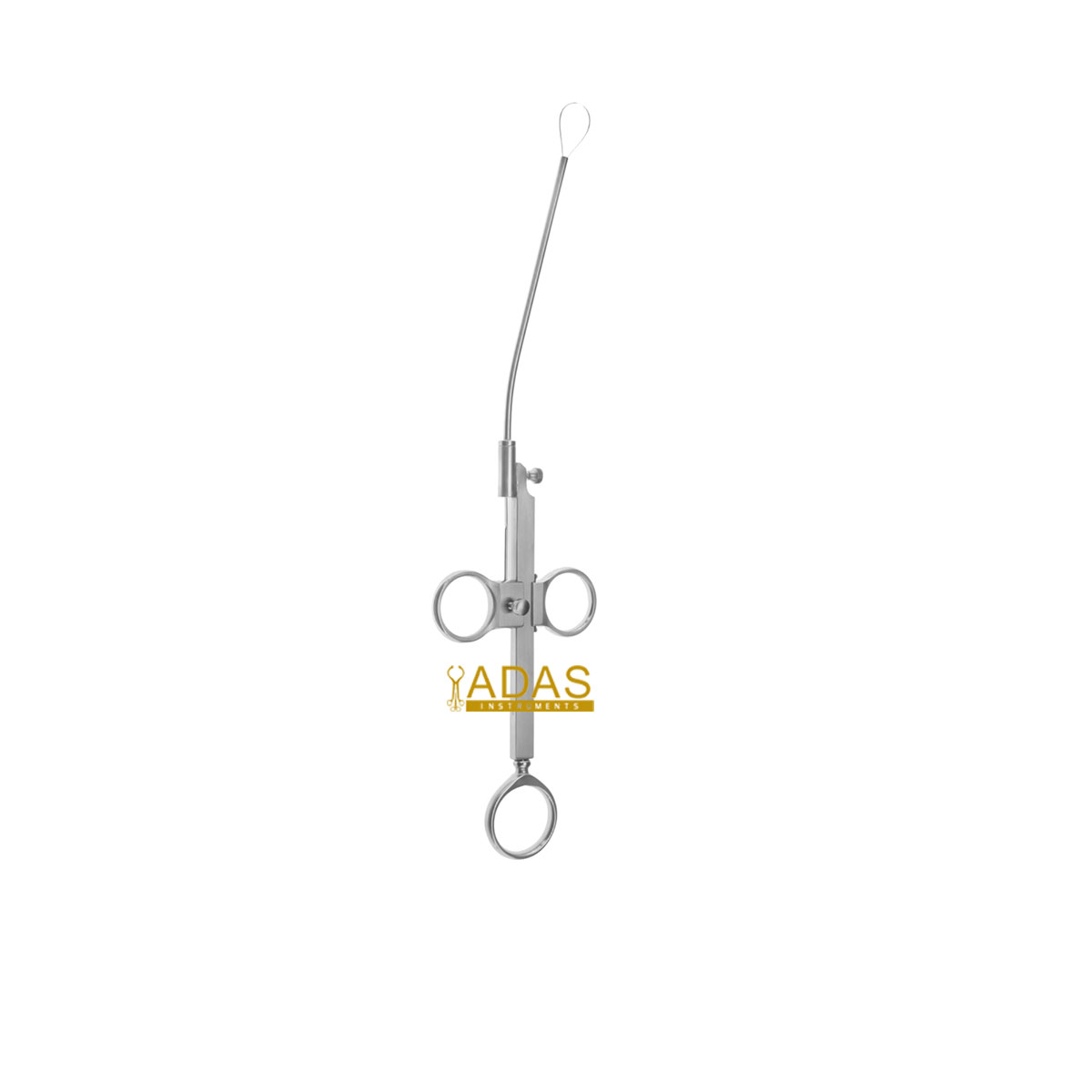
Krause Nasal Polypus Snare | Three Ring Handle, Fig 0 to Fig 4
$ 65.00
The Krause nasal polypus snare is a wire loop on a long slender shaft, and the handle is what makes it a Krause. Three rings: a thumb ring at the bottom that turns and steers the loop, and two sliding side rings that pull the wire back into the cannula. You put the loop around the base of a polyp, pull the rings, and the wire closes on the stalk.
Key Features
- Three ring sliding handle: one thumb ring to steer, two to tighten
- Replaceable wire loop, Fig 0 to Fig 4
- Bayonet shaft, so the hand sits below the line of sight
- The loop crushes the stalk as it tightens, which is why a snare bleeds less
- Takes our pack of 12 replacement wires
- Cut from high quality medical grade stainless steel and fully autoclavable
- Three year replacement warranty against manufacturing defects
- Item code ADR-445.26
Available on backorder

What a Krause nasal polypus snare is
A snare does not slice a polyp off. It strangles it. That is the whole argument for owning one, and it belongs before anything about the handle: the loop crushes the stalk as it tightens, and crushing a stalk closes the vessels in it, which is why a snare bleeds less than a blade through the same tissue.
The Krause is the three ring version of that instrument. The bottom ring takes your thumb and rotates, so you can turn the plane of the loop to match the plane of the polyp without turning your wrist. The two rings above it slide, and sliding them draws the wire back into the cannula, which closes the loop. Google’s own answer describes the same three rings doing the same three jobs, which is worth having on a handle that looks odd the first time you pick it up.
What people ask next is what a nasal snare is used for, and the honest answer is narrower than the catalogs suggest. It is for a growth on a stalk. Anything with a broad base is not a snare job, because there is nothing for the loop to sit behind.
The shaft is bent rather than straight, for the reason that shapes half the instruments in this category: the bend puts the hand below the line of sight, so the surgeon looks down the instrument at the tissue instead of past their own knuckles. A nasal polypectomy snare is worked by eye down a nostril, and a straight handle puts your fist where the light has to go.
Our record carries Fig 0 to Fig 4 for the loop and nothing else: no wire gauge and no cannula length. Rival listings quote a 30 S.W.G. wire and a 25 to 26.5 cm cannula. Those are their instruments. Ask us for the gauge and you will get our real number by email rather than a borrowed one off a page.
Key design features
The three ring handle, and what each ring does
Thumb ring at the bottom: it holds the instrument and it turns, which rotates the loop. Two sliding rings above it, for the index and middle fingers: pulling them back retracts the wire and closes the loop at whatever speed your fingers choose. That is the point of a slide rather than a trigger.
A replaceable loop, not a fixed blade
The wire is a consumable and the instrument is not. A loop that has been pulled through a fibrous stalk comes out and a fresh one goes in. We sell the wire in packs of 12 across the same Fig range, so one handle outlasts several hundred.
Fig 0 to Fig 4 loop sizes
Five loop sizes on our own record. The small figures are for a narrow nostril and a polyp near the front; the large ones for a bulky polyp you must get all the way around before tightening. Most clinics keep two sizes and the wire pack.
The bayonet shaft
The offset drops your hand below the line of sight, and it is not a comfort feature. The whole procedure is placing a loop you can barely see around a base you can barely see, and a fist in front of the light costs you the only view you have.
Which Fig size to order
Five loop sizes from our own record. Every other figure on this page is somebody else’s.
| Loop | Usually chosen for | Note |
|---|---|---|
| Fig 0 | The smallest polyp, the narrowest nostril | The one a pediatric list asks for |
| Fig 1 | Small anterior polyps | Pairs well with Fig 3 as a two size shelf |
| Fig 2 | General adult polypectomy | The single sensible first purchase |
| Fig 3 | Larger polyps with a clear stalk | The second one most clinics buy |
| Fig 4 | Bulky growths you must encircle before tightening | The largest loop we make |
| Wire | All five figures, pack of 12 | Ordered separately, and it fits this handle |
Where it is used
Nasal snare uses come down to one thing, which is why four of these five rows are the same operation under different names.
| Procedure | What the snare does | Loop |
|---|---|---|
| Nasal polypectomy | Encircles the stalk of a pedunculated polyp and crushes through it | Fig 2 or Fig 3 |
| Antrochoanal polyp | Takes the stalk where it comes through the choana | Fig 3 or Fig 4 |
| Pediatric polypectomy | The same, through a much narrower nostril | Fig 0 or Fig 1 |
| Fibrous nasal tags | Cuts the base without a blade near the septum | Fig 0 or Fig 1 |
| Teaching | A visible mechanism, which is why it turns up in ENT training sets | Any |
What it takes, and what it must not do
Every row here follows from one fact: a loop needs a stalk.
| The task | What this snare does | What it must not do |
|---|---|---|
| A polyp on a stalk | Encircles it and crushes through the base | It must NOT be dragged once the loop is tight. A snare that is pulled instead of closed tears the stalk above the base and leaves you the bleeding you bought it to avoid |
| A broad based polyp | Nothing useful. There is nothing to sit behind | Do not try to tighten a loop on a sessile mass. That is a forceps job, and the forceps for it is the Hartmann |
| A blunt or kinked wire | Nothing. A tired wire slips off the stalk | Do not reuse a wire that has been through fibrous tissue. It costs less than the time lost replacing it mid procedure |
| Reaching the back of the nose | The cannula is long and bent, so it reaches | It is still worked by eye down a nostril. A snare is not an endoscopic instrument and we do not list it as one |
How it compares with the other polypus instruments
Two snares, one forceps, one consumable. The handle is what separates the snares.
| Instrument | Mechanism | Handle | Buy it when |
|---|---|---|---|
| Krause nasal snare, this page | Wire loop, crushing | Three rings, two of them sliding | You want to control the speed of the crush with your own fingers |
| Lange Wilde snare | Wire loop, crushing | Bayonet shaft, sliding or ratchet | You want the longer reach and the fuller bayonet offset |
| Hartmann polypus forceps | Fenestrated jaws, grasping | Non locking finger rings | The polyp has no stalk to snare, or you want the specimen whole |
| Snare wire, pack of 12 | The consumable | None | You already own a handle and the loop is finished |
Materials and finish
Every Krause nasal polypus snare we make is cut from high quality medical grade stainless steel. The steel itself is made to a German specification. We do not publish a grade number. A certificate says nothing about whether a cannula mouth is still square after four hundred wires have been pulled through it, because a worn mouth lets the loop close off center and a loop that closes off center misses the stalk. The answer to that is in the making rather than in the alloy.
The cannula wears from the inside. Every wire drawn back into it runs against the same lip of steel, so that lip is finished square and polished rather than left as drilled. Nobody sees that piece of work and it decides how long the instrument stays accurate.
The three rings are brazed and then dressed so there is no step for a glove to catch on, and the sliding pair run on a shaft that is polished rather than ground, because a ground finish feels gritty on the one movement that has to be smooth.
Caring for it
Take the wire out before cleaning, every time. A snare put through an autoclave with a used loop still in it bakes tissue into the one channel you cannot brush.
Flush the cannula, brush the handle, dry it with the slide pulled fully back. Autoclave with the tray. Work the slide when it comes out: it should run the full travel with no catch. A sticky slide is debris, not wear, and a flush usually fixes it.
Ordering and wholesale
Every Krause nasal polypus snare is made by Adas Instruments in our own workshop and sold direct, which is why the price sits where it does against the catalog houses. Order one for a single tray, or in quantity for a hospital list or a distributor line. We do OEM work under your own brand and your own item numbers. Send us a sample and we will hold a run to your pattern rather than ours. Stock items ship from our own workshop. Backorder items take 10 to 12 working days to make. Every instrument carries a three year replacement warranty against manufacturing defects. Production is controlled under an ISO 13485 quality management system.
Frequently asked questions
What is a Krause nasal polypus snare used for?
Removing a polyp that sits on a stalk. The loop goes around the base, the sliding rings pull it tight, and the stalk is crushed through rather than cut: nasal polypectomy, antrochoanal polyps coming through the choana, and fibrous tags where you would rather not put a blade near the septum.
Why use a snare instead of cutting forceps?
Bleeding. A tightening loop closes the vessels in the stalk as it goes through it, so the same tissue bleeds less than it would under a blade. That is also the limit of the argument: the advantage only exists if there is a stalk for the loop to crush.
What do the three rings do?
The bottom ring takes your thumb, holds the instrument and rotates the loop. The two rings above it slide, and drawing them back pulls the wire into the cannula and closes the loop at the speed your fingers choose. Steering and tightening are separate movements, which is the whole idea of the pattern.
Can the wire be replaced?
Yes, and it is meant to be. The loop is a consumable. We sell replacement nasal polypus snare wire in packs of 12 across the same Fig 0 to Fig 4 range, and one handle will see out several hundred of them.
How is this different from the Lange Wilde snare?
Both are wire loop snares and both crush rather than cut. The Krause is the three ring pattern, with a rotating thumb ring and two sliding finger rings; the Lange Wilde is the full bayonet pattern with the longer reach. Choose on handle feel, because the mechanism is the same.
Related products and categories
The other snare in this family is the Lange Wilde polypus nasal snare. The loops themselves are the nasal polypus snare wire, pack of 12, and when a polyp has no stalk to snare the instrument you want is the Hartmann nasal polypus forceps.
The rest of this family sits under nasal speculum and polypus instruments, and the cutting and crushing forceps for the same operation are under nasal cutting, crusher and septum forceps.
| Weight | 0.15 kg |
|---|---|
| Select Fig | Fig 0, Fig 1, Fig 2, Fig 3, Fig 4 |
Be the first to review “Krause Nasal Polypus Snare | Three Ring Handle, Fig 0 to Fig 4”
Shipping & Delivery Policy
Processing Time: In-stock items are dispatched within 24-48 hours. For custom or out-of-stock items, production time is approximately 10-15 days.
Global Delivery Estimates
We partner with world-class couriers (DHL, FedEx) to ensure fast, tracked delivery.
- USA & Canada: 3-5 Business Days
- Europe & UK: 4-6 Business Days
- Rest of World: 5-7 Business Days
*We offer Air Cargo and Sea Freight options for bulk wholesale orders.
Customs & Duties
International buyers are responsible for any customs duties or taxes imposed by their country. Adas Instruments is not responsible for delays caused by customs clearance.
Lost Packages & Insurance
If your package is lost in transit, please contact us immediately. We offer full support and replacements for confirmed lost shipments. Note: You must report non-delivery within 3 weeks to be eligible for an insurance claim.
Related products


Reviews
There are no reviews yet.