
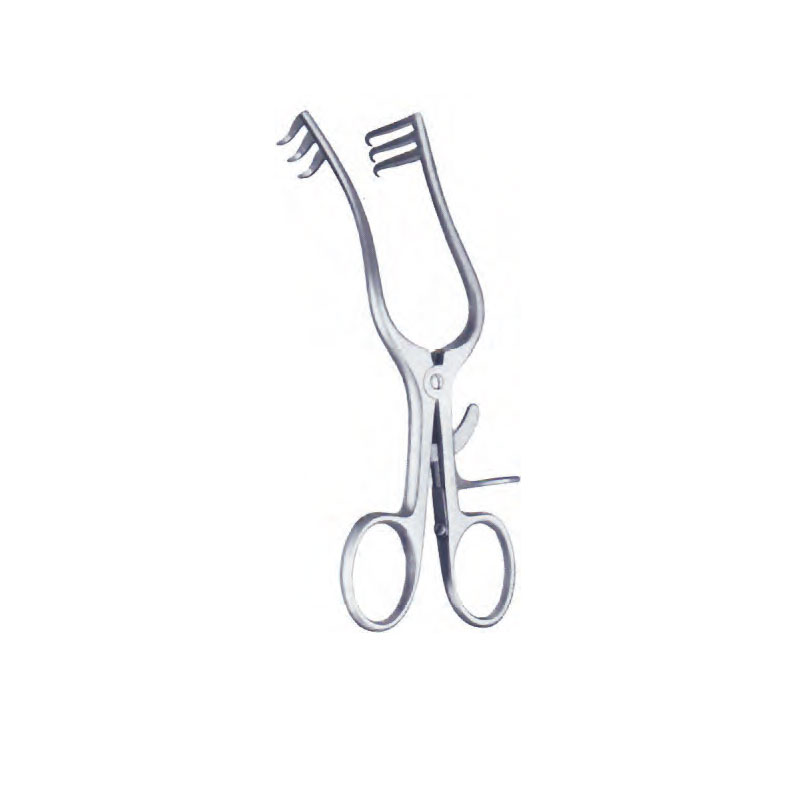
Wullstein Self Retaining Retractors, Micro Ear and Tympanoplasty
$ 34.00
Wullstein self retaining retractors are the compact ear pattern: prongs on both arms, a ring handled frame that locks itself open, and a short travel built for a shallow field rather than a deep one. Catalogues also list them as the Wullstein-Weitlaner, because the frame and the lock are a Weitlaner scaled down to ear work. That is what puts them on tympanoplasty and micro ear trays, where the opening is small and an assistant holding a retractor is an assistant in the way of the microscope.
Key Features
- Prongs on both arms, unlike the asymmetric Plester and Belluci
- Short travel, built for a shallow opening rather than a deep one
- Locks open where you set it and releases in one movement
- Ring handles, so it lies flat under an operating microscope
- Non glare satin finish, no reflection back up the objective
- One piece steel, no screwed on parts and no pinned prong carrier
- Blunt or sharp prongs; tell us which your list uses
- Item code ADE-371.11
Available on backorder

What a Wullstein self retaining retractor is
A wullstein self retaining retractor is a small ring handled retractor with prongs on both arms and a lock that holds the arms where you set them. It is named for Horst Wullstein, whose work on tympanoplasty is where the pattern comes from, and catalogues also sell it as the Wullstein-Weitlaner because the frame and the lock are a Weitlaner built to ear dimensions. Most lists simply call it the Wullstein retractor and leave it at that.
The useful thing to know is what it is NOT. It is not asymmetric, so there is no solid blade and no left or right version; both margins get prongs. And it is not big, so if the job is holding a mastoid flap off the bone then the Plester on the same tray is the instrument and this one is not.
Key design features
Prongs on both arms, and when that is what you want
The other ear retractors on this tray are asymmetric: prongs one side, a solid blade the other. The Wullstein is not. Both arms carry prongs, which is the right answer when both margins of the opening are tissue a prong can hold and neither one is a muscle flap waiting to slump back. It also means the instrument has no handedness, so there is no left and right version to get wrong.
Short travel, on purpose
A retractor opens as far as its frame allows and no further, and on this pattern that is deliberately not far. In a shallow field the danger is not that the retractor will not open wide enough, it is that it will: an opening stretched past what the operation needs takes longer to settle afterwards. The Wullstein holds firmly over a short distance and stops.
The lock, and what we will not claim about it
Open the arms and they stay. Release and they close. Catalogues describe this family as both a ratchet and a screw lock, and our own data does not say which ours is, so the copy says what it does rather than naming a mechanism. That is the same rule that stops us calling a single catch a multi position ratchet anywhere else on this site.
One piece, with nothing screwed on
Frame, arms and prongs are made as one, so there is no pinned carrier to work out of true. On an instrument that is sprung open under load and then run through a washer several hundred times, the joints you do not have are the ones that never fail.
What to tell us when you order one
This product carries no size attribute on our site, so rather than print a length we hold no data for, here is what to tell us.
| What to tell us | Why it matters | If you do not know |
|---|---|---|
| Prong form | Sharp holds tough superficial tissue; blunt is chosen near nerves | Blunt is the usual choice for ear work |
| Overall length | Long enough to span the opening, short enough to stay clear of the microscope | Tell us the operation rather than a number |
| How wide it needs to open | This pattern is short in its travel by design | Micro ear and tympanoplasty are what it is built for |
| How many | An ear tray normally carries two, so one is always clean | One to try, then a quantity once the fit is confirmed |
| Your own item number | We mark an OEM run to your catalogue rather than ours | Leave it blank and the run carries our code |
Where it is used
It is chosen for the SHAPE of the opening, shallow rather than deep, which is why the same retractor turns up outside the ear.
| Where it is used | What the retractor is doing there |
|---|---|
| Tympanoplasty | A small opening held steady for an eardrum repair |
| Micro ear surgery | Shallow exposure with nothing standing up into the microscope |
| Mastoid approaches | Holding a short post aural opening where no flap needs a blade |
| Middle ear reconstruction | Hands free exposure for the length of the case |
| Small joint and hand surgery | Any shallow opening with tissue a prong can hold |
What it holds, and what it must not pinch
Prongs on both arms means both margins are held the same way, and the second column is where that stops being an advantage.
| It holds | It must not pinch |
|---|---|
| Skin and subcutaneous tissue at both margins | The facial nerve, close in every ear approach |
| Periosteum, which the prongs are shaped for | External canal skin, which tears |
| An opening that would otherwise close itself | The eardrum or a graft, never under tension |
| Tissue on both sides equally | A muscle flap, which wants a solid blade not prongs |
How it compares with the rest of the ear family
Five names and two of them are this instrument. Worth being clear about before ordering.
| Pattern | How it differs | Do we make it |
|---|---|---|
| Wullstein | Prongs on BOTH arms, compact, no handedness. This page | Yes |
| Wullstein-Weitlaner | The same instrument. Catalogues run the two names together | Yes |
| Belluci | A Wullstein frame with one arm changed to a small solid blade | Yes |
| Plester | The bigger asymmetric post aural pattern, for a mastoid flap | Yes, in both hands |
| Weitlaner | The full size general purpose frame this one is scaled down from | Yes |
Materials and finish
Every wullstein retractor we make is cut from high quality medical grade stainless steel. The steel itself is made to a German specification. We do not publish a grade number, because the number on a certificate tells a surgeon nothing about whether the lock still holds after two hundred autoclave cycles, and the answer to that is in the teeth and the finish rather than in the alloy.
With prongs on both arms the load is shared, which sounds easier on the lock and is not: both margins pull and the lock takes the sum. The teeth are cut and then hardened for that reason. The prongs are ground and then polished by hand, because a burr on a blunt prong is a sharp prong nobody ordered, and the finish is satin so an operating microscope does not get its own light back.
Caring for it
Open the arms fully before it goes near a washer. Closed on itself it traps blood in the lock teeth, and dried blood in a lock is why self retaining retractors begin to slip. Brush the hinge and every tooth, then ultrasonic with a neutral pH enzymatic detergent.
Rinse in deionized water, dry fully with the arms open, autoclave at 134 degrees Celsius, and lubricate the hinge after drying rather than before. Test the lock by opening it halfway and squeezing the arms together: it should not give at all. A lock that creeps is a retractor to retire and we replace it inside the three years.
Ordering and wholesale
Every Wullstein retractor we sell is made in our own workshop and sold direct, which is why the price sits where it does against the catalogue houses. Order one for a single tray, or in quantity for a hospital list or a distributor line; we do OEM work under your own brand and your own item numbers, and we will hold a run to your pattern rather than ours if you send a sample. Stock items ship from our own workshop. Backorder items take 10 to 12 working days to make. Every instrument carries a three year replacement warranty against manufacturing defects. Production is controlled under an ISO 13485 quality management system.
Frequently asked questions
What is a Wullstein self retaining retractor used for?
Holding a small, shallow opening in ear surgery open without an assistant. In practice that means tympanoplasty, micro ear work, middle ear reconstruction and short post aural approaches. Prongs on both arms hold both margins, so it suits an opening where neither side needs a solid blade.
Is a Wullstein the same as a Weitlaner?
Not the same, but closely related, and catalogues sell this one as the Wullstein-Weitlaner for that reason. The frame, the ring handles and the lock are a Weitlaner; the Wullstein is that design built to ear dimensions, with a shorter travel and finer prongs. If your list says Weitlaner and means a general purpose tray retractor, the full size one is a separate product on this site.
Can a Wullstein retractor be used for mastoid surgery?
For a short post aural opening, yes, and it is sold as a mastoid retractor in some catalogues. What it will not do is hold a temporalis muscle flap back, because prongs hold a point and a flap needs holding along a length. That is the job the Plester solid blade exists for, and on a full mastoidectomy tray the two usually sit side by side.
What size is it?
We will not print a figure we cannot stand behind, and this product carries no size attribute on our site. What we can say is where it sits in the family: smaller than both Plesters, smaller than a full size Weitlaner, and about the same as the Belluci. Tell us the operation or the length your list specifies and we will confirm it from the workshop before anything ships.
What does a mastoid retractor look like in use?
Two flat ring handles lying against the drapes, a hinge at the center, and two short arms standing in the opening with their prongs turned outward into the tissue. Nothing projects upward, which is the point: the microscope objective sits directly over the field and anything standing proud of the patient is in the light path.
Related products and categories
For the asymmetric version of this frame, with one arm changed to a small solid blade, see the Belluci self retaining retractor. Where a mastoid flap has to be held back, the Plester mastoid retractor is the bigger pattern and the Plester left solid blade retractor is its left handed pair. The rest of the family sits in self retaining retractors, and the ear patterns are listed under ear instruments.
| Weight | 0.07 kg |
|---|
Be the first to review “Wullstein Self Retaining Retractors, Micro Ear and Tympanoplasty”
Shipping & Delivery Policy
Processing Time: In-stock items are dispatched within 24-48 hours. For custom or out-of-stock items, production time is approximately 10-15 days.
Global Delivery Estimates
We partner with world-class couriers (DHL, FedEx) to ensure fast, tracked delivery.
- USA & Canada: 3-5 Business Days
- Europe & UK: 4-6 Business Days
- Rest of World: 5-7 Business Days
*We offer Air Cargo and Sea Freight options for bulk wholesale orders.
Customs & Duties
International buyers are responsible for any customs duties or taxes imposed by their country. Adas Instruments is not responsible for delays caused by customs clearance.
Lost Packages & Insurance
If your package is lost in transit, please contact us immediately. We offer full support and replacements for confirmed lost shipments. Note: You must report non-delivery within 3 weeks to be eligible for an insurance claim.
Related products


Reviews
There are no reviews yet.