
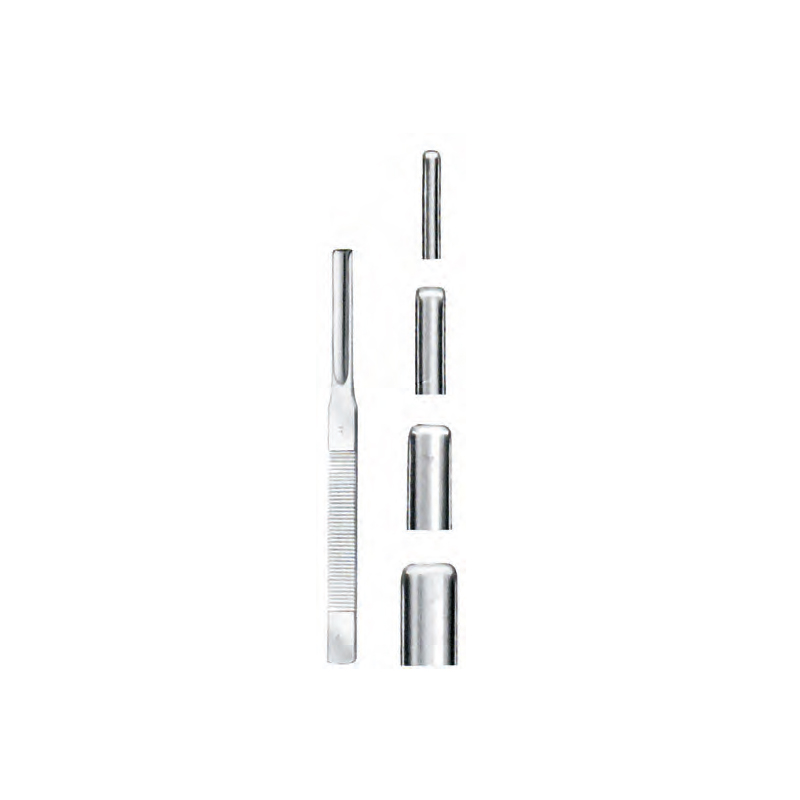
Trautmann Ear Gouge, 3 mm to 9 mm, Mastoid Bone Gouge
$ 15.00
The Trautmann Ear Gouge is a bone gouge with a curved, channelled cutting edge, used in mastoid and temporal bone surgery to lift cortical bone away in a controlled scoop rather than a flat slice. Adas Instruments forges it from German surgical grade stainless steel and offers tip widths of 3 mm, 5 mm, 7 mm and 9 mm, so the surgeon can match the gouge to the depth and width of the mastoid cavity. Driven with a mallet, the trough shaped blade follows the curve of the bone instead of cutting across it, which is what separates a gouge from a chisel. We ship to the USA, Europe and worldwide by DHL, FedEx and UPS.

What a Trautmann Ear Gouge Is, Where It Is Used, and What It Is Made Of
A Trautmann ear gouge is a hand held bone cutting instrument with a semi circular, trough shaped blade at the working end and a flat, serrated handle for grip. It is used in otology and lateral skull base surgery, chiefly during mastoidectomy, to remove cortical bone from the mastoid process, open the antrum and shape the walls of the mastoid cavity. Because the cutting edge is curved, it takes bone out as a channel and leaves a rounded floor, which is what a surgeon wants inside the mastoid. It is made from German surgical grade stainless steel, hardened so the edge survives repeated mallet strikes, and passivated for autoclave use.
Gouge or Chisel, and Why the Difference Matters
The two instruments look alike in a catalogue photograph and are often ordered by the wrong name. A chisel has a flat, straight edge and cuts a flat surface. A gouge has a curved edge and cuts a groove. In mastoid work both are used, often in the same tray, but they are not interchangeable: a flat chisel used where a gouge is needed leaves ridges that have to be cleaned up afterwards. If you need the flat pattern, see our Trautmann Ear Chisel. The equivalent curved instrument in the Alexander pattern is the Alexander Ear Gouge.
Sizes
Four tip widths are stocked: 3 mm, 5 mm, 7 mm and 9 mm. The narrow 3 mm and 5 mm sizes are used close to the sigmoid sinus and the facial nerve, where the cut has to be small and predictable. The 7 mm and 9 mm sizes remove cortical bone faster in the early part of the approach. Most departments keep at least one narrow and one wide gouge on the mastoid tray.
Material and Finish
Each gouge is forged from high tensile German surgical grade stainless steel, then hardened and tempered so the edge holds after repeated mallet impact without chipping. The handle carries fine cross serrations for grip with a wet glove. The finish is satin, which cuts glare under the operating microscope. Every instrument is passivated and is safe for steam autoclave sterilisation at 134 degrees Celsius.
Use With a Mallet
A gouge is a struck instrument. It is held in the non dominant hand and driven with short, controlled taps from a surgical mallet, not pushed by hand. A mallet that is too light gives a poor cut and tempts the surgeon to push. We supply a matching Lucae Bone Mallet, 250 g for this purpose.
Care and Sterilisation
Rinse immediately after use, before blood and bone dust dry on the blade. Clean with a soft brush and a neutral pH enzymatic detergent, rinse with demineralised water, dry fully, then autoclave. Do not use saline soaks or abrasive pads, both of which pit stainless steel. Inspect the cutting edge under magnification before each tray is packed, and retire any gouge with a rolled or nicked edge.
Ordering From Adas Instruments
Adas Instruments manufactures in Sialkot, Pakistan and supplies hospitals, surgical distributors and ENT departments worldwide. Custom sizes, laser marking and set packing are available on request. See the full range of osteotomes, chisels and gouges, or contact us for a quotation with your required quantities.
Common Questions
Is a Trautmann ear gouge the same as a mastoid gouge? Yes. Mastoid gouge is the descriptive name for the job, and Trautmann is the pattern. Surgeons use both terms for this instrument.
Which size should I order first? If you are buying a single gouge, the 5 mm is the most widely used size on a general mastoid tray.
Can it be resharpened? Yes, a curved edge can be reground by a competent instrument service, but the geometry must be kept. A badly reground gouge cuts wide of where the surgeon aims it.
Related instruments and categories
French Pattern Osteotome is driven with the same mallet, the French section for nasal bone cuts.
Both are listed under Osteotomes-Chisels-Gouges, where the range is grouped by the job each instrument does. Adas Instruments makes every pattern here at its own plant in Sialkot, Pakistan.
| Weight | 0.12 kg |
|---|---|
| Select Size | 3.0 MM, 5.0 MM, 7.0 MM, 9.0 MM |
Be the first to review “Trautmann Ear Gouge, 3 mm to 9 mm, Mastoid Bone Gouge”
Shipping & Delivery Policy
Processing Time: In-stock items are dispatched within 24-48 hours. For custom or out-of-stock items, production time is approximately 10-15 days.
Global Delivery Estimates
We partner with world-class couriers (DHL, FedEx) to ensure fast, tracked delivery.
- USA & Canada: 3-5 Business Days
- Europe & UK: 4-6 Business Days
- Rest of World: 5-7 Business Days
*We offer Air Cargo and Sea Freight options for bulk wholesale orders.
Customs & Duties
International buyers are responsible for any customs duties or taxes imposed by their country. Adas Instruments is not responsible for delays caused by customs clearance.
Lost Packages & Insurance
If your package is lost in transit, please contact us immediately. We offer full support and replacements for confirmed lost shipments. Note: You must report non-delivery within 3 weeks to be eligible for an insurance claim.
Related products

Reviews
There are no reviews yet.