
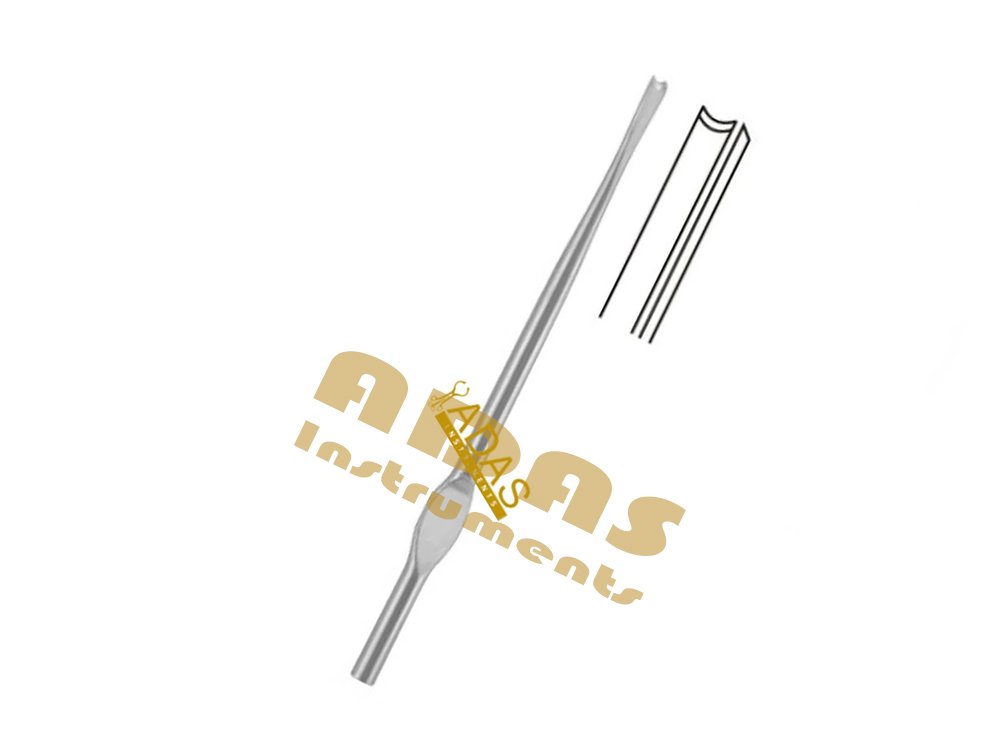
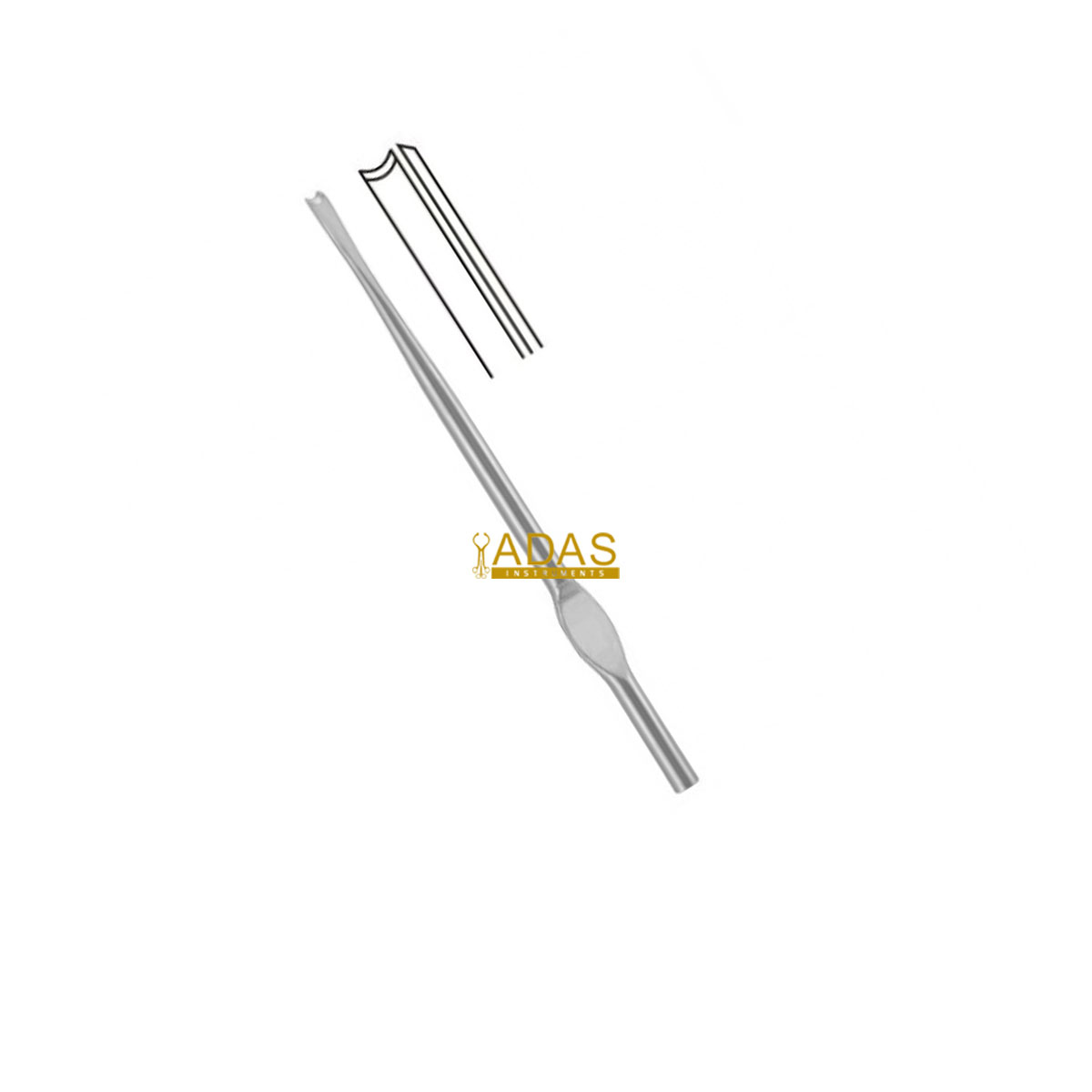
Walter Chisel | Moon Shape Tip | 3mm 5mm 12mm
$ 28.00
Walter chisel is used in rhinoplasty and ENT surgery to reduce a bony hump and contour the nasal vault, and the tip is ground as a moon shape rather than straight across. That concave edge follows the curve the nasal vault already has, so bone comes down in a smooth sweep instead of in the flat facets a straight blade leaves behind, and there is no ridge at the end of each pass to go back and take off. It is made in 3mm, 5mm and 12mm, each with a straight or a curved shaft.
Key Features
- Moon shape concave tip, follows the contour of the nasal vault
- Three sizes: 3mm, 5mm and 12mm
- Straight or curved shaft, ordered per instrument
- Flat handle end for mallet work
- Single bevel chisel geometry, not an osteotome
- High quality medical grade stainless steel, fully autoclavable
- Three year replacement warranty against manufacturing defects
- Item code AM-51-03

What the Walter chisel is
The Walter chisel reduces a bony hump and contours the nasal vault in rhinoplasty and ENT surgery. What sets it apart from the flat chisels beside it is the tip: it is ground as a moon shape, a shallow concave curve, rather than straight across.
That curve exists because the nasal vault is curved. A flat blade takes a flat facet out of a rounded surface, so reducing a vault with one means a series of facets and a second pass to blend the ridges between them. A concave edge sits across the curve and takes the whole width in one sweep, leaving a surface that is already the shape it is meant to be.
It is a chisel, ground on one face, so it has a flat side and an angled side and it shaves a surface. An osteotome is ground on both faces and splits into bone. That matters here more than on most pages, because we also make a Walter osteotome and it is a different instrument with a different job. Adas Instruments makes this chisel in 3mm, 5mm and 12mm, with a straight or a curved shaft.
Key design features of the moon shape nasal chisel
The moon shape tip, and what it is for
The edge is a shallow concave arc. Set it on a convex bony vault and the two ends of the arc touch first and the middle clears, so the blade is guided by the shape of the bone instead of skating across it. The bone comes down in a curve that matches the curve the surgeon is building, rather than in flats that have to be blended.
Three sizes, 3mm, 5mm and 12mm
The jump from 5mm to 12mm is deliberate rather than a gap in the range. 3mm and 5mm are detail widths, for a small hump or for finishing an edge; 12mm crosses the whole vault in one pass. There is no 8mm because a moon shape blade at that width does neither job well.
A straight shaft or a curved shaft
The straight shaft gives the most direct line of force from the mallet to the edge and is the default. The curved shaft drops the handle out of the line of sight, which is what a surgeon wants when the blade is at the top of the vault. Both are ordered per instrument.
A flat handle end, and one piece throughout
The far end of the handle is a true flat face, so a mallet lands square and the whole tap goes forward into the blade. There is no joint, screw or moving part on the instrument, so nothing works loose and there is nowhere for tissue or cleaning solution to sit.
Which Walter chisel size and shaft to order
Three widths and two shaft shapes, ordered per instrument. Every figure below is our own product record, and the table also says what this instrument does NOT have.
| Feature | This instrument |
|---|---|
| Edge shape | Moon shape, a shallow concave arc |
| Sizes | 3mm, 5mm and 12mm |
| Shaft | Straight or curved, ordered per instrument |
| Bevel | Single bevel, the chisel geometry, not an osteotome |
| Guard | NONE on this pattern. The guarded chisels are the Braithwaite and the Silver |
| Supplied as | Single instrument, item code AM-51-03 |
If one is being bought, the 5mm straight covers the most ground. A practice doing regular profile work usually carries the 5mm and the 12mm as a pair, and adds the curved shaft where the approach is narrow. The 3mm is a finishing blade rather than a first choice.
Where the Walter chisel is used
Every row is nasal. It is worth saying so directly, because the searches that arrive at a page like this one are contaminated twice over: the word chisel belongs to carpentry, and the word chisel in a clinical setting often means a dental instrument.
| Procedure | What the chisel does there |
|---|---|
| Rhinoplasty, hump reduction | Takes down a bony hump along the curve of the vault |
| Rhinoplasty, vault contouring | Shapes the bony vault after the hump is off |
| ENT nasal surgery | Reduces bone where the approach is through the nostril |
| Nasal reconstruction | Recontours a vault that has healed out of shape |
| Revision rhinoplasty | Blends a facet or ridge left by a flat blade |
In all of these the soft tissue is lifted first and the chisel is advanced by short mallet taps. The moon shape is chosen over a flat blade whenever the surface being reduced is curved rather than planar.
What it cuts, and what it has to leave alone
The argument for a curved edge is not that it removes more bone. It is that it removes bone in the shape the nose will keep, and leaves the things beside it alone.
| Tissue | What happens to it |
|---|---|
| Bone of the nasal vault | Reduced along its own curve. This is the target |
| The dorsal line | Shaped rather than cut through. A sweep leaves no step to blend |
| Periosteum over the vault | Lifted or tunnelled first so the blade works on bare bone |
| Soft tissue beside the cut | Protected by lifting it clear and by the angle of the blade, NOT by the instrument. This pattern has no guard |
| Nasal lining | Must stay whole. Lifted clear before the chisel is driven |
The fourth row is the honest limit of this instrument. A moon shape chisel has no guard, so the lining and periosteum are protected by lifting them clear beforehand and by the angle the blade is held at, not by the blade. Where the cut has to run right beside tissue that must stay, a guarded pattern is the safer instrument.
How it compares with the rest of the nasal chisel family
Five nasal chisels sit next to each other here, separated by the SHAPE OF THE EDGE and by whether the blade carries a guard. This one and the McIndoes are the two curved patterns, and they are not interchangeable.
| Instrument | Edge | Where it is the right choice |
|---|---|---|
| Walter chisel | Moon shape concave, 3mm 5mm 12mm | Contouring the nasal vault in a smooth sweep |
| McIndoes nasal chisel | Moon shaped curve, 11mm 13mm 15mm | A defined convex ridge, at lateral osteotomy widths |
| Sheehan nasal chisel | Flat, single bevel, 7mm to 12mm | Taking a flat plane of bone down evenly |
| Braithwaite nasal chisel | Flat, guarded on one side, left or right | Cutting right beside soft tissue that must not be touched |
| Silver cartilage chisel | Single sided guard, 3mm 5mm 7mm | The cartilage framework, and depth read off the guard |
Between the two curved chisels: this one is made small, at 3mm and 5mm, and large, at 12mm, and it takes the vault down in a sweep. The McIndoes is made at 11mm, 13mm and 15mm, which are ridge and lateral widths, for a defined convex ridge. If a guard is needed, neither has one and the Braithwaite or the Silver is the answer.
Walter chisel materials and finish
The chisel is ground from high quality medical grade stainless steel, hardened through the blade so the concave edge keeps its arc through resharpening, and left softer along the shaft so an off square tap sets no permanent bend. A curved edge is harder to regrind than a straight one, which is why hardness through the blade matters on this pattern. The steel itself is made to a German specification.
The finish is satin rather than mirror bright. A polished blade under a headlamp reflects light back up the nostril and satin scatters it. Satin also shows bone dust plainly, which on a concave edge is exactly where it collects.
Caring for a Walter chisel
Rinse the blade under cool running water as soon as the case is finished, and pay attention to the inside of the curve. A concave edge holds bone dust the way a spoon holds water, and once it has dried in there it takes a brush and time.
Ultrasonic clean in a neutral pH enzymatic solution, rinse in deionized water, then dry fully before pouching. Tap water dried on steel is the ordinary cause of pitting.
Autoclave at 134 degrees Celsius. Store with the edge guarded and clear of other blades. The two horns of a moon shape edge are the thinnest points on the instrument and the first to chip against another blade.
Ordering a Walter chisel, and wholesale
The Walter chisel is supplied as a single instrument, item code AM-51-03, in 3mm, 5mm or 12mm, with a straight or a curved shaft. Say which sizes and shafts you want. It is ground and finished in our own workshop, so a set can be made with the handle pattern and finish matching the rest of the nasal chisels.
Wholesale and distributor pricing is available on quantity, and larger orders can carry a laser marked hospital or practice reference at no separate tooling charge. Send the quantity and the marking text and we will quote both.
Item code AM-51-03. Every instrument carries a three year replacement warranty against manufacturing defects. Stock items ship from our own workshop. Backorder items take 10 to 12 working days to make. Production is controlled under an ISO 13485 quality management system.
Frequently asked questions
What is a Walter chisel used for
It reduces a bony hump and contours the nasal vault in rhinoplasty and ENT surgery. The moon shape tip means it is chosen where the surface being reduced is curved, and it is driven by a mallet against the flat end of the handle.
What is the advantage of the Walter chisel moon shape tip
A concave edge sits across a convex surface and takes the whole width of it in one sweep. A flat blade removes a flat facet, so a rounded vault reduced with one needs the ridges between the facets blended afterwards. The curve does that work as it cuts.
Is a Walter chisel the same as a Walter osteotome
No, and it is worth being clear because search engines treat them as one thing. We make both. The chisel is ground on one face, so it shaves a surface. The osteotome is ground on both, so it splits into bone along a line. Same surgeon name, two instruments.
Which chisel is most commonly used by dentists
A dental chisel is a different instrument from anything on this page. In dentistry the common patterns are the straight and the binangle chisel, used to shape enamel margins, and they are hand instruments a few centimeters long. These are mallet driven nasal bone instruments.
What is the purpose of a round nose chisel
That is a woodworking and metalworking term, and it comes up here because the word chisel is shared. A round nose chisel in a workshop cuts round bottomed grooves in metal. It has nothing to do with this instrument, which is a surgical chisel for nasal bone.
Related products and categories
Browse the full range of osteotomes, chisels and gouges, or see the wider set of rhinoplasty instruments this instrument belongs to.
| Weight | 0.07 kg |
|---|---|
| Tip options | Curved, Straight |
| Select Size | 12 mm, 3 mm, 5 mm |
Be the first to review “Walter Chisel | Moon Shape Tip | 3mm 5mm 12mm”
Shipping & Delivery Policy
Processing Time: In-stock items are dispatched within 24-48 hours. For custom or out-of-stock items, production time is approximately 10-15 days.
Global Delivery Estimates
We partner with world-class couriers (DHL, FedEx) to ensure fast, tracked delivery.
- USA & Canada: 3-5 Business Days
- Europe & UK: 4-6 Business Days
- Rest of World: 5-7 Business Days
*We offer Air Cargo and Sea Freight options for bulk wholesale orders.
Customs & Duties
International buyers are responsible for any customs duties or taxes imposed by their country. Adas Instruments is not responsible for delays caused by customs clearance.
Lost Packages & Insurance
If your package is lost in transit, please contact us immediately. We offer full support and replacements for confirmed lost shipments. Note: You must report non-delivery within 3 weeks to be eligible for an insurance claim.
Related products
Reviews
There are no reviews yet.