
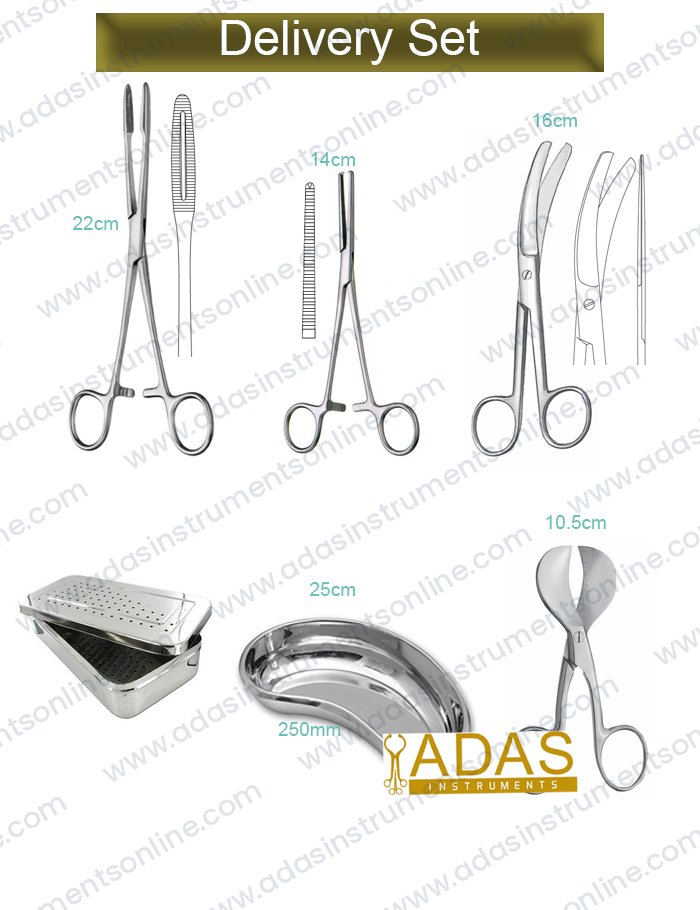
Delivery Instrument Set, 5 Pieces
$ 45.50
Our delivery instrument set is a five piece steel tray for the moment a baby is born: clamping and cutting the umbilical cord, handling swabs, and catching what comes away in a kidney bowl. It carries two umbilical scissors, an Ochsner-Kocher artery forceps and a 22 cm dressing forceps, sized for labor wards, birth centers and midwife kits at 45.50 dollars.
Key Features
- 5 pieces across 5 patterns, in a stainless steel instrument box
- Busch umbilical scissors, 16 cm, curved
- Umbilical cord scissors, 4 inch
- Ochsner-Kocher artery forceps, 14 cm, straight
- Gross-Maier dressing forceps 22 cm and a 250 mm kidney bowl
- Made from high quality medical grade stainless steel, fully autoclavable
- Three year replacement warranty against manufacturing defects
- Item code AD-95601
Available on backorder

What a delivery instrument set is
A delivery instrument set is the steel a midwife or obstetrician keeps open on the trolley for a vaginal birth. Google’s own summary describes it as the tools used by obstetricians, gynecologists and midwives during childbirth, and lists a basic kit of 16 to 21 pieces. Ours is five pieces, and the gap between those two numbers is the first thing a buyer should understand.
This tray is the cord and birth set. It does the jobs that happen on every delivery: the cord is clamped, cut, and the swabs and placenta are handled. It does not carry episiotomy scissors, a needle holder, sponge forceps or a scalpel handle, which Google lists in larger kits. Those belong to a repair set, used only when a tear or an episiotomy needs stitching, and keeping them out keeps this box small enough to be opened for every birth.
People searching for normal delivery set instruments usually want to know what is used on an ordinary birth with no complications. This is that list, and nothing extra. A basic delivery instruments set that is opened, used and autoclaved many times a day has to be quick to wash, and five pieces are washed in a minute.
The instruments in a delivery set are simple, so what decides whether a tray works is the steel and the cut. The cord is tough and slippery. A scissor that chews it instead of cutting it costs seconds the midwife does not have, which is why both pairs here are made to cut cord and nothing else.
How many to order is the question we answer most for labor wards. Count three trays for each delivery room as the floor: one open on the trolley, one going through the autoclave, and one sealed and ready for the birth that arrives before the cycle ends. Wards that stock a single delivery instrument set per room end up borrowing from the next room at night, which is exactly when nobody has time to go looking.
Key design features
Busch umbilical scissors
16 cm, curved, with a blunt tip on the lower blade. The blunt tip slides under the cord between the clamps without catching the baby’s skin, and the curve keeps the hand clear of the baby while the cut is made.
A second, shorter cord scissors
The 4 inch umbilical cord scissors is the small pair, for a cord clamped close or for trimming after the clamp. Two umbilical cord scissors in one box means the long pair never has to be used for the short job, and both stay sharp longer.
Ochsner-Kocher artery forceps
14 cm, straight, with the interlocking teeth at the tip that mark the Kocher pattern. It is the clamp on the placental side of the cord, and the teeth hold a wet, slippery cord where a smooth jaw would slide off.
Dressing forceps and kidney bowl
The Gross-Maier dressing forceps, 22 cm, straight, carries swabs and lifts the membranes clear. The 250 mm kidney bowl takes the placenta and the used swabs, so the midwife can check that the placenta is complete before it leaves the room.
What is in the tray, piece by piece
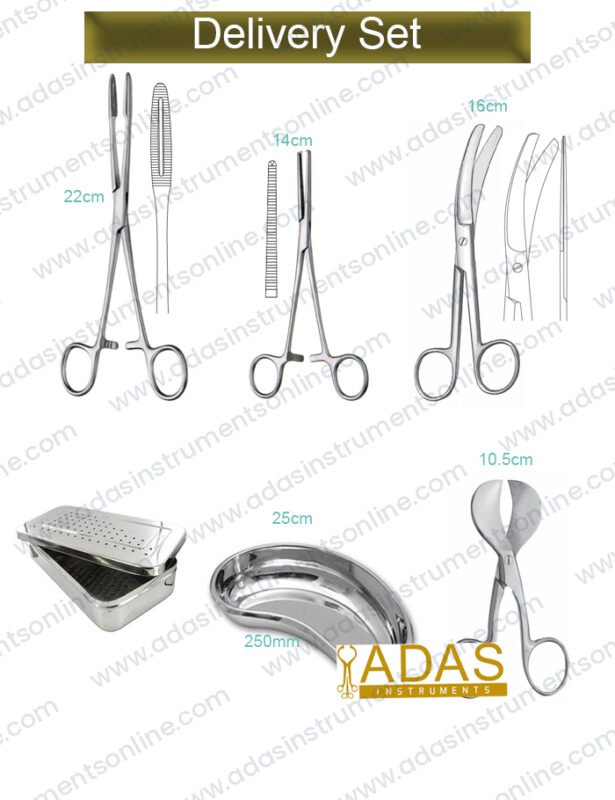
Read off our own pattern record for item AD-95601. Five pieces, five patterns, with the box counted separately.
| Instrument | Size or pattern | Qty |
|---|---|---|
| Busch umbilical scissors | 16 cm, curved | 1 |
| Umbilical cord scissors | 4 inch | 1 |
| Ochsner-Kocher artery forceps | 14 cm, straight | 1 |
| Gross-Maier dressing forceps | 22 cm, straight | 1 |
| Kidney bowl | 250 mm | 1 |
| Stainless steel instrument box | Holds the full set | 1 |
Where the set is used
Every birth room that sees vaginal deliveries needs a stack of these trays, not one.
| Setting | What the set does | Pieces doing the work |
|---|---|---|
| Hospital labor ward | Opened for every normal birth | The whole tray |
| Birth center | Cord clamping and cutting, placenta check | Umbilical scissors, Kocher forceps, kidney bowl |
| Midwife home birth kit | A small box that travels and autoclaves easily | The whole tray |
| Emergency department | An unplanned birth before transfer | Cord scissors, Kocher forceps |
| Training programs | Teaches the cord routine on real steel | Both scissors, Kocher forceps |
What it does, and what it must not be asked to do
Five instruments with clear jobs. Using one for another’s job is the commonest way a delivery tray is spoiled.
| Instrument | What it does | What it must not do |
|---|---|---|
| Busch umbilical scissors | Cuts the cord between two clamps | Cut perineal tissue. Episiotomy scissors are a different pattern, not in this set |
| Umbilical cord scissors, 4 inch | Trims a cord clamped close | Cut tape, sutures or packaging. That dulls a cord scissors fast |
| Ochsner-Kocher forceps | Clamps the placental side of the cord | Grip the baby side of the cord near the skin. Use a cord clamp there |
| Gross-Maier dressing forceps | Carries swabs and lifts membranes | Clamp anything. It has no ratchet |
| The set as a whole | The cord and birth routine on a normal delivery | Repair a tear. It has no needle holder or suture scissors |
How it compares with the other obstetric sets
Our obstetric trays climb from the everyday to the rare. This one is the everyday.
| Set | Pieces | What it carries | Buy it when |
|---|---|---|---|
| Delivery, this page | 5 | Two umbilical scissors, Kocher forceps, dressing forceps, kidney bowl | Every normal birth |
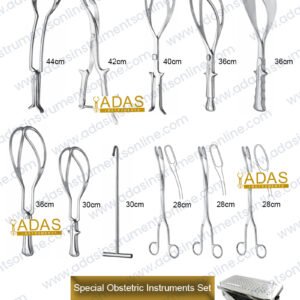
| Special obstetric instruments | 11 | Six obstetrical forceps, three ovum forceps | An assisted vaginal delivery is needed |
| Embryotomy | 8 | Perforators, cranioclast, Braun hook | Obstructed labor after fetal death, where cesarean is not possible |
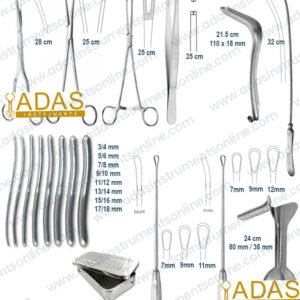
| Uterine evacuation | 16 | Hegar dilators, blunt curettes, tenacula | Retained tissue after the birth |
Materials and finish
Every piece in this delivery instrument set is made from high quality medical grade stainless steel. The steel itself is made to a German specification. We do not publish a grade number. What a labor ward needs to know is whether the Busch scissors still cut a cord cleanly after a year of daily autoclaving, and that comes from how the blades are hardened and set, not from a number.
The scissor blades are hardened after shaping and then set by hand at the joint, so they meet along the full edge. The kidney bowl is pressed from one sheet with a rolled rim, which means no seam for fluid to sit in. Everything has a satin finish so the overhead light in a birth room does not flash off the steel.
Caring for it
Rinse the tray straight after the birth. Cord blood dries fast and is hardest to shift from the joint of the Busch scissors and the teeth of the Kocher. Open the Kocher ratchet and the scissors for cleaning and for the autoclave.
Test both scissors on a strip of wet gauze every few weeks. A pair that folds the gauze instead of cutting it will chew a cord. Send it back to us with the item code and we will sharpen it, which costs far less than a new tray.
Ordering and wholesale
Every piece of the delivery instrument set is made by Adas Instruments in our own workshop and sold direct, which is why the price sits where it does against the catalog houses. Order one for a single tray, or in quantity for a hospital list or a distributor line. We do OEM work under your own brand and your own item numbers. Send us a sample and we will hold a run to your pattern rather than ours. Stock items ship from our own workshop. Backorder items take 10 to 12 working days to make. Every instrument carries a three year replacement warranty against manufacturing defects. Production is controlled under an ISO 13485 quality management system.
Frequently asked questions
What instruments are included in a normal delivery set?
The core is a pair of umbilical scissors, an artery forceps to clamp the cord, dressing forceps and a bowl for the placenta. Ours carries exactly that in five pieces. Larger kits add the episiotomy and repair instruments.
What are the instruments used in delivery?
On an ordinary birth: cord clamps, umbilical scissors, an artery forceps such as the Kocher, dressing forceps and a kidney bowl. For an assisted birth, obstetrical forceps are added, which are in our special obstetric instruments set.
What type of scissors are used to cut the umbilical cord?
Umbilical scissors with curved blades and a blunt lower tip, such as the Busch pattern, so the blade slides under the cord without catching the baby. This set carries the 16 cm Busch and a shorter 4 inch pair.
Does this set include episiotomy scissors or a needle holder?
No. Our delivery instrument set is the cord and birth tray only. Repairing a tear or an episiotomy needs a separate set with a needle holder and suture scissors.
What instruments are included in a cesarean section set?
A cesarean set is a full abdominal tray: retractors, many artery forceps, scissors, needle holders and a uterine incision set. It is a different tray from this one. We make a cesarean section set as well; ask us for its component list.
Related products and categories
When a birth needs assisting, the special obstetric instruments set carries six obstetrical forceps. The embryotomy instrument set is the rare tray for obstructed labor, and the uterine evacuation instrument set clears tissue left after a birth.
All of our trays for this specialty sit under gynecology and obstetrics instrument sets, and the full range of procedure trays is under surgical instrument sets.
| Weight | 0.35 kg |
|---|
Be the first to review “Delivery Instrument Set, 5 Pieces”
Shipping & Delivery Policy
Processing Time: In-stock items are dispatched within 24-48 hours. For custom or out-of-stock items, production time is approximately 10-15 days.
Global Delivery Estimates
We partner with world-class couriers (DHL, FedEx) to ensure fast, tracked delivery.
- USA & Canada: 3-5 Business Days
- Europe & UK: 4-6 Business Days
- Rest of World: 5-7 Business Days
*We offer Air Cargo and Sea Freight options for bulk wholesale orders.
Customs & Duties
International buyers are responsible for any customs duties or taxes imposed by their country. Adas Instruments is not responsible for delays caused by customs clearance.
Lost Packages & Insurance
If your package is lost in transit, please contact us immediately. We offer full support and replacements for confirmed lost shipments. Note: You must report non-delivery within 3 weeks to be eligible for an insurance claim.
Related products
Reviews
There are no reviews yet.