
Special Obstetric Instruments Set, 11 Pieces
$ 609.00
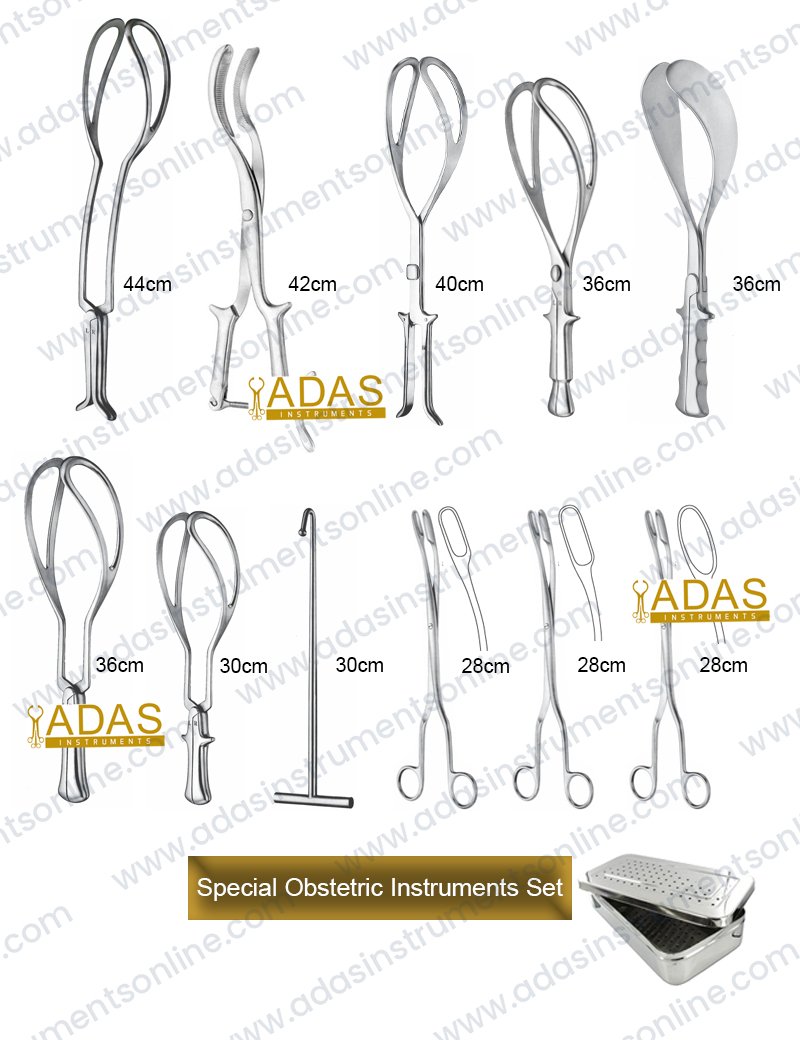
Our special obstetric instruments set is the operative birth tray: six patterns of obstetrical forceps in one box, from the 30 cm Simpson to the 44 cm Piper, with three Winter ovum forceps. It lets an obstetric unit choose the right forceps for the head position in front of it, including the Kielland-Luikart for rotation, instead of making one pattern do every job.
Key Features
- 11 pieces across 9 patterns, in a stainless steel instrument box
- Obstetrical forceps: Simpson-Braun 36 cm, Simpson 30 cm, Naegele 36 cm, McLean 36 cm
- Piper obstetrical forceps 44 cm and Kielland-Luikart 40 cm
- Three Winter ovum forceps, 28 cm, straight, Fig.1, 2 and 3
- Braun decapitating hook 30 cm and Braun cranioclast 42 cm
- Made from high quality medical grade stainless steel, fully autoclavable
- Three year replacement warranty against manufacturing defects
- Item code AD-95600
Available on backorder

What a special obstetric instruments set is
A special obstetric instruments set is the tray an obstetric unit opens when a birth needs more than hands. Google’s own summary sorts obstetric sets by the stage or complication they handle, from routine labor support to operative intervention. This one sits at the operative end: it is built around obstetrical delivery forceps, with ovum forceps for what is left behind and two rare instruments for the worst case.
The reason to buy six forceps rather than one is that no single pattern suits every head. The types of obstetric forceps differ in length, in the curve of the blades, and in how the two halves lock, and each difference exists because of a particular head position or a particular stage of descent. An obstetrician who trained on Simpson forceps and meets a breech with an after-coming head wants the Piper, and wants it now.
Many teaching texts split forceps into short and long curved obstetric forceps. The short kind, such as the Wrigley, is an outlet instrument for a head already on the perineum. The long kind reaches a head sitting higher in the pelvis. All six forceps in this set are the long curved kind, from 30 cm to 44 cm, and there is no short outlet pattern in the box. Units that use a Wrigley for most assisted births should know that before ordering, because it changes which tray goes on the trolley first.
What the tray does not carry needs saying too. There is no vacuum extractor, and no episiotomy scissors or repair instruments. Units that use ventouse first and forceps second will have the cups in a separate kit already.
At 609.00 dollars it is the most expensive of our gynecology and obstetric trays. Six long forceps take more steel and far more hand work than any other set in the category, because each pair of blades is fitted to its own partner and will not swap with another pair.
Key design features
Six obstetrical forceps patterns
Simpson-Braun 36 cm, Simpson 30 cm, Naegele 36 cm, McLean 36 cm, Piper 44 cm and Kielland-Luikart 40 cm, all recorded curved. The four classical patterns cover most outlet and low deliveries. The Piper and the Kielland are the specialists, and they are the two a unit regrets not having.
The Kielland for rotation
Kielland obstetric forceps are the rotational pattern, with a sliding lock so the two blades can sit at different levels on an asymmetric head. Our Kielland-Luikart is 40 cm. It is the forceps that needs the most training to use, and the one most often missing from older trays.
The Piper for a breech
The 44 cm Piper is the longest instrument in the set. Its long shanks are made for the after-coming head in a breech delivery, where the forceps go in under the baby’s body. Nothing else in the tray can do that job.
Three ovum forceps and two rare instruments
Three Winter ovum forceps, 28 cm, straight, Fig.1, 2 and 3, remove retained placenta and membranes after the birth. The Braun decapitating hook and Braun cranioclast are for obstructed labor after fetal death, where a cesarean cannot be done. Most units hope never to open them.
What is in the tray, piece by piece
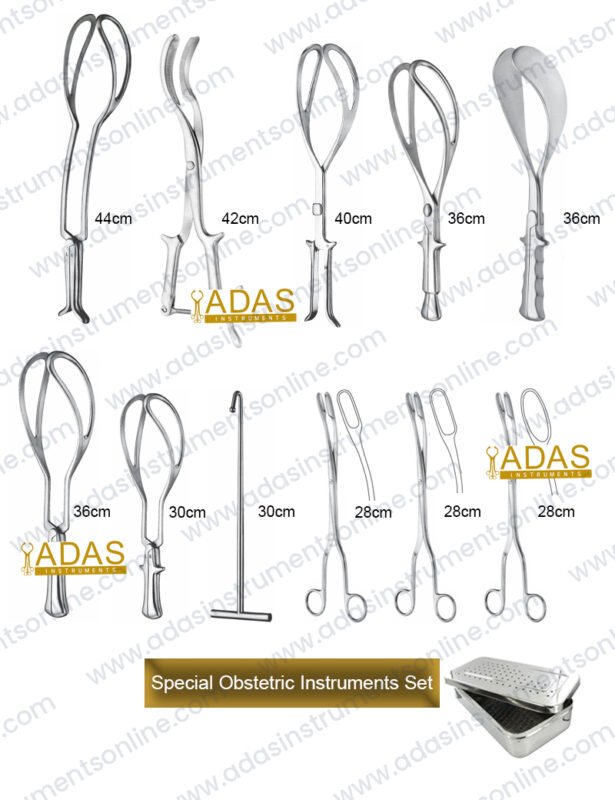
Read off our own pattern record for item AD-95600. Eleven pieces, nine patterns, the box counted separately.
| Instrument | Size or pattern | Qty |
|---|---|---|
| Simpson-Braun obstetrical forceps | 36 cm, curved | 1 |
| Simpson obstetrical forceps | 30 cm, curved | 1 |
| Piper obstetrical forceps | 44 cm, curved | 1 |
| Naegele obstetrical forceps | 36 cm, curved | 1 |
| Kielland-Luikart obstetrical forceps | 40 cm, curved | 1 |
| McLean obstetrical forceps | 36 cm, curved | 1 |
| Winter ovum forceps | 28 cm, straight, Fig.1, Fig.2 and Fig.3 | 3 |
| Braun decapitating hook | 30 cm | 1 |
| Braun cranioclast | 42 cm, upwards | 1 |
| Stainless steel instrument box | Holds the full set | 1 |
Where the set is used
Each situation below calls for a different instrument from the same box, which is the whole argument for buying them together.
| Situation | What the set does | Pieces doing the work |
|---|---|---|
| Delay in the second stage, head low | Assists the delivery of the head | Simpson, Simpson-Braun, Naegele or McLean |
| Malposition needing rotation | Rotates the head before traction | Kielland-Luikart, by a trained operator |
| Breech, after-coming head | Delivers the head after the body | Piper forceps |
| Retained placenta or membranes | Removes what the uterus has kept | Winter ovum forceps |
| Obstructed labor after fetal death | Reduces the head when cesarean is not possible | Braun cranioclast and hook |
What it does, and what it must not be asked to do
Forceps are only as safe as the choice of pattern and the hands using it. The limits below are the ones that matter.
| Instrument | What it does | What it must not do |
|---|---|---|
| Classical forceps | Guide and assist the head in a low or outlet delivery | Rotate a head. Their fixed lock and pelvic curve are not made for it |
| Kielland-Luikart | Rotates a malpositioned head | Be used by an untrained operator. Rotation is a skill, not a feature |
| Piper forceps | Delivers the after-coming head in a breech | Stand in for classical forceps on a cephalic birth |
| Winter ovum forceps | Lift retained tissue out of the uterus | Grip the uterine wall. Close them only on what can be seen or felt |
| Braun hook and cranioclast | The rare destructive delivery after fetal death | Ever be used on a living baby |
How it compares with the other obstetric sets
Our obstetric trays go from the everyday to the rare. This one is the operative middle.
| Set | Pieces | What it carries | Buy it when |
|---|---|---|---|
| Special obstetric, this page | 11 | Six obstetrical forceps, three ovum forceps, hook and cranioclast | Assisted vaginal birth is done on the unit |
| Delivery | 5 | Two umbilical scissors, Kocher forceps, kidney bowl | Every normal birth |
| Embryotomy | 8 | Two perforators, cranioclast, hook, scalp flap forceps | The unit needs the full destructive set, not just the two pieces here |
| Uterine evacuation | 16 | Hegar dilators, blunt curettes, tenacula | Retained tissue needs clearing after the birth |
Materials and finish
Every piece in this special obstetric instruments set is made from high quality medical grade stainless steel. The steel itself is made to a German specification. We do not publish a grade number. The real question about a pair of obstetrical forceps is whether the blades still meet evenly at the lock after years of autoclaving, and that depends on how the pair was fitted, not on a certificate.
Each pair is made and finished as a pair, and the two blades carry the same mark so they are never separated in the sterile processing department. The blades are polished smooth on the inside, the side that touches the baby. The handles are left with a satin grip so a gloved hand does not slip under traction.
Caring for it
Separate every pair of forceps at the lock before washing. Blood trapped in a lock dries and makes the blades hard to articulate on the next birth, which is the worst moment to find it. Autoclave them apart and reassemble only matching marks.
Check the Kielland sliding lock moves freely along its full travel. A sliding lock that sticks halfway defeats the reason for having a Kielland. We service obstetrical forceps; send them back with the item code.
Ordering and wholesale
Every piece of the special obstetric instruments set is made by Adas Instruments in our own workshop and sold direct, which is why the price sits where it does against the catalog houses. Order one for a single tray, or in quantity for a hospital list or a distributor line. We do OEM work under your own brand and your own item numbers. Send us a sample and we will hold a run to your pattern rather than ours. Stock items ship from our own workshop. Backorder items take 10 to 12 working days to make. Every instrument carries a three year replacement warranty against manufacturing defects. Production is controlled under an ISO 13485 quality management system.
Frequently asked questions
What are obstetric forceps used for?
To assist the delivery of the baby’s head when the second stage of labor needs help, by guiding and gently drawing the head down the birth canal. Some patterns also rotate the head or deliver the head in a breech.
What are the 3 main types of OB forceps?
Classical forceps such as the Simpson and Naegele, rotational forceps such as the Kielland, and specialized forceps such as the Piper for a breech. Our special obstetric instruments set carries all three types.
What is different about Kielland obstetric forceps?
A sliding lock and very little pelvic curve, so the blades can sit at different levels and the head can be rotated. Ours is the Kielland-Luikart pattern, 40 cm.
Why is the Piper forceps so long?
Because it goes in under the baby’s body to reach the after-coming head in a breech delivery. Ours is 44 cm, the longest instrument in the set.
Does the set include a vacuum extractor?
No. It is a forceps and ovum forceps set. Vacuum cups and pumps are a separate kit.
Related products and categories
For every normal birth, the delivery instrument set is the five piece cord tray. The full destructive set is the embryotomy instrument set, and the uterine evacuation instrument set clears tissue retained after a birth.
All of our trays for this specialty sit under gynecology and obstetrics instrument sets, and the full range of procedure trays is under surgical instrument sets.
| Weight | 0.8 kg |
|---|
Be the first to review “Special Obstetric Instruments Set, 11 Pieces”
Shipping & Delivery Policy
Processing Time: In-stock items are dispatched within 24-48 hours. For custom or out-of-stock items, production time is approximately 10-15 days.
Global Delivery Estimates
We partner with world-class couriers (DHL, FedEx) to ensure fast, tracked delivery.
- USA & Canada: 3-5 Business Days
- Europe & UK: 4-6 Business Days
- Rest of World: 5-7 Business Days
*We offer Air Cargo and Sea Freight options for bulk wholesale orders.
Customs & Duties
International buyers are responsible for any customs duties or taxes imposed by their country. Adas Instruments is not responsible for delays caused by customs clearance.
Lost Packages & Insurance
If your package is lost in transit, please contact us immediately. We offer full support and replacements for confirmed lost shipments. Note: You must report non-delivery within 3 weeks to be eligible for an insurance claim.
Reviews
There are no reviews yet.