
V-Dissector Cannulas: Fibrous Release Before Aspiration
Nov
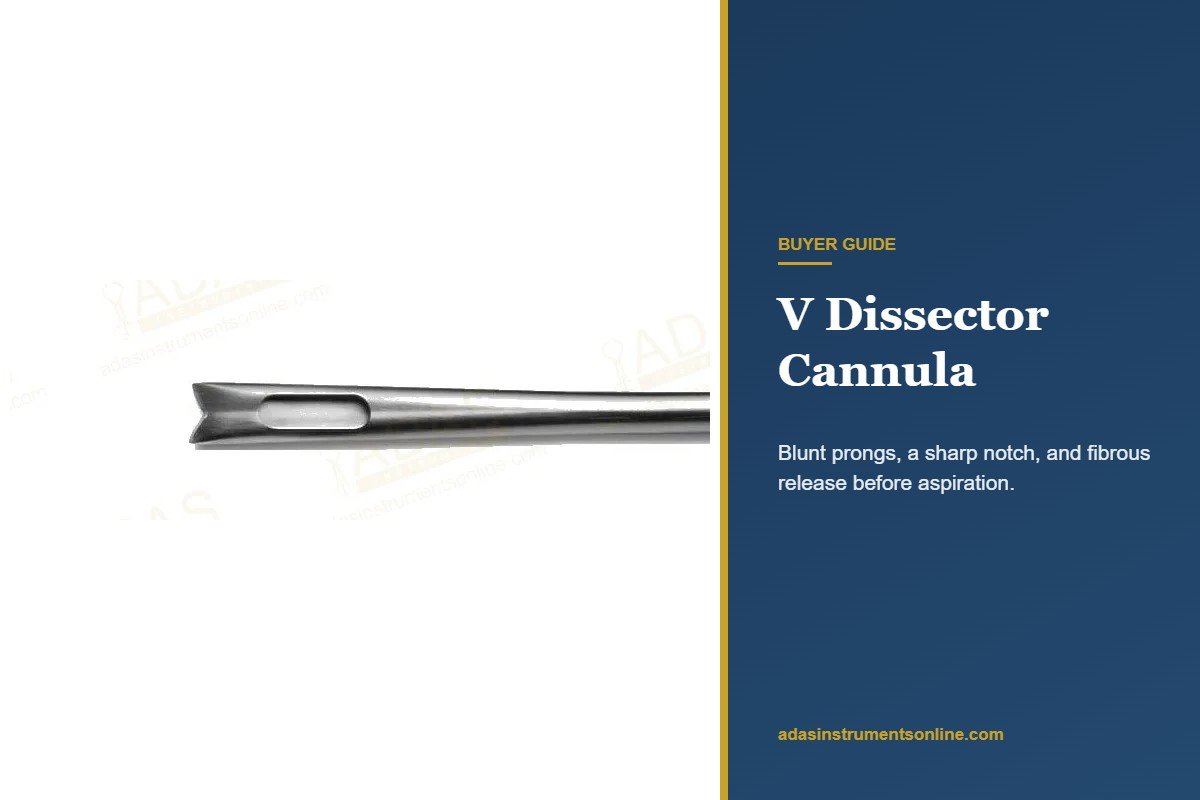
A V dissector cannula is a liposuction cannula with a forked tip: the two outer prongs are blunt and only the inner notch cuts, so it divides fibrous bands without slicing everything in its path. Surgeons use it before aspiration, a step called pre-tunneling, in revision cases, the male chest and the back. Adas Instruments makes the V-dissector cannula in 2 mm to 5 mm diameters and 15 cm to 35 cm lengths, alongside its aspiration cannulas.
The V-dissector is the pickle fork’s disciplined sibling: a forked tip whose outer edges stay blunt while only the inner notch cuts, built to pre-tunnel fibrous fields so aspiration cannulas can work them. In revision cases and dense zones, a V-dissector pass first turns a fight into a procedure. Here is the pattern’s guide.
Key takeaways
- Blunt outer prongs, sharp inner notch: it cuts only the bands that enter the V.
- It prepares the plane; the fat still comes out with standard aspiration cannulas afterwards.
- It earns its place in revision cases, dense male chests and fibrous backs, not in primary soft-fat work.
- Check that both prongs are truly rounded and the notch is honed before every case.
Blunt Outside, Sharp Inside
The geometry is the safety feature: rounded outer prongs glide past vessels and nerves the way any blunt cannula does, while bands entering the V meet the sharpened crotch and divide. It cuts only what it captures, which is what separates dissection from laceration in a blind plane, a controlled version of the subcision logic behind the pickle fork.
Pre-Tunneling: The Workflow Step
In scarred or fibrous fields (revision cases, gynecomastia, the back), a fan of V-dissector passes releases the septal web before suction starts. Aspiration cannulas then travel pre-made tunnels, extracting evenly where they would have skidded and stalled. The two-instrument sequence beats forcing a basket cannula through everything, especially where scar density varies stroke by stroke.
Where It Earns Its Slot
Revision liposuction leads: prior-surgery scar defeats standard tips before they start. Dense male chests, fibrous back rolls, and release-then-graft contour corrections where the freed space then receives a fat graft. Primary soft-fat cases skip it entirely; the V-dissector is a specialist, not a default.
Buying and Care
Check prong tips are truly rounded (a burred prong forfeits the whole safety design), the notch edge is honed, and shaft stiffness suits pre-tunneling force. Sheath the tip in storage, inspect the V at every cycle, and flush per standard lumen discipline even though many patterns are solid-shaft: tissue rides the fork the same way.
V Dissector Cannula Tips at a Glance
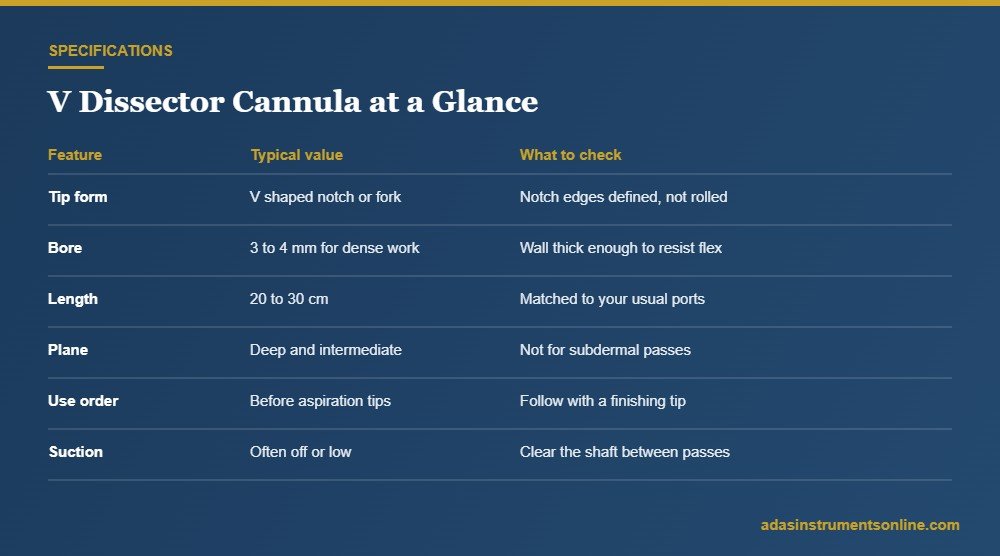
A v dissector cannula carries a V shaped notch or fork at the tip that splits fibrous tissue as the shaft advances. It is a preparation instrument: it opens the plane so that ordinary aspiration tips can then work without fighting the septa.
| Feature | Typical value | Purpose | What to check |
|---|---|---|---|
| Tip form | V shaped notch or fork | Splits septa ahead of the shaft | Notch edges defined, not rolled |
| Bore | 3 to 4 mm | Shaft strength through dense fat | Wall thick enough to resist flex |
| Length | 20 to 30 cm | Back, flank and chest reach | Matched to your usual ports |
| Plane | Deep and intermediate | Opens the working layer | Not for subdermal passes |
| Use order | Before aspiration tips | Reduces force needed later | Follow with a finishing tip |
| Suction | Often off or low | Dissection, not removal | Clear the shaft between passes |
| Finish | Satin or matte | Low glare, easy inspection | Uniform through the tip |
Order V-dissector cannulas direct from the maker
Adas Instruments makes the V-dissector cannula in 2, 2.4, 3, 4 and 5 mm diameters and 15 cm to 35 cm lengths, with luer lock, Toomey, super fix or threaded hubs, from 32 dollars. Plain or laser marked with your brand.
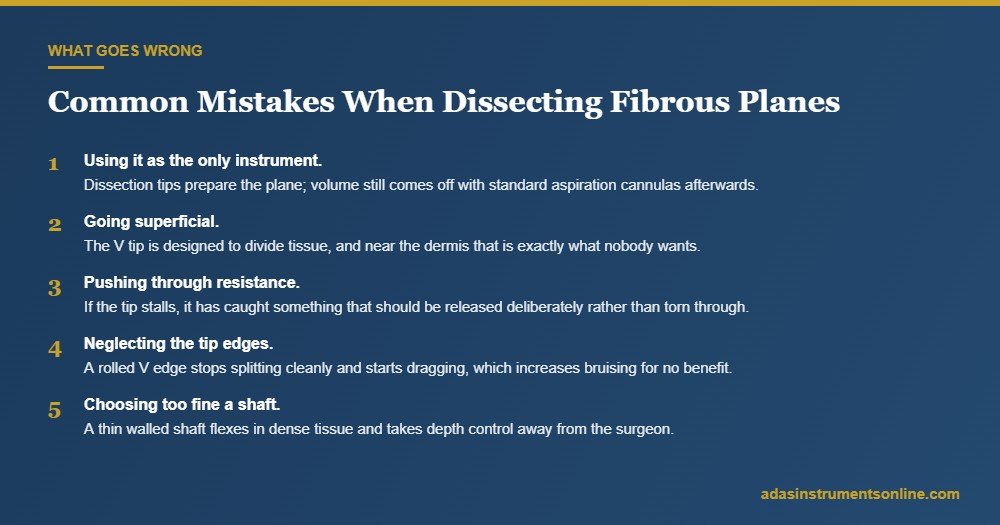
Common Mistakes When Dissecting Fibrous Planes
Opening a plane badly makes every later pass harder. Five points prevent most of it.
- Using it as the only instrument. Dissection tips prepare the plane; volume still comes off with standard aspiration cannulas afterwards.
- Going superficial. The V tip is designed to divide tissue, and near the dermis that is exactly what nobody wants.
- Pushing through resistance. If the tip stalls, it has caught something that should be released deliberately rather than torn through.
- Neglecting the tip edges. A rolled V edge stops splitting cleanly and starts dragging, which increases bruising for no benefit.
- Choosing too fine a shaft. A thin walled shaft flexes in dense tissue and takes depth control away from the surgeon.
Ordering Dissection Cannulas For Dense Tissue Work
Tip form, notch depth, wall thickness and shaft length all belong in the specification for a dissection instrument. Adas Instruments builds them in high quality medical grade stainless steel, match them to the hub standard you already use, assemble them into a set to a surgeon’s own list and mark them for OEM or white label supply. Production time on custom work is 10 to 15 working days, depending on order size.
Technique papers on fibrous and revision liposuction are indexed on PubMed and are worth reading before committing to one dissection approach over another. When you order, keep the dissection tips in the same family as your aspiration cannulas so handles, tubing and racks all continue to fit.
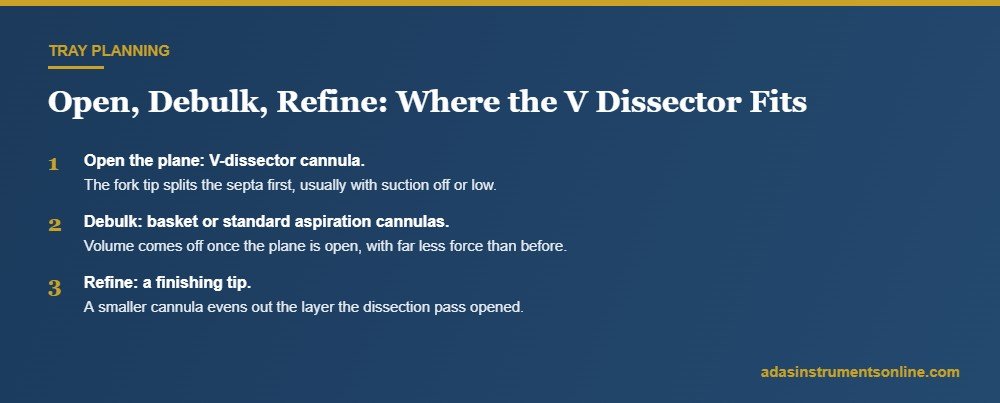
How Dissection Tips Fit the Fibrous Case Tray
A dense case usually runs in three stages: open the plane, debulk it, then refine it. The v dissector cannula owns the first stage only, which is why it is bought inside a broader liposuction cannula set that carries the other two stages as well.
For a side by side view of how V dissector, basket, fork and Mercedes tips differ in aggressiveness, our liposuction cannula types guide lays the families out together. Store dissection tips so the V cannot catch on other shafts, because the tip edges are the working surface and they mark easily.
Frequently Asked Questions
What is a V-dissector cannula?
A forked-tip liposuction cannula with blunt outer prongs and a sharpened inner notch. It glides bluntly through tissue and divides only the fibrous bands that are captured in its V, which is why it is safer than an open cutting tip.
How is a V-dissector different from a pickle fork?
The difference is where the edge sits. A classic pickle fork carries more exposed sharpness for superficial subcision, while the V-dissector blunts everything except the notch and works deeper, opening the plane before bulk removal.
When should fibrous fields be pre-tunneled?
When prior scar or dense tissue would stall the aspiration tips. Revisions, dense gynecomastia and back work come out faster and more evenly once the septal web has been released by a dissection pass.
Do you use suction with a V dissector?
Usually little or none during the dissection passes, because the job is to divide tissue rather than remove it. Suction is reconnected to clear the shaft and then the case moves to standard aspiration tips.
Which areas benefit most from dissection tips?
The back, the bra roll, the male chest and any revision field with scar tissue. These are the places where a standard tip stalls against septa and where forcing it produces bruising instead of contour.
