
Why Cannulas Clog Mid-Case and How to Prevent It
Nov
Cannula clogging in liposuction is a loss of flow mid-case, when fat or fibrous tissue blocks the ports or the line behind them. In almost every case it traces to one of five causes: fibrous plugs, vacuum too high for the bore, kinked tubing, a full canister, or residue left in the lumen. Adas Instruments makes the aspiration cannulas these checks apply to, in bores from 2 mm upward.
A clogged cannula mid-case is the most common equipment interruption in liposuction, and almost every episode traces to one of five causes, four of them preventable before the first pass. Here is the diagnostic list in the order to check it, and the habits that keep lumens flowing for whole cases.
Key takeaways
- Walk the line from tip to canister before swapping the cannula: tubing and filters fake a clog often.
- In fibrous zones, a basket or a pre-tunneling pass prevents plugs better than more vacuum.
- Clear a plug at the back table with a stylet or reverse flush, never by banging the tip.
- A cannula that clogs case after case is usually telling you about its cleaning, not its design.
Cause One: Fibrous Plugs at the Ports
Septal tissue bridges and wedges in the openings, the classic stall in dense zones. Prevention is instrument choice: basket cannulas or pre-tunneling with a V dissector in fibrous fields, per zone, before frustration. Clearing is a stylet or reverse flush at the back table, never tip-banging on the field edge, which bends tips and per our retirement guide ends instruments early.
Cause Two: Vacuum Set Wrong for the Bore
High vacuum through fine bores collapses tissue INTO the ports and packs it; micro work runs moderate machine settings or syringe suction per the facial workflow. If the fine cannula keeps plugging, the dial is usually the culprit, not the instrument.
Causes Three and Four: The Circuit, Not the Cannula
Tubing kinks at the drape edge and filter-canister saturation mimic cannula clogs perfectly; a thirty-second circuit walk, hub, tubing run, canister line, before swapping instruments saves swaps. Worn hub seals per the handles guide add air leaks that read as weak flow.
Cause Five: The Residue You Kept
Lumens narrowed by protein varnish from incomplete reprocessing clog earliest: the full lumen care workflow is mid-case flow insurance. A cannula that clogs repeatedly across cases is telling you about its cleaning history, not its geometry.
Cannula Clogging in Liposuction: Causes and Fast Checks
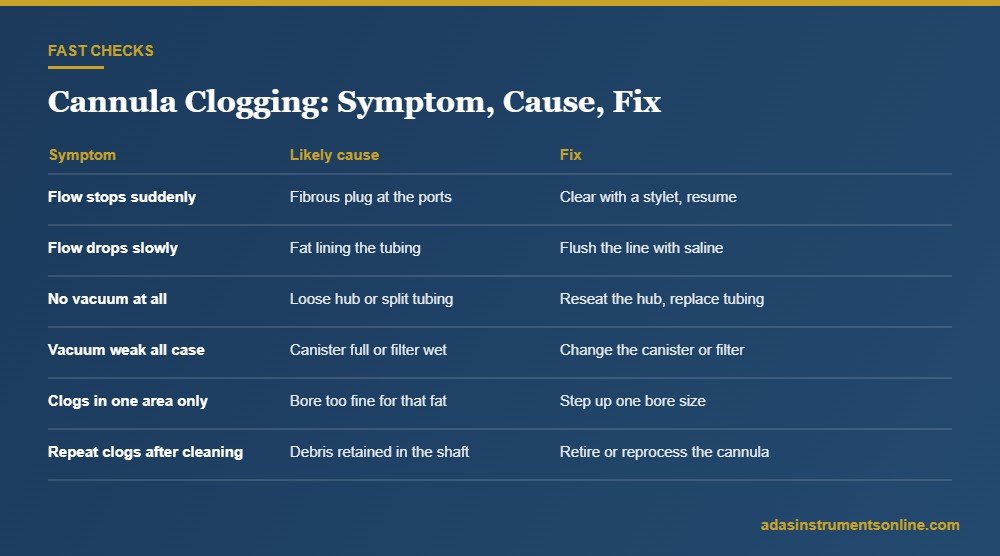
Cannula clogging in liposuction almost always traces to one of six places, and the fastest way to find it is to work along the line from tip to canister rather than guessing.
| Symptom | Likely cause | Fast check | Fix |
|---|---|---|---|
| Flow stops suddenly | Fibrous plug at the ports | Withdraw and inspect the tip | Clear with a stylet, resume |
| Flow drops slowly | Fat lining the tubing | Pinch and release the line | Flush the line with saline |
| No vacuum at all | Loose hub or split tubing | Listen for air at the joints | Reseat the hub, replace tubing |
| Vacuum weak all case | Canister full or filter wet | Check the level and the filter | Change the canister or filter |
| Clogs in one area only | Bore too fine for that fat | Compare with a wider tip | Step up one bore size |
| Repeat clogs after cleaning | Debris retained in the shaft | Flow test after washing | Retire or reprocess the cannula |
| Clogging with grafting fat | Luer fitting on dense fat | Check the fitting standard | Switch to a Toomey fitting |
Cannulas for fibrous fields, direct from the maker
Adas Instruments makes the Becker basket cannula in 3, 4, 5 and 6 mm bores and 20 cm to 45 cm lengths from 55 dollars, and the V-dissector cannula for pre-tunneling from 32 dollars. Plain or laser marked with your brand.

Common Mistakes That Cause Clogging
Most clogging is created before the case starts. Five habits are responsible for the majority of it.
- Under wetting the area. Dry fibrous tissue packs the ports; adequate tumescent infiltration is the single best prevention.
- Choosing too fine a bore. A 2 mm tip in a fibrous back is a clogging machine, however carefully it is handled.
- Skipping the flow test. A cannula that passed visual inspection can still be blocked internally from the previous case.
- Letting the canister fill. Vacuum falls long before the canister looks full, and everyone blames the cannula first.
- Cleaning without a lumen brush. Surface washing leaves the inside of the shaft coated, and that coating is next week’s clog.
Ordering Cannulas That Clog Less Often
A cannula that clogs less has a smooth internal bore, deburred ports and no internal step at the hub. Those are manufacturing details, and they are worth naming on the order along with bore, length and port pattern. Adas Instruments makes them from high quality medical grade stainless steel, built to custom lengths, matched to your hub standard and available with OEM or white label marking. Production time on custom work is 10 to 15 working days, depending on order size.
Reprocessing practice is part of the same problem, and perioperative bodies such as AORN publish the guidance that most theatre teams work from. On the equipment side, adapters, couplers and handles sit in the liposuction accessories range.
Building a Tray That Recovers From a Clog Quickly
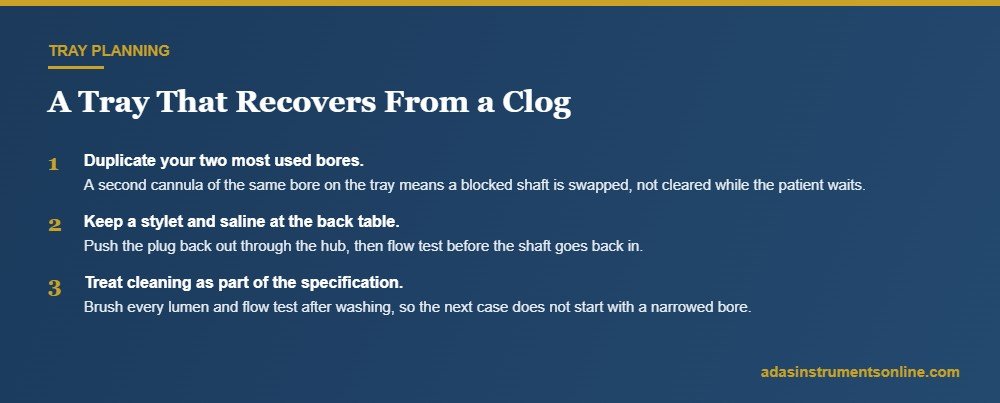
The practical answer to clogging delays is redundancy: a second cannula of the same bore already on the tray, so a blocked shaft is swapped rather than cleared while the patient waits. Keep duplicates of your two most used bores from the aspiration cannula range.
Cleaning is where the next case clogs get created, so treat the wash and sterilize step as part of the instrument specification. Our autoclaving surgical instruments guide covers the cycle side, and the lumen brushes and drying racks that go with it belong with your standing accessory order.
Frequently Asked Questions
Why does my liposuction cannula keep clogging?
There are five usual causes, best checked in this order: fibrous plugs at the ports, vacuum set too high for the bore, kinked tubing, a saturated canister filter, and lumens narrowed by residue from incomplete cleaning.
Does higher vacuum prevent clogging?
Often the opposite, especially in fine bores. Excess vacuum packs tissue into the ports and holds it there. Matching the pressure to the bore works better than turning the dial up when flow drops.
Does a bigger cannula clog less?
Generally yes, particularly in fibrous areas such as the back and male chest. Stepping up one bore size is often faster than repeatedly clearing a fine tip, and the contour difference at the deep layer is small.
How do I clear a clogged cannula during surgery?
Withdraw it, disconnect the tubing and push the plug back out through the hub with a stylet rather than pulling it forward through the ports. Then flow test with saline before the shaft goes back into the patient.
Can tubing cause what looks like a cannula clog?
Yes, frequently. Fat lining the tubing, a wet filter or a nearly full canister all reduce vacuum in the same way a blocked tip does. Check the disposable side before blaming the instrument.
