
Bishop Harmon Forceps: Why Eyelid Surgeons Swear by Them
Nov
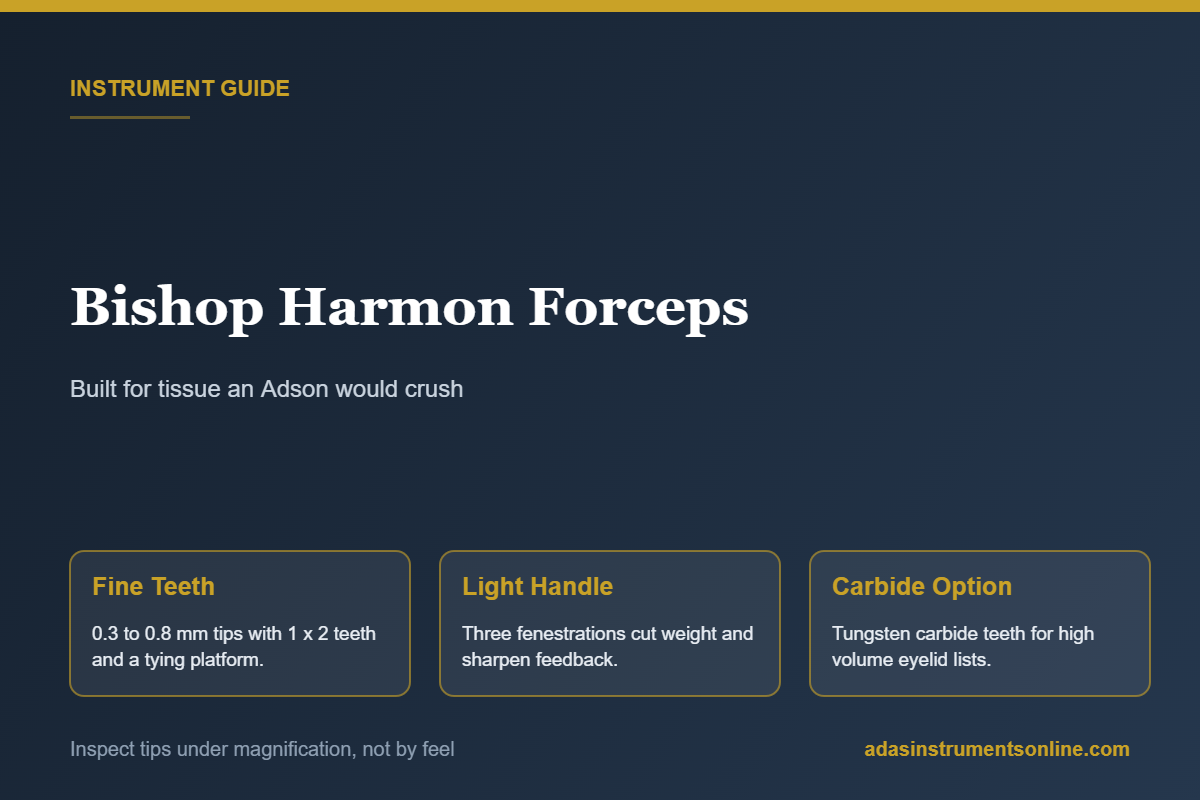
Bishop Harmon forceps are fine tissue forceps with three holes cut through each arm to take weight out of the instrument, so the hold comes from fingertip pressure rather than grip. Surgeons use them for eyelid skin, muscle and other tissue that bruises under any extra force, which is why they sit in every set of blepharoplasty instruments. Adas Instruments makes them with a 0.4 mm or 0.6 mm tip, toothed or serrated.
Bishop Harmon forceps are the small forceps with the three signature holes in each arm, and in eyelid and fine facial surgery they are close to a religion. Light, precise and perfectly balanced, they hold tissue measured in fractions of a millimeter without crushing it. This guide covers Bishop Harmon forceps uses, the toothed and smooth variants, and what the holes are actually for.
Key takeaways
- The three holes in each arm cut weight, so fingertip pressure, not grip force, controls the hold.
- The 1×2 toothed tip grips eyelid skin for excision and suturing; the serrated tip handles tissue that teeth would puncture.
- They are built for eyelid-class tissue, where a standard Adson is too much instrument.
- Adas Instruments makes them with a 0.4 mm or 0.6 mm tip and a fenestrated handle.
The Holes Are the Point
The three fenestrations in each arm remove weight where it matters most: an instrument light enough that fingertip pressure, not grip force, controls the hold. In eyelid skin, where the difference between holding and bruising is grams, that weight reduction is the feature. The holes also index the fingers to the same position every time, which is why the hold feels identical case after case.
Toothed vs Smooth
The 1×2 toothed pattern grips eyelid skin and orbicularis securely for excision and suturing, the fine-tissue equivalent of the rat tooth logic from our pickups guide. The smooth (serrated) pattern handles conjunctiva, fat pads and suture ends where teeth would puncture. Standard length runs about 8.5 cm, deliberately short for work close to the eye.
Where They Are Used
Upper and lower blepharoplasty at every step, ptosis and brow work, lacerations near the lid margin, chalazion and lesion excision, and any facial closure in 6-0 or finer where standard Adsons feel like machinery. They pair with Westcott scissors and the Castroviejo needle holder as the fine trio of the blepharoplasty set.
Shop Bishop Harmon forceps direct from the maker
Adas Instruments makes Bishop Harmon iris tissue forceps with a fenestrated handle, a 0.4 mm or 0.6 mm tip and a 1×2 toothed or serrated jaw, from 13.20 dollars. Plain or laser marked with your brand.
Buying Checks
Tips must meet exactly under magnification, teeth must interdigitate without shear, and the spring should return silently with no side wander. High quality medical grade stainless steel with a satin or anti-glare finish suits loupe and microscope work; our bleph range carries both finishes.

Bishop Harmon Forceps Uses by Tip Pattern
Bishop Harmon forceps uses cluster around one thing: handling tissue that is too delicate for Adson forceps. The three hole handle keeps the instrument light, and the tip pattern decides what it can safely hold.
| Tip pattern | Tip width | Tying platform | Best suited to |
|---|---|---|---|
| 1 x 2 teeth | 0.3 mm | Yes | Eyelid skin and conjunctiva |
| 1 x 2 teeth | 0.5 mm | Yes | General fine plastic work |
| 1 x 2 teeth | 0.8 mm | Yes | Thicker facial skin |
| Serrated, no teeth | 0.5 mm | Yes | Dressings and suture handling |
| Tungsten carbide teeth | 0.5 mm | Yes | High volume lists |

How Fine Forceps Get Retired Early
A pair of Bishop Harmon forceps should last years. The ones that do not usually died from one of these five.
- Used as a needle holder. Gripping a needle in the teeth springs the tips out of alignment permanently.
- Dropped tip first. The tips are the instrument. A drop that would not mark a hemostat can end a fine forceps.
- Tangled in the wash basket. Fine tips catch on heavier instruments. Process them in a protected tray or with tip guards.
- Teeth checked by feel. Teeth should be inspected under magnification, not judged by how they feel in the hand.
- One pair on the tray. When the only fine forceps bends mid case, the case continues with the wrong instrument.
Specifying Bishop Harmon Forceps
Specify tip width in millimeters, tooth pattern, whether you want a tying platform, and whether you want tungsten carbide inserts on the teeth. Carbide costs more and lasts far longer on a busy list. Ours are made from high quality medical grade stainless steel with tips inspected under magnification, and they are listed in the dressing and tissue forceps category.
Custom tip widths, non reflective black or satin finishes, alternative handle lengths and practice or distributor marking are available, and a fine instrument set can be built to a surgeon’s written list. Production time on custom work is 10 to 15 working days, normally 15 working days depending on order size. General device handling and reprocessing expectations are set out on the US FDA medical device pages.
The Fine Tray This Instrument Belongs To
Bishop Harmon forceps uses rarely stand alone. The instrument almost always travels with a matched set: fine scissors, a Castroviejo or Webster needle holder, small skin hooks and a caliper. Practices doing eyelid work keep the whole group together in the blepharoplasty instruments range rather than scattering it through a general tray.
For finer work still, the micro surgery instruments range picks up where Bishop Harmon leaves off, with jeweler patterns from 0.1 mm. Between them they cover almost all delicate soft tissue handling, and buying across both avoids the temptation to use a heavier instrument on skin that will show it.
Completing the fine trio? Bishop Harmon patterns, toothed and smooth, in medical grade steel.
Frequently Asked Questions
What are Bishop Harmon forceps used for?
Holding eyelid skin, muscle and delicate facial tissue during blepharoplasty, ptosis work and fine closure: the fenestrated arms make the instrument light enough for fingertip control on tissue that bruises easily.
Why do Bishop Harmon forceps have holes?
Weight reduction and finger indexing: the three fenestrations lighten the arms so grip force stays in grams, and they seat the fingers identically every time.
What is the difference between Bishop Harmon and Adson forceps?
Scale: the Adson is the general skin workhorse at 12 cm; the Bishop Harmon is shorter, lighter and finer for eyelid-class tissue where an Adson is too much instrument.
Why do Bishop Harmon forceps have holes in the handle?
The fenestrations reduce weight and give the fingers a consistent grip position. A lighter instrument transmits more tactile feedback, which matters when the tissue being held is under a millimeter thick.
Are tungsten carbide tips worth it?
On a high volume list, yes. Carbide teeth hold their grip far longer than steel and resist the rounding that makes an old forceps slip. For occasional use, a well made steel tip is entirely adequate.
