
Luer Lock vs Toomey Tip: Syringe Standards Decoded
Nov
Two syringe standards run every liposuction and fat transfer room, and half the ordering mistakes we untangle trace to confusing them. Luer lock vs Toomey is not a question of which is better but of geometry: threaded 6 percent taper versus wide catheter taper, precision versus volume. Decode them once and every cannula and adapter order becomes obvious.
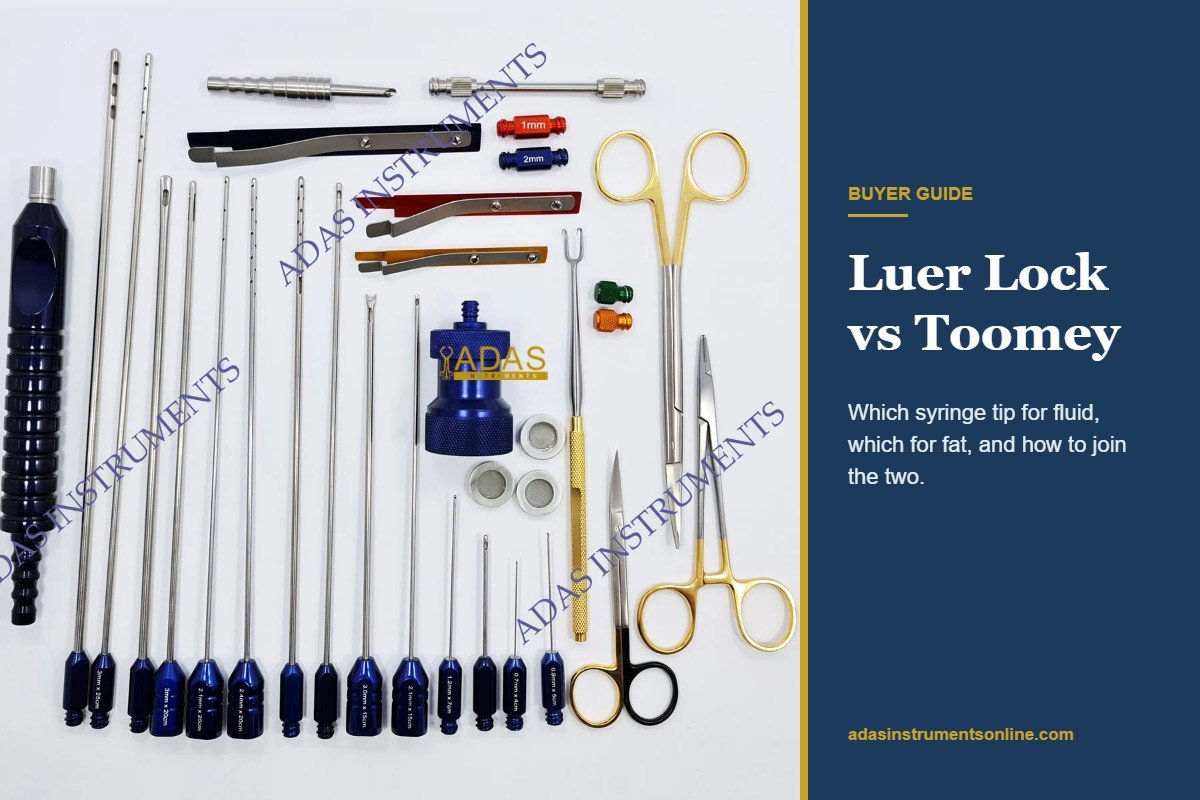
Luer lock vs Toomey comes down to the tip of the syringe. A luer lock tip is a small 6 percent taper with a threaded collar, used for tumescent fluid, local anesthetic and fine fat injection. A Toomey tip is a wide, unthreaded catheter taper that seats by friction and moves fat in volume during harvest and transfer. Adas Instruments makes liposuction and fat grafting cannulas with both hubs, in high quality medical grade stainless steel, along with the couplers that join them.
Key takeaways
- Luer lock is a 6 percent taper with a threaded collar, so it holds under pump pressure and torque.
- Toomey is a friction fit with a wide channel, so fat passes through the joint without shearing.
- The two tapers do not fit each other directly; a Toomey to luer coupler is needed when you harvest with one and inject with the other.
- Order cannulas by hub first, then bore and length, and label every tray and drawer by fitting.
The Luer Standard: Small, Threaded, Universal
The luer is medicine’s universal small connector: a standardized taper, in lock form secured by a threaded collar that cannot slip under pressure. In our world it rules infiltration lines, syringe-based facial liposuction per the facial cannula guide, and every micro and nanofat injector. Its orifice is deliberately small, perfect for anesthetic solutions and fine aliquots, hostile to whole fat parcels.
The Toomey Standard: Wide, Friction-Fit, Volume
The Toomey catheter taper seats by friction over a wide cone: no thread, fast swaps, and an internal channel that passes fat lobules unsheared, the engineering covered in our Toomey systems guide. It dominates harvest and high-volume reinjection, and its honest weakness is the friction fit: under real pressure a Toomey joint can burp where a luer lock cannot.
The Decision Table in Words
Choose luer lock when: fluid is thin, precision matters, pressure is high or the connection must survive torque (infiltration pumps, micro injection). Choose Toomey when: fat itself moves through the joint and shear is the enemy (harvest, transfer, gluteal reinjection). Stock couplers for the crossings, and order every cannula by hub standard first, pattern second.
Labeling Your Inventory
The practical fix that ends mid-case surprises: separate storage, hub type on every shelf label, and both standards in the count sheets. Our listings state the hub on every cannula because the fitting, not the tip, is what makes an instrument usable on your setup.
Luer Lock vs Toomey: A Direct Specification Comparison
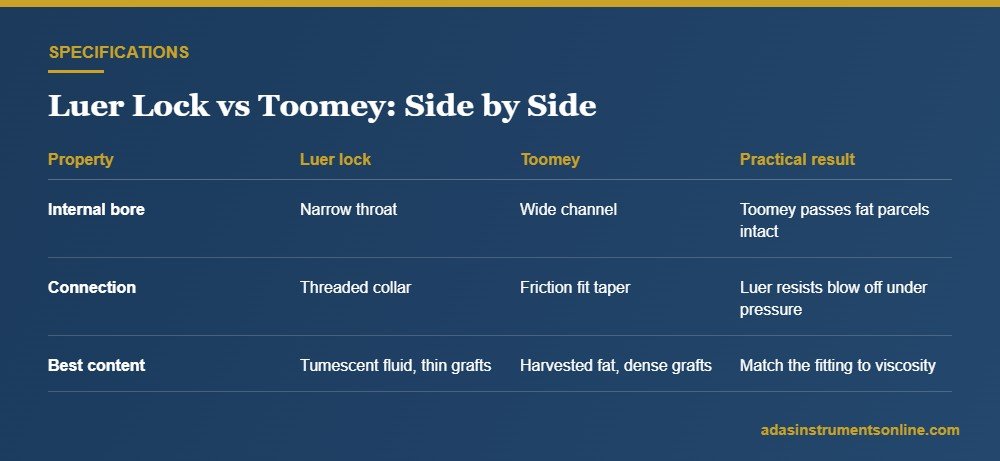
The luer lock vs toomey question is not a preference argument, it is a bore size argument. One standard was designed for fluid and the other for tissue, and using the wrong one shows up as clogging or as leaking.
| Property | Luer lock | Toomey | Practical result |
|---|---|---|---|
| Internal bore | Narrow throat | Wide channel | Toomey passes fat parcels intact |
| Connection | Threaded collar | Friction fit taper | Luer resists blow off under pressure |
| Best content | Tumescent fluid, thin grafts | Harvested fat, dense grafts | Match the fitting to viscosity |
| Typical barrel | 1 to 10 cc | 20 and 60 cc | Injection versus harvest volumes |
| Clog risk | High with fibrous fat | Low | Fewer stops in the middle of a case |
| Adapters | Toomey to luer available | Luer to Toomey available | One set can serve both standards |
| Where it wins | Fine facial injection | Body harvest and transfer | Most practices need both |
Shop luer and Toomey fittings direct from the maker
Adas Instruments makes the adapters, couplers, syringe holders and handles that join both standards, from a 4.50 dollar luer to luer transfer adapter to a 28 dollar luer lock super handle. Cannulas come with luer lock or Toomey hubs on request, plain or laser marked with your brand.
Common Mistakes When Mixing the Two Standards
Almost every fitting problem in a fat transfer case traces back to one of these five.
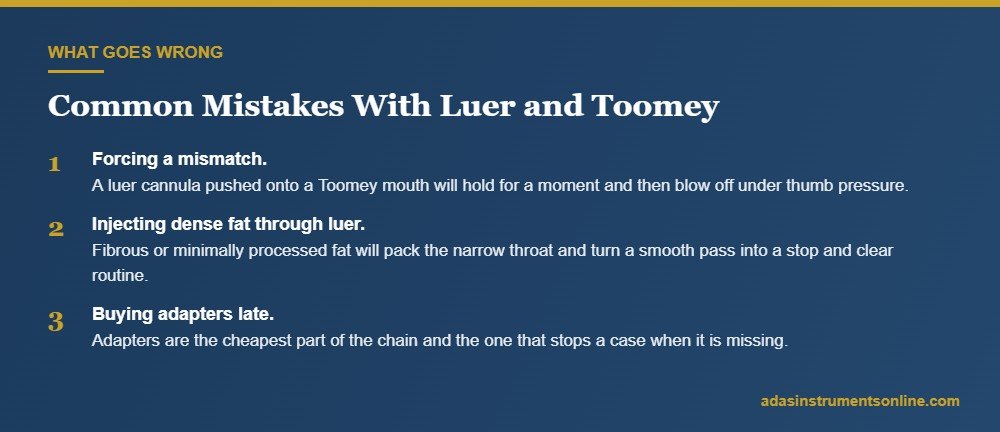
- Forcing a mismatch. A luer cannula pushed onto a Toomey mouth will hold for a moment and then blow off under thumb pressure.
- Injecting dense fat through luer. Fibrous or minimally processed fat will pack the narrow throat and turn a smooth pass into a stop and clear routine.
- Buying adapters late. Adapters are the cheapest part of the chain and the one that stops a case when it is missing.
- Ignoring thread wear. A luer collar that has been cross threaded once never seals the same way again, so retire it.
- Assuming one standard for everything. Harvest wants Toomey and fine facial injection wants luer; a set built around only one will fight you somewhere.
Ordering Cannulas Around a Fitting Standard
When you specify cannulas, name the hub standard on every line of the order. Adas Instruments builds the same shaft in high quality medical grade stainless steel with either fitting, in custom lengths and hole patterns, and mark it for OEM or white label supply. Production time on custom work is 10 to 15 working days, normally 15 working days depending on order size.
Fitting standards are exactly the kind of dimensional detail that international standards bodies such as ISO exist to hold steady, which is why an adapter from one supplier usually mates with a syringe from another. If you are ordering a mixed set, the simplest approach is to buy the harvest side and the injection side together from one liposuction cannula set so the fittings are known to agree.

Building a Tray That Handles Both Fittings
A practical fat transfer tray settles the luer lock vs toomey question by carrying both: Toomey barrels and harvest cannulas for volume, luer syringes and fine cannulas for placement, and two or three adapters to bridge them. Keep the fine end stocked from the fat grafting and injection cannula range.
Label the adapters and store them with the syringes rather than loose in a tray corner, because they are small enough to disappear into a wash basket. Spare adapters, caps and plunger handles sit naturally with the rest of the liposuction accessories on a standing reorder.
Untangling your fittings? Cannulas and adapters in both standards, hub type stated on every listing.
Frequently Asked Questions
What is the difference between luer lock and Toomey tip?
Geometry and purpose: luer lock is a small threaded taper for secure precision connections; Toomey is a wide friction taper that passes fat in volume without shear. They serve opposite ends of the same workflow.
Can a luer cannula fit a Toomey syringe?
No, not directly. The two tapers are different sizes and shapes, so the joint will leak or blow off under pressure. Use a Toomey to luer coupler, and keep couplers for both directions on every tray where the two systems run side by side.
Why does fat transfer avoid luer connections for volume work?
The narrow luer throat squeezes fat lobules as they pass, and that shear can damage the graft. The wide Toomey channel lets fat parcels move through intact, so harvest and bulk transfer run on Toomey while luer is kept for fine placement.
Is Toomey bigger than luer lock?
Yes. The Toomey tip and its channel are much wider than a luer tip, which is why Toomey is used for harvesting and transferring fat while luer is used for fluid and for fine injection.
Do I need adapters between the two standards?
If you harvest with Toomey and inject through luer cannulas, yes. A Toomey to luer adapter is a small stainless part that lets one harvest syringe fill many small injection syringes without decanting fat into an open bowl.
Which fitting is better for facial fat grafting?
Luer lock, for placement. Facial work uses 1 cc and 3 cc syringes with 0.9 to 1.2 mm cannulas, and the threaded luer collar keeps the cannula attached under the higher pressure that fine bores create.
Can luer lock syringes be used for harvesting?
They can for very small volumes, but the narrow throat shears and clogs with anything dense. For harvest of more than a few cc, a Toomey barrel with a matched wide bore cannula is the more reliable choice.
