
Osteotome vs Chisel in Rhinoplasty: Straight, Curved or Guarded
Oct
Osteotome vs chisel comes down to the grind. An osteotome is ground on both faces, so it splits bone along a line. A chisel is ground on one face, so it shaves a surface. In rhinoplasty the osteotome makes the bone cuts, from the hump down to the lateral and medial lines, while the chisel trims septal bone and spurs. Adas Instruments makes both in high quality medical grade stainless steel, in widths from 2 mm to 16 mm and lengths of 16 to 19 cm.
All of the patterns below sit in our osteotome and chisel range, which runs to 21 instruments. Most nasal trays need six or seven of them. Which six depends on the cuts you make, so this osteotome vs chisel guide goes cut by cut.
Key takeaways
- Osteotome vs chisel: an osteotome has a double bevel and cuts a line through bone. A chisel has a single bevel and shaves along it.
- Straight osteotomes of 8 to 16 mm take the dorsal hump. Curved blades of 2 to 4 mm follow the lateral wall.
- A guard is a small rounded ridge beside the blade. It protects the soft tissue and lets you feel the blade through the skin.
- Our nasal osteotomes start at 18 dollars for the Cottle and 28 dollars for the Rubin, Walter or Cinelli.
Osteotome vs Chisel: The Bevel Decides
Lay the two blades side by side and they look almost the same. Turn them edge on and the difference is plain. The osteotome tapers to its edge from both faces, like a knife. The chisel is flat on one face and ground only on the other, like a wood chisel.
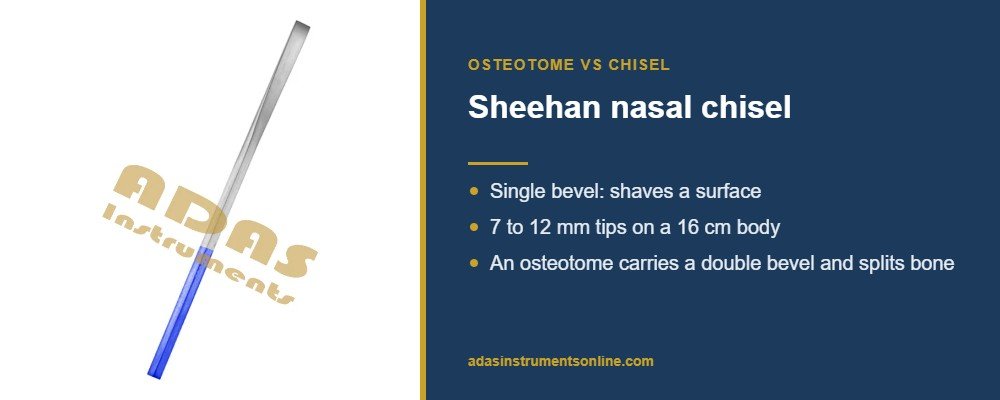
That one detail changes how each behaves in bone. A double bevel pushes the bone apart evenly on both sides, so the cut goes where it is pointed. A single bevel rides along the flat face, so it lifts a sliver off the surface. That is why surgeons reach for a Sheehan or a Freer chisel on the septum and keep the osteotome for the nasal bones.
| Osteotome | Chisel | |
|---|---|---|
| Grind | Both faces | One face |
| What it does | Splits bone along a line | Shaves a surface |
| Rhinoplasty job | Dorsal hump plus lateral and medial cuts | Septal bone, spurs, fine trimming |
| Our patterns | Cottle, Rubin, Walter, Cinelli, Giunta, Rozner | Sheehan, Freer, Silver, Walter chisel |
The names do not always help. Our Silver cartilage chisel carries a guard like an osteotome, and some catalogues call any nasal blade a chisel. Check the edge, not the label. That is the whole osteotome vs chisel test.
Straight Osteotomes for the Dorsal Hump
A straight osteotome takes the bony hump off in one piece once the cartilage has been released. Width matters most here. A blade as wide as the hump keeps the cut flat from start to finish, and a narrow one tends to wander.
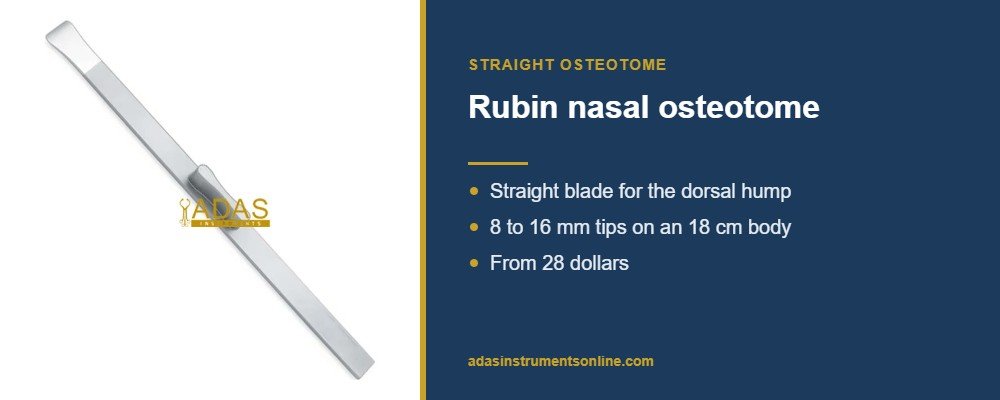
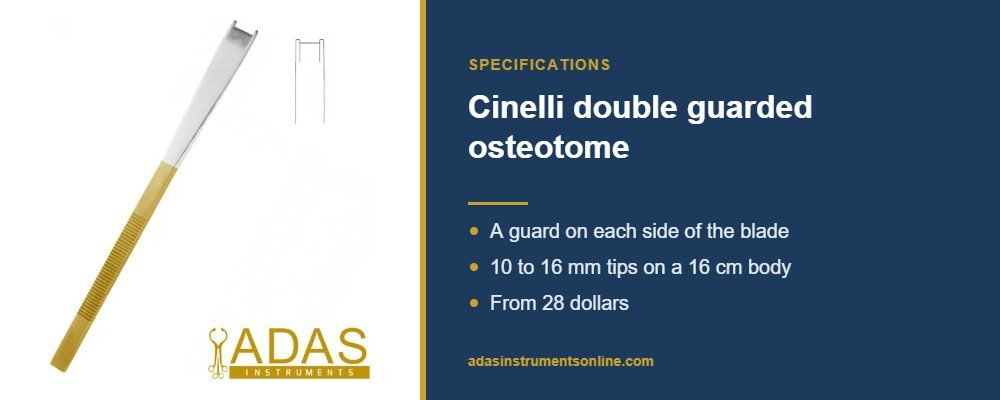
The Rubin nasal osteotome is the usual choice, 18 cm long with tips from 8 to 16 mm. The Cinelli does the same job with a guard on each side and comes in 10 to 16 mm on a 16 cm body. If you want one straight blade in several widths, the Cottle 18 cm runs from 2 mm right up to 16 mm, and at 18 dollars it is the cheapest way to cover the range.
Curved Osteotomes for the Lateral Cut
The lateral osteotomy follows the line where the nasal bone meets the maxilla. That line curves, so the blade curves with it. A straight blade here either cuts too high or skids off the bone.
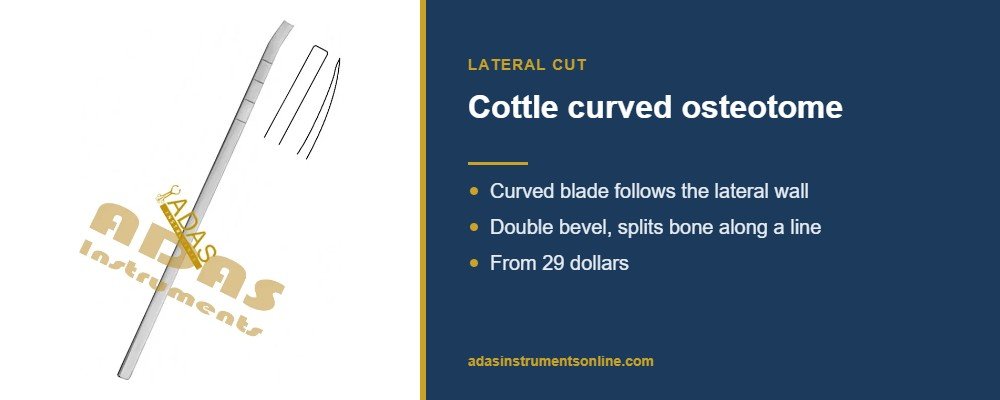
The Cottle curved osteotome is built for exactly this cut. The Walter comes straight or curved in six widths from 2 mm to 12 mm on a 19 cm body, so one pattern covers the fine lateral work and the wider cuts. Most surgeons use 2 to 4 mm on the lateral wall.
Guarded Osteotomes: What the Guard Does
A guard is a small rounded ridge running down one side of the blade. It earns its place in two ways. It keeps the periosteum and skin from tearing as the blade moves forward. It also gives you something to feel through the skin, so you know where the edge is without looking.
Single guarded blades are the norm for intranasal lateral work. Double guarded patterns such as the Cinelli and Giunta suit the hump, where both edges of the cut run close to soft tissue. On an open approach, where you can see the dorsum, many surgeons prefer no guard at all.
Osteotome vs Chisel Patterns by Width
Every figure in this table comes from the instruments Adas Instruments makes and ships today.
| Pattern | Widths | Length | Shape | From |
|---|---|---|---|---|
| Cottle nasal osteotome | 2 to 16 mm | 18 cm | Straight or curved, graduated | $18 |
| Walter osteotome | 2, 3, 4, 7, 9, 12 mm | 19 cm | Straight or curved | $28 |
| Rubin nasal osteotome | 8 to 16 mm | 18 cm | Straight, for the hump | $28 |
| Cinelli osteotome | 10 to 16 mm | 16 cm | Straight, double guarded | $28 |
| Giunta nasal osteotome | V shaped tip | 18 cm | Straight or curved, double guarded | $29 |
| Silver cartilage chisel | 3, 5, 7 mm | n/a | Single guard, straight or curved left and right | $25 |
| Sheehan nasal chisel | 7 to 12 mm | 16 cm | Single bevel chisel | $24 |
Shop nasal osteotomes direct from the maker
Every pattern in the table is made in our own workshop. Cottle from 18 dollars, Rubin, Walter or Cinelli from 28 dollars, with matching mallets from 22 dollars. Wholesale pricing for clinics and distributors, branded or plain.
Osteotome and Mallet: Match the Pair
An osteotome is only as controlled as the mallet behind it. Light, even taps move the blade a fraction at a time and let you hear the change in pitch as it reaches thinner bone. Heavy blows are what break the bone into fragments.
Weight is the thing to match. Our Lucae mallet is 250 g and the Hayden, with its nylon head, is 255 g. The Cottle rhinoplasty mallet has a double ended head with Teflon faces, which keeps the sound and the shock down. A mallet that is too light for a 16 mm blade means more blows, and more blows means more chances to slip.
What Goes Wrong at the Instrument End
Uneven cuts and broken fragments get blamed on technique. Often the tray made the technique harder than it needed to be.
- A dull edge. It crushes bone instead of splitting it, and the cut wanders. Check every edge before the list, not once a year.
- The wrong width. Too wide and the blade cannot follow the curve of the lateral wall. Too narrow and the cut drifts off line.
- No guard on a closed approach. Without one, the blade can tear the periosteum it is riding under.
- Sharpening in house. The bevel angle is the instrument. A hand regrind changes it, and the osteotome starts behaving like a chisel.
Osteotomes rarely work alone. A nasal bone case usually runs elevator first, then osteotome, then rasp to smooth what is left. The elevators are covered in our periosteal elevator guide and the finishing step in our nasal rasp guide. For the full tray, see the essential rhinoplasty instruments guide or the 72 piece rhinoplasty set, which carries Cottle osteotomes in 4 mm, 7 mm and 9 mm plus Rubin osteotomes in 10 and 12 mm. For background on the surgical side, the NIH StatPearls review of rhinoplasty covers where each osteotomy is made.
Frequently Asked Questions
Osteotome vs chisel: what is the difference?
An osteotome is ground on both faces and splits bone along a straight line. A chisel is ground on one face only and shaves a thin layer off a surface. In rhinoplasty the osteotome makes the bone cuts and the chisel trims the septum.
What is an osteotome used for in rhinoplasty?
It cuts the nasal bones so they can be moved. A straight osteotome removes the bony hump, a curved one makes the lateral cut along the side wall, and a narrow 2 to 3 mm blade is used for fine medial and percutaneous cuts.
What is a guarded osteotome?
It is an osteotome with a small rounded ridge along one or both sides of the blade. The guard protects the periosteum and skin as the blade advances, and the surgeon can feel it through the skin to track where the cut is going.
What size osteotome is used for a lateral osteotomy?
Most surgeons use a 2 to 4 mm curved blade for the lateral cut, guarded for an intranasal approach. Wider straight blades from 8 to 16 mm are kept for taking down the dorsal hump.
How often should osteotomes be sharpened?
By condition, not by date. Test the edge on a wooden tongue depressor before each list. It should bite with light pressure. If it skids or crushes, send it to a regrinding service that can hold the original double bevel.
