


Cottle Nasal Osteotome 18cm | Graduated Blade | 2mm to 16mm
$ 18.00
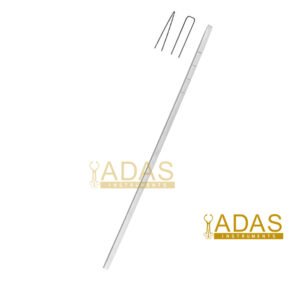
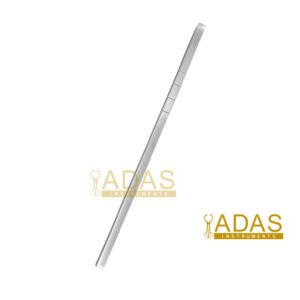
Cottle nasal osteotome cuts and divides the nasal bones in rhinoplasty and nasal reconstruction, most often on the lateral wall where the bone has to be released before the nose can be narrowed. It is double beveled, which is the difference between an osteotome and a chisel: a chisel is ground on one face and shaves a surface, an osteotome is ground on both and splits straight into bone. This is the 18cm graduated pattern and it comes in nine blade widths from 2mm to 16mm with a straight or a curved tip, so one handle pattern covers the whole set of cuts.
Key Features
- Nine blade widths, 2mm to 16mm
- Straight tip or curved tip, ordered per instrument
- Double beveled edge, the osteotome geometry
- 18cm overall length with a graduated shaft
- Flat handle end for mallet work
- High quality medical grade stainless steel, fully autoclavable
- Three year replacement warranty against manufacturing defects
- Item code AM-04.04

What the Cottle nasal osteotome 18cm is
The Cottle nasal osteotome is the general purpose instrument for cutting and dividing the nasal bones in rhinoplasty and nasal reconstruction. Most of its work is on the lateral wall, releasing the bone so the sidewall of the nose can be moved, and it is the pattern a tray carries when one instrument has to cover several different widths of cut.
It is an osteotome and not a chisel, and the grind is the difference. A chisel is beveled on one face, which gives it a flat side to lay against tissue and lets it shave a surface. An osteotome is beveled on both faces, so the edge runs down the middle of the blade and splits straight into bone. Google states the same rule in one line: unlike a chisel, which is beveled on only one side, a true osteotome is double beveled.
Adas Instruments makes this as the 18cm graduated pattern in nine blade widths, 2mm, 4mm, 5mm, 7mm, 9mm, 10mm, 12mm, 14mm and 16mm, with a straight or a curved tip. That range is why it is the archetype of the class rather than a specialist, and it is the page that carries the class term nasal osteotome for this whole family.
Key design features of the graduated nasal osteotome
Nine blade widths on one handle pattern
2mm through to 16mm. A 2mm blade starts an osteotomy in a thin sidewall without shattering it; a 16mm blade takes a wide dorsal or basal cut in one pass. Because all nine are ground on the same 18cm shaft and the same handle, a surgeon swapping widths mid case does not have to relearn the balance of the instrument.
Straight tip or curved tip
The straight tip gives the most direct line of force and is the default for a release on the lateral wall. The curved tip follows the junction with the maxilla where that cut has to travel along a curve. Both are the same osteotome otherwise and both are ordered per instrument.
A double beveled edge
Both faces are ground back to a central edge, so the cut is a split rather than a shaving. There is no flat guard face on a double bevel, which is why the lining is lifted clear before the osteotome is used rather than being shielded by the blade.
A graduated 18cm shaft
The shaft carries depth marks and 18cm is the length that puts the handle outside the nostril with the blade at the top of the osteotomy. The blade is out of sight within a centimeter of entering, so the marks are how depth is known rather than judged.
Which Cottle nasal osteotome size to order
Nine widths and two tip shapes, ordered per instrument rather than supplied as a set. The widths below are our own product options, not a trade average.
| Blade width | What it is for |
|---|---|
| 2mm | Starting an osteotomy in a thin sidewall without shattering it |
| 4mm and 5mm | Narrow lateral releases and work near the bone and cartilage junction |
| 7mm and 9mm | The general purpose lateral osteotomy widths |
| 10mm and 12mm | Wider releases and thicker bone |
| 14mm and 16mm | Wide basal and dorsal cuts taken in one pass |
| Tip options | Straight tip or curved tip on any width, ordered per instrument |
If a tray is being built from scratch, 2mm, 7mm and 12mm cover most of the range between them, and the curved tip is added where lateral osteotomies are routine. The 16mm is the one to skip unless wide basal cuts are part of the practice.
Where the Cottle nasal osteotome 18cm is used
Every row says nasal, and that is deliberate. The word osteotome is shared with dental implantology, where an osteotome is a sinus lift instrument and not a bone cutting blade at all, and Keyword Planner shows that dental demand is larger than ours.
| Procedure | What the osteotome does there |
|---|---|
| Rhinoplasty, lateral osteotomy | Releases the nasal bone so the sidewall can be moved |
| Rhinoplasty, medial osteotomy | Divides the bone at the top of the dorsum before narrowing |
| Nasal reconstruction | Recuts bone that has healed out of line |
| Nasal fracture reduction | Divides malunited bone so it can be reset |
| Maxillofacial surgery | Divides bone at the nasal base |
In all of these the approach is made and the periosteum lifted or tunnelled first, and the osteotome is then driven by short mallet taps rather than pushed.
What it cuts, and what it has to leave alone
What the instrument must not do is as fixed as what it must. A sidewall broken into fragments instead of cut, or a lining torn on both sides, is not recoverable.
| Tissue | What happens to it |
|---|---|
| Nasal bone, lateral wall | Divided along a controlled line. This is the target |
| Bone at the maxillary junction | Cut where the osteotomy crosses it |
| Periosteum | Lifted or tunnelled first so the blade works on bare bone |
| The upper cavity and the medial canthus | Never a target. This is what the graduations guard against |
| Nasal lining | Must stay whole. A double bevel has no guard face, so the lining is lifted clear first |
The fourth row is why the graduations exist. Depth that is read is safer than depth that is felt, particularly at the upper end of the cut.
How it compares with the rest of the nasal osteotome family
Five nasal osteotomes sit beside each other here and they are separated by WHERE ON THE NOSE they work. Two are for the bridge. Three are for the sidewall and the base.
| Instrument | Blade | Where on the nose it works |
|---|---|---|
| Cottle nasal osteotome 18cm | Straight or curved, nine widths 2mm to 16mm | The lateral wall, the general purpose release |
| Cottle nasal osteotome curved | Curved, double bevel | The lateral wall, following the curve of the bone |
| Cottle chisel fishtail | Flares to 16mm | Nasal bone where the blade must not dive off line |
| Rubin nasal osteotome | 8mm to 16mm, shaft stabilizer | The dorsum, the bridge of the nose |
| Rozner nasal osteotome | Slim tapered, 18cm | The dorsum, through a narrow opening |
This is the one to buy first. Nine widths and both tip shapes make it the instrument that covers the most ground, and the other four are added where a specific cut comes up often enough to justify a dedicated blade.
Cottle nasal osteotome 18cm materials and finish
The osteotome is ground from high quality medical grade stainless steel, hardened through the blade so a double bevel holds its angle through resharpening, and left softer along the shaft so a tap that lands off square bends nothing permanently. The steel itself is made to a German specification.
The finish is satin rather than mirror bright. Under a headlamp a polished blade throws light back up the nostril, and satin scatters it. On a graduated shaft satin also keeps the depth marks readable instead of lost in reflection.
Caring for a Cottle nasal osteotome 18cm
Rinse the blade and the graduations under cool running water before anything dries. Bone dust settles into etched marks and sets there, and graduations that cannot be read have lost the point of the instrument.
Ultrasonic clean in a neutral pH enzymatic solution, rinse in deionized water, then dry fully before pouching. Tap water dried on steel is the ordinary cause of pitting.
Autoclave at 134 degrees Celsius. Store each width with the edge guarded and not touching another blade. Nine osteotomes in one tray is nine chances for two edges to meet, and that is how a double bevel gets dulled.
Ordering a Cottle nasal osteotome 18cm, and wholesale
The Cottle nasal osteotome 18cm is supplied as a single instrument, item code AM-04.04, in any of nine blade widths from 2mm to 16mm with a straight or a curved tip. Say which widths and which tips you want. Full sets are made to order in matching finish.
Wholesale and distributor pricing is available on quantity, and larger orders can carry a laser marked hospital or practice reference at no separate tooling charge. Send the widths, the quantity and the marking text and we will quote it together.
Item code AM-04.04. Every instrument carries a three year replacement warranty against manufacturing defects. Stock items ship from our own workshop. Backorder items take 10 to 12 working days to make. Production is controlled under an ISO 13485 quality management system.
Frequently asked questions
What is a Cottle nasal osteotome used for
It cuts and divides the nasal bones in rhinoplasty and nasal reconstruction, most often as a lateral osteotomy releasing the sidewall of the nose. It is driven by a mallet and it comes in nine blade widths so the cut can be matched to the bone.
What is the difference between a chisel and an osteotome
The bevel. A chisel is ground on one face, so it has a flat side and it shaves a surface. An osteotome is ground on both faces, so the edge is central and it splits straight into bone. In the nose the chisel tends to work the septum and the osteotome the nasal bones.
What sizes does the Cottle nasal osteotome come in
Nine widths: 2, 4, 5, 7, 9, 10, 12, 14 and 16 mm, each with a straight or a curved tip, all on the same 18cm graduated shaft. They are ordered per instrument.
What is the purpose of an osteotome
To divide bone along a controlled line. The double bevel puts the edge in the center of the blade so the force of a mallet tap splits the bone forward instead of crushing it, which is what keeps a nasal sidewall in one piece.
Is a nasal osteotome the same as the dental sinus lift osteotome
No, and they are easy to confuse because they share the word. A dental osteotome for a sinus elevation is a short blunt instrument used to push the sinus floor upward through a tooth socket. A nasal osteotome is a long sharp bladed instrument for cutting bone. They are not interchangeable in either direction.
Related products and categories
Browse the full range of osteotomes, chisels and gouges, or see the wider set of rhinoplasty instruments this instrument belongs to.
| Weight | 0.09 kg |
|---|---|
| Tip options | Curved Tip, Straight Tip |
| Select Size | 10 mm, 12 mm, 14 mm, 16 mm, 2 MM, 4 MM, 5 mm, 7 mm, 9 mm |
Be the first to review “Cottle Nasal Osteotome 18cm | Graduated Blade | 2mm to 16mm”
Shipping & Delivery Policy
Processing Time: In-stock items are dispatched within 24-48 hours. For custom or out-of-stock items, production time is approximately 10-15 days.
Global Delivery Estimates
We partner with world-class couriers (DHL, FedEx) to ensure fast, tracked delivery.
- USA & Canada: 3-5 Business Days
- Europe & UK: 4-6 Business Days
- Rest of World: 5-7 Business Days
*We offer Air Cargo and Sea Freight options for bulk wholesale orders.
Customs & Duties
International buyers are responsible for any customs duties or taxes imposed by their country. Adas Instruments is not responsible for delays caused by customs clearance.
Lost Packages & Insurance
If your package is lost in transit, please contact us immediately. We offer full support and replacements for confirmed lost shipments. Note: You must report non-delivery within 3 weeks to be eligible for an insurance claim.
Related products
Reviews
There are no reviews yet.