
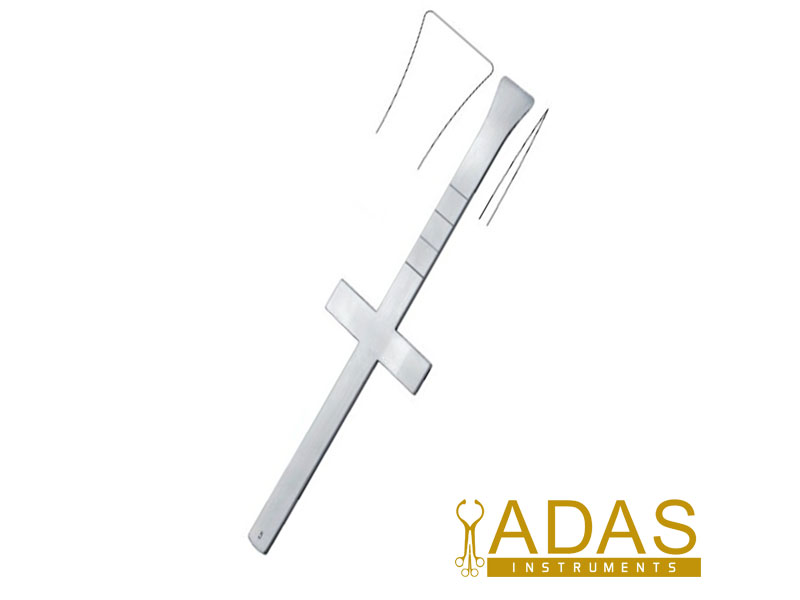
Cottle Chisel Fishtail | Graduated 16mm Nasal Osteotome
$ 33.00
Cottle chisel fishtail, listed in catalogues as the Cottle fishtail osteotome too, is used in rhinoplasty and septoplasty to cut nasal bone with a blade that flares out to 16mm instead of running parallel. The flare is the whole idea: a wide symmetrical tip spreads the contact across more bone, so the blade beds down where it is placed rather than diving off line into something softer behind it. The shaft carries depth graduations, which is what lets a surgeon advance it into a nasal cavity by reading rather than by feel.
Key Features
- Fishtail blade flaring to 16mm across the tip
- Wide symmetrical contact, resists diving off the cut line
- Graduated shaft for reading depth of advance
- Flat handle end shaped to take mallet taps
- Single piece construction, nothing to work loose
- High quality medical grade stainless steel, fully autoclavable
- Three year replacement warranty against manufacturing defects
- Item code AM-04.16
Available on backorder

What the Cottle chisel fishtail is
The Cottle chisel fishtail, which catalogues also list as the Cottle fishtail osteotome, is used in rhinoplasty, septoplasty and reconstructive craniofacial surgery to cut nasal bone with a blade that flares outward instead of running parallel.
The flare is the whole idea. A parallel blade contacts the bone across its own width and no more, so if the bone is uneven the edge can slip sideways or dive forward into something softer behind it. A tip that widens to 16mm spreads the contact across more bone, and a blade that is bedded across a wider surface stays in the line it was set in when the mallet lands. Surgeons call that not diving, and it is the reason this pattern exists alongside the straight Cottles.
The shaft is graduated so depth is read rather than judged, and the handle end is flat for a mallet. Adas Instruments makes it as a single instrument, item code AM-04.16.
Key design features of the fishtail nasal osteotome
A tip that flares to 16mm
The blade widens symmetrically toward the edge. Both the width and the symmetry matter: a wide tip spreads the load, and a symmetrical one loads evenly on both sides so the blade does not steer as it advances. An asymmetric tip under a mallet walks off line.
Why a wide blade resists diving
Bone is not uniform. Where a narrow edge finds a soft spot it drops into it and the cut deviates; a wide edge bridges that spot because the rest of the tip is still bearing on solid bone. On the nose that difference shows in the profile afterwards, which is why the shape earned a name of its own.
A graduated shaft
Marks along the shaft give a reading of how far the blade has travelled. The blade is out of sight almost as soon as it enters, and with a 16mm tip in a confined cavity knowing the depth matters more rather than less.
A flat handle end, one piece throughout
The far end is flat so a mallet lands square and transfers the whole tap into the blade. There is no joint, screw or moving part on the instrument, so nothing works loose and there is no hinge for tissue or cleaning solution to sit in.
What the 16mm fishtail blade is for
One pattern, one blade. The 16mm figure below is the width across the flare and it comes from our own product record, not from a trade average.
| Feature | This instrument |
|---|---|
| Blade shape | Fishtail, flaring symmetrically toward the edge |
| Width across the flare | 16mm |
| Shaft | Graduated, for reading depth of advance |
| Handle | Flat mallet face at the end, single piece throughout |
| Graduation intervals | NOT ON FILE in our product data, so not stated here |
| Supplied as | Single instrument, item code AM-04.16 |
The exact graduation intervals are not recorded in our product data for this item, so they are not stated here. Suppliers describe this pattern with marks at 10mm intervals or at 20, 30, 40 and 50mm; our own records do not confirm which, so this page does not print a figure. Ask us and we will measure one.
Where the Cottle chisel fishtail is used
Each row is a procedure this instrument is bought for, and each one says nasal or craniofacial. The word osteotome is shared with dental implantology, where it means a sinus lift instrument, and that is a different tool entirely.
| Procedure | What the osteotome does there |
|---|---|
| Rhinoplasty | Cuts nasal bone where the blade must hold its line |
| Septoplasty | Divides the bony septum with a wide bearing surface |
| Craniofacial reconstruction | Cuts thin or uneven bone without the edge dropping off line |
| Nasal fracture reduction | Divides malunited bone so it can be reset |
| Revision rhinoplasty | Cuts bone left irregular by earlier surgery |
In all of these the approach is made first and the osteotome is driven by short mallet taps. The fishtail is picked over a parallel blade when the bone under the cut is uneven or thin.
What it cuts, and what it has to leave alone
The point of a wide symmetrical tip is what it does not do. It does not slip, and it does not drop into a soft spot and take the cut somewhere it was not meant to go.
| Tissue | What happens to it |
|---|---|
| Nasal bone | Divided along the set line. This is the target |
| Bony septum | Divided where the cut crosses it |
| Periosteum | Lifted or tunnelled first so the blade works on bare bone |
| Soft bone and marrow spaces behind the cut | The wide tip bridges them rather than dropping in |
| Nasal lining | Must stay whole. Lifted clear before the osteotome is driven |
The fourth row is the one this blade shape was designed around. A blade that dives has already gone somewhere the surgeon did not choose.
How it compares with the rest of the nasal osteotome family
Five nasal osteotomes sit beside each other here, told apart by WHERE ON THE NOSE they work and by the shape of the blade rather than by grade or price.
| Instrument | Blade | Where on the nose it works |
|---|---|---|
| Cottle chisel fishtail | Flares to 16mm | Nasal bone where the blade must not dive off line |
| Cottle nasal osteotome 18cm | Straight or curved, nine widths 2mm to 16mm | The lateral wall, the general purpose release |
| Cottle nasal osteotome curved | Curved, double bevel | The lateral wall, following the curve of the bone |
| Rubin nasal osteotome | 8mm to 16mm, shaft stabilizer | The dorsum, the bridge of the nose |
| Rozner nasal osteotome | Slim tapered, 18cm | The dorsum, through a narrow opening |
So: the fishtail is the one to reach for when the blade must not wander, the straight 18cm Cottle is the general purpose release in nine widths, the curved Cottle follows the sidewall curve, and the Rubin and the Rozner work the bridge.
Cottle chisel fishtail materials and finish
The instrument is ground from high quality medical grade stainless steel, hardened through the blade so the edge holds under mallet work and left softer along the shaft so an off square tap does not set a bend. The steel itself is made to a German specification.
The finish is satin rather than mirror bright. A polished blade under a headlamp throws light back up the nostril; satin scatters it and keeps the depth marks readable instead of lost in glare.
Caring for a Cottle chisel fishtail
Rinse the blade and the graduations under cool running water as soon as the case is over. Bone dust sets into etched marks and once they cannot be read the instrument has lost the feature it was bought for.
Ultrasonic clean in a neutral pH enzymatic solution, rinse in deionized water, then dry fully before pouching. Tap water dried on steel is the ordinary cause of pitting.
Autoclave at 134 degrees Celsius. Store with the edge guarded. A 16mm edge has more length to protect than a narrow one and it is the widest part of the instrument, so it is also the part most likely to meet another blade in a tray.
Ordering a Cottle chisel fishtail, and wholesale
The Cottle chisel fishtail is supplied as a single instrument, item code AM-04.16, with the 16mm fishtail blade on a graduated shaft. It is ground and finished in our own workshop so it can be ordered to match the handle pattern of the other nasal osteotomes on a tray.
Wholesale and distributor pricing is available on quantity, and larger orders can carry a laser marked hospital or practice reference at no separate tooling charge. Tell us the quantity and the marking text and we will quote both.
Item code AM-04.16. Every instrument carries a three year replacement warranty against manufacturing defects. Stock items ship from our own workshop. Backorder items take 10 to 12 working days to make. Production is controlled under an ISO 13485 quality management system.
Frequently asked questions
What is a Cottle fishtail chisel used for
It cuts nasal bone in rhinoplasty, septoplasty and reconstructive craniofacial surgery. The blade flares to 16mm, which spreads the contact across more bone so the edge stays in the line it was set in rather than slipping or dropping off it.
Is the Cottle fishtail chisel the same as a fishtail osteotome
Yes. The same instrument is listed both ways, as a Cottle fishtail chisel and as a Cottle fishtail osteotome, and people search for both. If you have been quoted either name, this is the instrument.
Why is the blade shaped like a fishtail
So the contact with the bone is wider than the shaft. A wide symmetrical tip loads evenly and bridges a soft or uneven spot instead of dropping into it, which is what keeps the cut on the line the surgeon chose.
What is a surgical chisel
A bladed instrument driven by a mallet to divide bone or cartilage along a line. A chisel is normally beveled on one face; a gouge has a concave trough and scoops; an osteotome is beveled on both faces and splits into bone.
What is the difference between a chisel and an osteotome
The bevel. One face ground makes a chisel, which shaves a surface and has a flat side to lay against tissue. Both faces ground makes an osteotome, which splits straight into bone. This instrument is listed under both words because catalogues have never agreed on which it is.
Related products and categories
Browse the full range of osteotomes, chisels and gouges, or see the wider set of rhinoplasty instruments this instrument belongs to.
Be the first to review “Cottle Chisel Fishtail | Graduated 16mm Nasal Osteotome”
Shipping & Delivery Policy
Processing Time: In-stock items are dispatched within 24-48 hours. For custom or out-of-stock items, production time is approximately 10-15 days.
Global Delivery Estimates
We partner with world-class couriers (DHL, FedEx) to ensure fast, tracked delivery.
- USA & Canada: 3-5 Business Days
- Europe & UK: 4-6 Business Days
- Rest of World: 5-7 Business Days
*We offer Air Cargo and Sea Freight options for bulk wholesale orders.
Customs & Duties
International buyers are responsible for any customs duties or taxes imposed by their country. Adas Instruments is not responsible for delays caused by customs clearance.
Lost Packages & Insurance
If your package is lost in transit, please contact us immediately. We offer full support and replacements for confirmed lost shipments. Note: You must report non-delivery within 3 weeks to be eligible for an insurance claim.
Related products

Reviews
There are no reviews yet.