


Wieder Tongue Depressor, 28 to 43 mm Blades
$ 17.00
The Wieder tongue depressor is a right angled steel instrument used to press down and hold the tongue out of the operative field, by ENT specialists, oral surgeons and dentists in tonsillectomy, adenoidectomy and arch bar placement. AI Mode describes its heart shaped blade with inner serrations and windows that grip the tongue and let fluid drain, on a handle that ends in a hook for leverage. Ours comes with a 28, 32, 36 or 43 mm blade, at 17 dollars each.
Key Features
- Heart shaped blade, ribbed across
- Three teardrop windows in the blade
- Angled from the handle
- Slotted handle ending in a hook
- Four blade sizes: 28 mm, 32 mm, 36 mm on 14 cm, 43 mm on 15 cm
- Made from high quality medical grade stainless steel, 17 dollars any size
- Three year replacement warranty against manufacturing defects
- Item code ADM-115.01

What the Wieder tongue depressor is
The Wieder tongue depressor is as much a tongue retractor as a depressor, which is why a Wieder tongue retractor and a Wieder tongue depressor are one instrument. Its broad, heart shaped blade sits over the tongue and the floor of the mouth, and its handle bends away and ends in a hook. That shape lets an assistant hold the tongue down and pull it aside for a long stretch of oral surgery, where a flat blade would be pushed out of place again and again.
Google AI Mode, read on 5 November 2026, describes the Wieder tongue depressor, called a sweetheart retractor in the operating room, as a right angled stainless steel surgical instrument used to press down and hold the tongue out of the operative field. In its words, it is used by ENT specialists, oral surgeons and dentists in tonsillectomy, adenoidectomy and arch bar placement, and its heart shaped working end follows the contour of the tongue and the lower jaw. It describes inner serrations for grip, and holes that improve the hold and let fluid drain or a suction tube pass.
Gemini, read the same day, places it in oral and maxillofacial surgery, ENT and anesthesia, on the dorsum of the tongue and the soft tissue around it. It lists the Wieder heart shaped tongue depressor and the Wieder dental retractor as catalog names, and sets it apart from the Bruenings by its wide, windowed blade angled down from the handle, where the Bruenings is a narrow straight strip.
AI Mode gives two working sizes, a small blade of about 28 to 29 mm for children and a large one of about 36 to 38 mm for adults. Ours covers that and more: 28 and 32 mm blades, a 36 mm blade on a 14 cm handle and a 43 mm blade on a 15 cm handle. As a medical tongue depressor it is the widest reach on this tray.
Key design features
A heart shaped blade
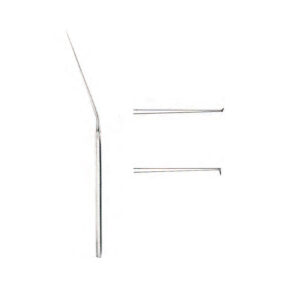
The drawing on our photograph shows the blade outline as a heart, with two rounded lobes at the tip. The lobes sit either side of the middle of the tongue and the notch between them follows its center line, so the blade stays put. AI Mode says the shape follows the contour of the tongue and the lower jaw.
Ribs and three windows
The blade is ribbed across and has three teardrop shaped windows cut through it. The ribs hold the wet tongue; the windows let the tongue press up a little into the blade, and, in AI Mode’s words, let fluid drain or a suction tube pass, so the field under the blade stays clear.
A hooked handle
The handle in our photograph bends away from the blade, has a slot along it, and ends in a hook. The hook gives the assistant’s fingers something to pull against, so the tongue can be held down and drawn aside at the same time. That is the heart shaped tongue depressor working as a retractor.
Four blade sizes
The listing sells a 28 mm and a 32 mm blade, a 36 mm blade on a 14 cm instrument and a 43 mm blade on a 15 cm one, all at 17 dollars. The smaller blades suit children and small mouths, the larger ones adults and the heavier tongue that arch bar work has to hold back.
Which blade size to order
Four sizes at one price, read off the variations on 5 November 2026. The guide in the third column is ours.
| Size, from the listing | Blade | Suits, our guide | Price |
|---|---|---|---|
| 28 mm blade | 28 mm | Children | 17 dollars |
| 32 mm blade | 32 mm | Small adult mouths | 17 dollars |
| 14 cm | 36 mm | Adults | 17 dollars |
| 15 cm | 43 mm | Large adult mouths, arch bar work | 17 dollars |
Where it is used
AI Mode and Gemini, read on 5 November 2026, name these cases for the Wieder tongue depressor. The reasons in the last column are ours, read off the blade and the handle.
| Case | What it holds back | Why this one |
|---|---|---|
| Arch bar placement | The tongue, away from the lower teeth | The hooked handle holds it aside |
| Tonsillectomy | The tongue, clear of the tonsil bed | Windows let fluid drain |
| Oral and maxillofacial surgery | The tongue and floor of the mouth | Broad heart shaped blade |
| Anesthesia | The tongue, clear of the airway | Named by Gemini |
What it does, and what it must not do
The Wieder tongue depressor holds the tongue down and aside by hand, and the hook lets it be held for longer than a flat blade. It does not hold the mouth open. Beside a mouth gag it frees the surgeon from the tongue altogether.
| Job | Use the Wieder? | What to use instead or beside it |
|---|---|---|
| Holding the tongue down and aside for oral surgery | Yes | This is the job it is made for |
| A quick look at the throat | No | The Bruenings or the Doyen tongue depressor |
| A long blade for the base of the tongue | No | The Tobold tongue depressor |
| Holding the mouth open | Beside it | The Denhardt or the Heister mouth gag |
| Levering a tooth or bone | Never | An elevator |
How it compares with the rest of the oral access tray
Ten oral access instruments make up this family on our site. The working ends and handles are read off each listing’s own photograph, the options off the variations and the prices off the order form, on 5 November 2026.
| Instrument | Working end, from our photograph | Handle or frame, from our photograph | Size or options | Price |
|---|---|---|---|---|
| Bruenings depressor | flat blade at each end, four windows in each | flat strip, angled at the middle | one size | 5 dollars |
| Doyen depressor | broad plain blade, flared at each end | none, the blade is bent through its middle | 16 cm or 13.5 cm | 7 dollars |
| Hartmann depressor | angled blade with a ribbed face | open loop handle | one size | 12 dollars |
| Tobold depressor | angled blade with a ribbed face | solid flat handle | 15 cm or 14.5 cm | 17 dollars |
| Wieder depressor (this page) | angled ribbed blade with three windows | slotted handle ending in a hook | four blade sizes | 17 dollars |
| Denhardt gag | two tooth plates | crossing arms with a ratchet and a release lever | one size | 36 dollars |
| Dingman gag set | frame with cheek arms and a tongue blade holder | three tongue blades in the set | complete set | 150 dollars |
| Heister gag | two straight jaws, cross cut at the tips | a screw turned by a broad thumb disc | one size | 45 dollars |
| Roser-Koenig gag | serrated jaw tips | scissor action handles with a ratchet | 19 cm or 16 cm | 30 dollars |
| Luniatschek packer | a fine V notched tip at each end, one curved | knurled round handle | one size | 24 dollars |
Materials and finish
Every Wieder tongue depressor we make is formed from high quality medical grade stainless steel. The steel itself is made to a German specification. We do not publish a grade number.
The Wieder tongue depressor has a plain steel finish. Look at the window edges and the hook before each case. A window edge knocked out of line can catch the tongue, and a hook bent open loses its hold, so that instrument should be set aside.
Caring for it
Rinse the Wieder tongue depressor as soon as the case ends, before blood and saliva dry in the windows and the handle slot. Brush across the ribs, through each window and along the slot, wash it, dry it, and steam sterilize it on the normal cycle with the rest of the tray.
Ordering and wholesale
The Wieder tongue depressor is made by Adas Instruments in our own workshop and sold direct, which is why the price sits where it does against the catalog houses. Order one for a single tray, or in quantity for a hospital list or a distributor line. We do OEM work under your own brand and your own item numbers. Send us a sample and we will hold a run to your pattern rather than ours. Stock items ship from our own workshop. Backorder items take 10 to 12 working days to make. Every instrument carries a three year replacement warranty against manufacturing defects. Production is controlled under an ISO 13485 quality management system.
Frequently asked questions
What is the Wieder tongue depressor used for?
It presses down and holds the tongue out of the operative field, in tonsillectomy, adenoidectomy and arch bar placement, in AI Mode’s words. Gemini adds oral and maxillofacial surgery and anesthesia. Ours has a 28 to 43 mm blade, at 17 dollars.
Is the Wieder a tongue retractor or a tongue depressor?
Both. The blade presses the tongue down like a depressor, and the hooked handle lets it be drawn aside like a retractor. AI Mode notes it is called a sweetheart retractor in the operating room, for the heart shaped blade.
Which Wieder blade size should I order?
Take the 28 mm for children and the 32 mm for small adult mouths. Take the 36 mm, on 14 cm, for adults, and the 43 mm, on 15 cm, for large mouths and arch bar work. All four are 17 dollars.
Why does the blade have windows?
The windows let the tongue press up a little into the blade so it holds, and, in AI Mode’s words, let fluid drain or a suction tube pass. Our drawing shows three teardrop windows in a ribbed, heart shaped blade.
Can the Wieder be autoclaved?
Yes. It is stainless steel with no coating, and it goes through the normal steam cycle with the rest of the tray. Brush through every window and along the handle slot first, then dry it fully before it is wrapped.
Related products and categories
Three more instruments from the same oral access tray: the Denhardt mouth gag, the Dingman mouth gag complete set and the Heister mouth gag. The rest of the range is under maxillofacial instruments, which sits inside our ENT instruments.
| Weight | 0.07 kg |
|---|---|
| Select Size | 14 cm/5½” 36 mm, 15 cm/6” 43 mm, 28 mm Blade, 32 mm Blade |
Be the first to review “Wieder Tongue Depressor, 28 to 43 mm Blades”
Shipping & Delivery Policy
Processing Time: In-stock items are dispatched within 24-48 hours. For custom or out-of-stock items, production time is approximately 10-15 days.
Global Delivery Estimates
We partner with world-class couriers (DHL, FedEx) to ensure fast, tracked delivery.
- USA & Canada: 3-5 Business Days
- Europe & UK: 4-6 Business Days
- Rest of World: 5-7 Business Days
*We offer Air Cargo and Sea Freight options for bulk wholesale orders.
Customs & Duties
International buyers are responsible for any customs duties or taxes imposed by their country. Adas Instruments is not responsible for delays caused by customs clearance.
Lost Packages & Insurance
If your package is lost in transit, please contact us immediately. We offer full support and replacements for confirmed lost shipments. Note: You must report non-delivery within 3 weeks to be eligible for an insurance claim.
Related products



Reviews
There are no reviews yet.