
Yankauer Suction Tip: Uses, French Sizes and the Frazier Compared
Oct
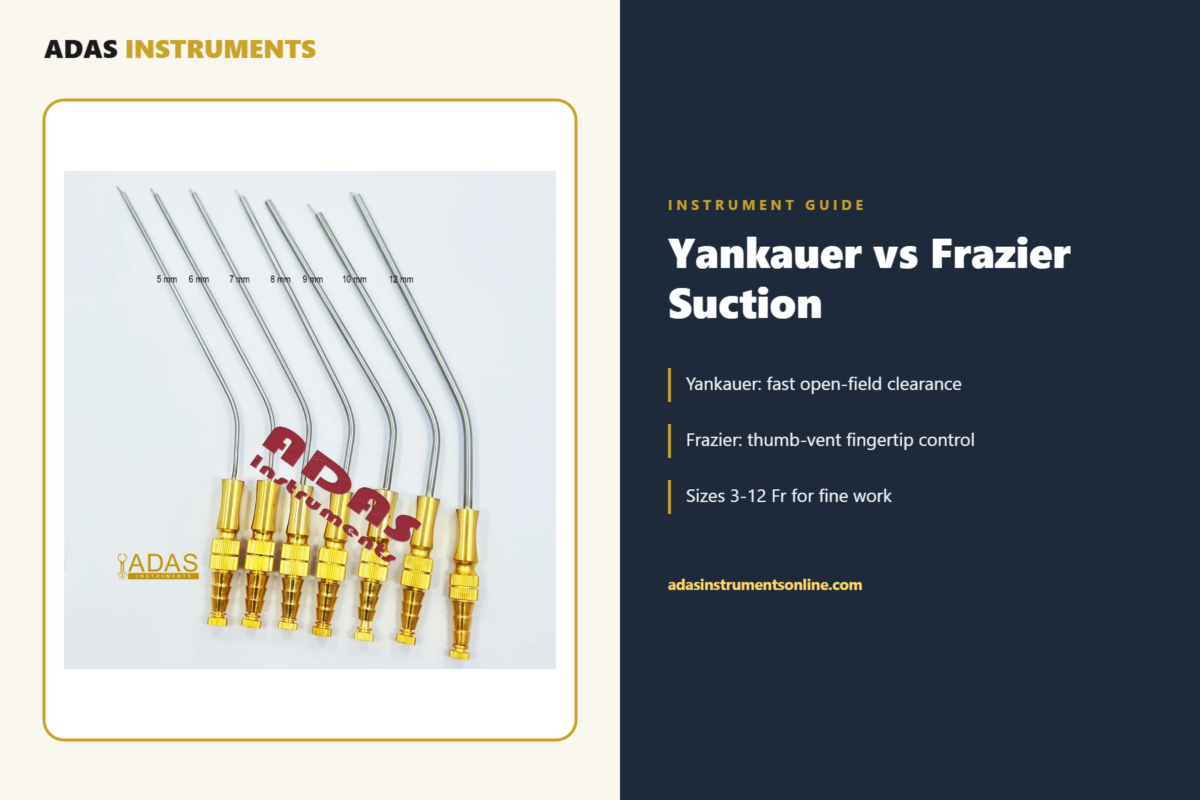
A Yankauer suction tip is a rigid, angled suction tube with a rounded bulb at the end, pierced by one large hole and several small side holes, used to clear blood, saliva and fluid from the mouth, the throat and open surgical fields without catching tissue. It is the wide bore workhorse of surgical suction. When the field shrinks to a nose, an ear or a fine flap, surgeons switch to a narrow Frazier or Adson tube, which Adas Instruments makes in high quality medical grade stainless steel, the Frazier suction tube in eight French sizes from 14 dollars.
This guide explains what a Yankauer suction tip is for, how it differs from the finer Frazier and Adson tubes, what French sizes mean, and how to keep a reusable suction tube from clotting halfway through a case.
Key takeaways
- A Yankauer suction tip clears large volumes fast in open fields. Its bulb and side holes stop it from grabbing tissue.
- A Frazier tube is the fine, angled choice for narrow fields such as the nose and ear, with a thumb hole that controls the pull.
- French size is outer diameter in thirds of a millimetre, so a 9 Fr tube is 3 mm across.
- Reusable steel suction tubes last for years if the lumen is flushed at the table and cleared with the stylet before it dries.
What Is a Yankauer Suction Tip Used For?
The Yankauer suction tip is used wherever a lot of fluid has to leave a large space quickly. In theatre that means open abdominal and chest work and tonsillectomy, anywhere blood has to be cleared from a wide field. Outside theatre it is the oral suction on every anaesthetic machine and crash cart, used to clear the mouth and throat of a patient who cannot do it alone.
The design is what makes it safe for that work. The bulb at the end spreads the pull over one end hole and a ring of side holes, so if soft tissue covers one opening the others keep working and the tip does not latch onto the tissue. The shaft is rigid, so it can be guided around the back of the throat without folding, and its angle keeps the surgeon’s hand out of the line of sight.
Why Is It Called a Yankauer?
The instrument is named after Sidney Yankauer, a New York ear, nose and throat surgeon who designed it for tonsil surgery in the early 1900s. That origin explains its shape: a tool made to reach the back of the throat, clear blood fast and stay out of the way of the tonsil being removed. The same pattern is sold today as the tonsil suction tip or oral suction tip, and many staff simply call it the Yankauer. Its background and the common variants are also summarised on Wikipedia’s Yankauer suction tip page.
Yankauer Suction Tip vs Frazier Suction Tube
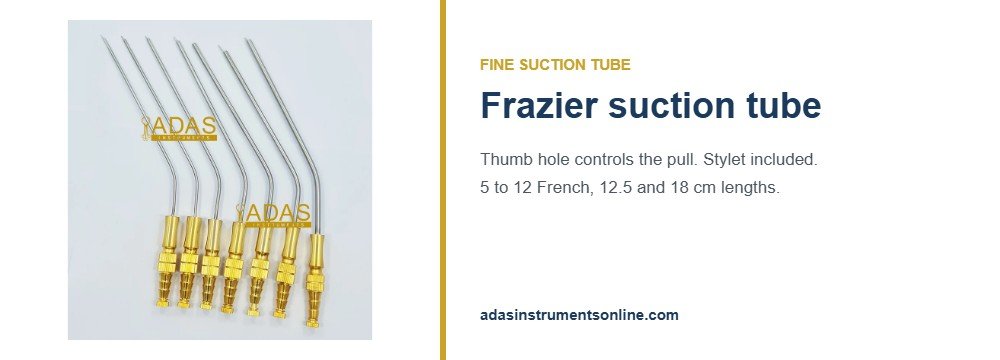
The two patterns are opposites, and most trays carry both. A Yankauer suction tip has a wide bore and moves volume. A Frazier suction tube, also listed as the Ferguson Frazier, is a slender angled tube built for precision. It has a thumb hole at the base of the handle: cover it and the tube pulls full vacuum, lift the thumb and the pull drops at once. That control is why the Frazier is the standard in rhinoplasty, ENT, neurosurgery and fine plastic surgery, where a Yankauer would block the view and pull too hard on delicate tissue.
Ours comes with a stylet for clearing clots mid case, in 12.5 and 18 cm working lengths and sizes from 5 to 12 French, or as a set of all eight sizes. The 7 to 10 Fr range covers most nasal work, and the smaller sizes suit ear and eyelid fields.
Other Suction Patterns: Adson, Poole and Baron
The Adson suction tube is a slim straight pattern with a finely tapered tip and a smooth bore, used in neurosurgery and plastic surgery where the surgeon wants to suction right at the point of dissection. The Poole tip goes the other way: an inner tube inside a perforated outer sleeve, so it can sit in a pool of abdominal fluid or irrigation without clogging on bowel or omentum. The Baron is the fine end of the Frazier idea, a small ear suction with a teardrop shaped thumb control.
One more pattern combines two jobs. A suction coagulator carries suction down an insulated tube and coagulates at the tip, which is why it is common in adenoid and tonsil surgery, where bleeding and clearance happen in the same place.
Yankauer, Frazier and Other Suction Patterns Compared
| Pattern | Bore and tip | Control | Best use |
|---|---|---|---|
| Yankauer suction tip | Wide bore, bulb with side holes | Vented or non vented | Mouth, throat, open fields, tonsillectomy |
| Frazier suction tube | 5 to 12 Fr, angled | Thumb hole, stylet | Rhinoplasty, ENT, fine plastic surgery |
| Adson suction tube | Slim, finely tapered | Steady pull | Neurosurgery and flap dissection |
| Poole suction tip | Inner tube in perforated sleeve | Steady pull | Abdominal fluid and irrigation |
| Baron suction tube | Very fine, angled | Teardrop thumb control | Ear and micro work |
| Suction coagulator | Insulated tube | Suction plus coagulation | Adenoid and tonsil bleeding |
What French Sizes Mean on a Suction Tube
Suction tubes are sized in French, and one French is a third of a millimetre of outside diameter. A 6 Fr tube is 2 mm across, a 9 Fr is 3 mm and a 12 Fr is 4 mm. The larger the number, the more volume the tube moves and the more room it takes. A Yankauer suction tip is far wider than any Frazier, which is the whole difference in one figure.
Pick the smallest size that keeps up with the bleeding. Too small and the tube clogs and the field floods. Too large and the tube crowds the view and pulls on tissue that should be left alone.
Fine suction tubes direct from the maker
Frazier suction tubes in 5 to 12 French with stylet, from 14 dollars, and the Adson suction tube, made in the Adas Instruments workshop in Sialkot. Clinics and distributors can order full size sets, plain or laser marked.
Why Steel Suction Tubes Clog, and How to Stop It
Most hospital Yankauer suction tips are single use plastic. Fine suction tubes are a different story: a steel Frazier or Adson is reused for years, and the thing that ends its life early is almost always the lumen. Blood that dries inside a narrow tube hardens into a plug that no brush will shift, and a tube with a partial plug clots again within minutes of the next case.
From the workshop side, the internal bore matters as much as the outside finish. A rough bore gives blood something to hold on to, so it clogs faster and cleans worse. The Frazier and Adson tubes we make are finished with a smooth internal lumen, and any suction tube is worth holding up to a light before it goes on a tray. At the table, three habits keep it clear:
- Flush during the case. Draw saline through the tube between suction runs, before blood can dry.
- Use the stylet straight away. Clear the lumen as soon as the case ends, not after the tray has sat.
- Brush, then autoclave. Run a lumen brush through before sterilising, then follow our autoclave temperature and time guide.
Reusable or Disposable Yankauer?
For bedside and airway use, disposable plastic Yankauer suction tips are the norm, and they make sense there. In surgical sets a steel Yankauer still earns its place: it does not kink, it does not soften near cautery, and it survives hundreds of cycles. Adas Instruments does not make a Yankauer, so practices building a tonsillectomy or general set usually pair a Yankauer from their hospital supplier with the steel Frazier and Adson tubes we list.
Liposuction is a separate world. Body contouring aspiration runs through cannulas with locking hubs rather than suction tips, at much higher volumes. Our liposuction cannula types guide covers that side.
Frequently Asked Questions
What is a Yankauer suction tip used for?
A Yankauer suction tip is used to clear blood, saliva and fluid from the mouth, the throat and open surgical fields. Its bulb tip with side holes lets it move a large volume quickly without catching soft tissue, which is why it is used in tonsillectomy, open surgery and airway care.
What is another name for Yankauer suction?
The Yankauer is also called a tonsil suction tip or an oral suction tip. In operating rooms and on wards most staff simply call it a Yankauer.
What is the difference between a Yankauer and a Frazier suction?
A Yankauer has a wide bore and a bulb tip for fast clearance in large open spaces. A Frazier is a fine angled tube with a thumb hole that controls the pull, used in narrow fields such as the nose and ear.
What do French sizes mean on a Frazier suction tube?
French size is the outside diameter in thirds of a millimetre. A 9 Fr Frazier is 3 mm across. Rhinoplasty usually uses 7 to 10 Fr, and ear and eyelid work use smaller sizes.
Can a steel suction tube be autoclaved?
Yes. Stainless steel suction tubes are autoclavable. Flush the lumen during the case, clear it with the stylet straight after, brush it, and then sterilise it so no dried blood is baked inside.
