
Towel Clamp Types: Backhaus, Lorna, Jones and How to Choose
Oct
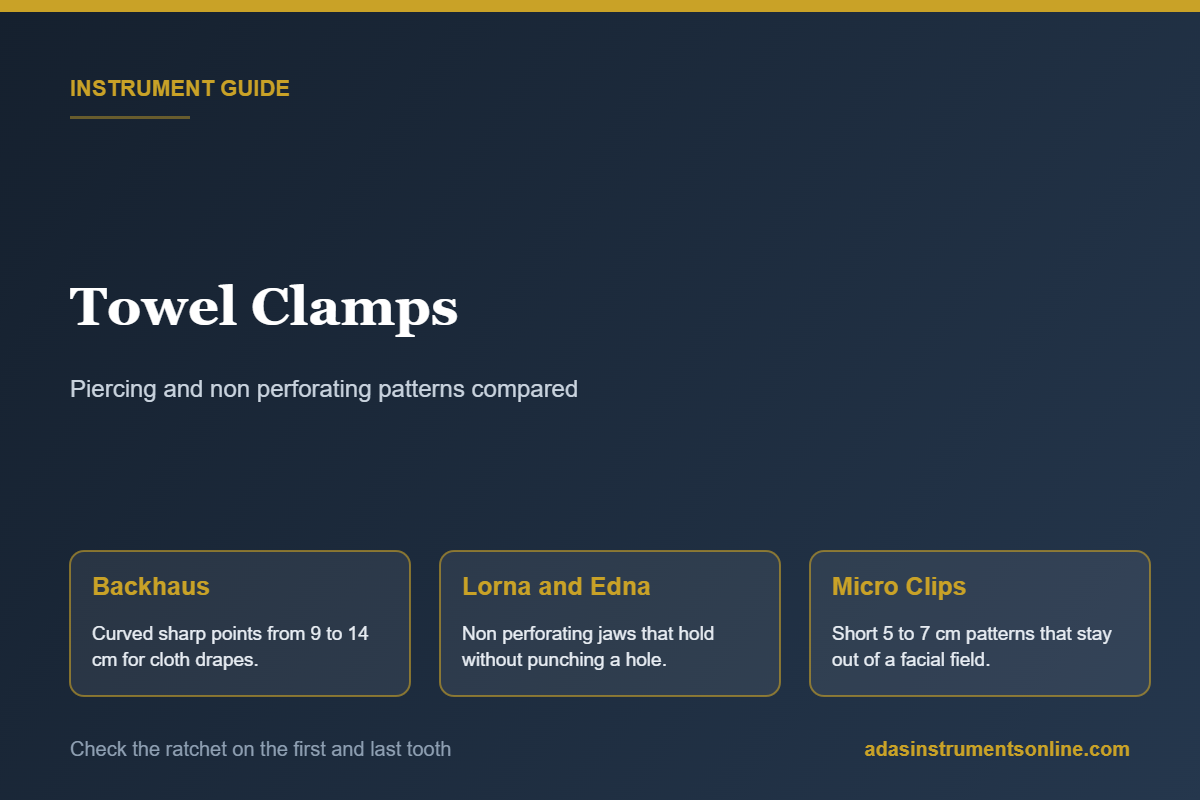
A towel clamp is a ratcheted or sprung instrument that pins sterile drapes and towels to the edge of the operating field so the barrier stays where it was laid for the whole case. The towel clamp types on a modern tray come down to one choice: points that pierce the drape, like the Backhaus, or jaws that grip it without a hole, like the Lorna. Adas Instruments makes the Backhaus towel clamp in four lengths from 9 to 15 cm, in high quality medical grade stainless steel, from 9 dollars.
This guide sorts the towel clamp types by tip and length, explains why non perforating patterns took over wherever disposable drapes are used, and lists the checks that keep a clamp from letting go halfway through a case.
Key takeaways
- Every towel clamp is either perforating (sharp points) or non perforating (flat or ball jaws). Everything else follows from that choice.
- The Backhaus is the perforating standard and doubles as a grasping and traction instrument.
- Lorna and Edna patterns grip a fold of drape without a hole, which keeps a disposable barrier intact.
- Facial trays need short clamps of 9 cm or less. A long clamp sits in the working space all case.
What a Towel Clamp Does
A drape only protects the field while it stays put. Patients are moved, tubing is pulled and staff lean across the table, and an unfixed drape slides. A towel clamp locks the drape to itself, to a towel or to the edge of the field so none of that movement opens a gap. In US operating rooms the same instrument is often called a towel clip, and catalogs use the two names for the same thing.
The second job is cable control. Suction tubing, cautery leads and light cables are clipped to the drape with a towel clamp so they cannot drag across the field or pull an instrument off the table. That job is where the difference between towel clamp types shows most clearly, because a sharp point through a cable sheath is damage nobody wants.
The Backhaus Towel Clamp: The Perforating Standard
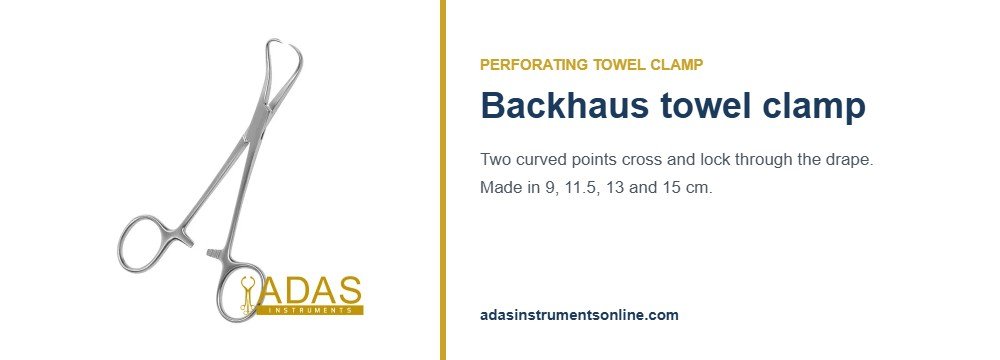
The Backhaus towel clamp has two curved points that face inward and cross as the ratchet closes. The points pass through the drape and lock against each other, so the hold comes from the steel, not from friction on the cloth. It is the strongest hold in the family, which is why a perforating Backhaus is still the first choice for heavy cloth drapes.
Surgeons also use the Backhaus for work far beyond draping: holding a rib edge, applying traction to dense tissue, steadying a small bone fragment and lifting a skin edge under tension during closure. On those jobs the sharp points are the point. Ours comes in 9, 11.5, 13 and 15 cm, so the short pattern can go on a facial tray and the long one on a body contouring field.
Lorna and Edna: Non Perforating Towel Clamp Types
The Lorna towel clamp replaces the points with flat or ball and socket jaws that close on a fold of drape and hold it by pressure. Many catalogs list the same design as the Edna, or as the Lorna Edna, and the two names describe near identical patterns. No point means no hole, and no hole means no channel for fluid to wick through the sterile barrier.
That matters most with disposable paper and plastic drapes, which are built as a continuous barrier. A puncture through one is a small breach that stays open for the rest of the case. A non perforating towel clamp also clips tubing and cables to the field without cutting the sheath, so most modern trays carry both kinds: perforating for heavy work, non perforating for the field.
Other Towel Clamp Types: Jones, Roeder and Micro Clips
Three smaller patterns fill the gaps. The Jones towel clamp is a cross action design that closes by its own spring, so it goes on with one hand and needs no ratchet. It suits light drapes and small fields. The Roeder towel clamp is a sharp pattern with a small bead on each point that stops the points from passing deeper than intended, which limits the bite when a clamp has to go near skin.
Micro towel clips, around 5 to 7 cm, are the facial and hand surgery answer. A full length clamp on a face lift or eyelid field gets knocked every time the head is turned, while a micro clip stays out of the surgeon’s hands.
Towel Clamp Types Compared
| Pattern | Tip | Typical length | Best use |
|---|---|---|---|
| Backhaus | Curved sharp points | 9 to 15 cm | Cloth drapes, traction, rib and bone holding |
| Backhaus ball tip | Rounded, non piercing | 11 to 13 cm | Paper drapes where a ratchet hold is wanted |
| Lorna, Edna | Flat or ball jaws, non perforating | 11 to 16 cm | Disposable drapes, tubing and cables |
| Jones | Sharp, cross action spring | About 9 cm | Light drapes, one hand use |
| Roeder | Sharp with bead stop | About 13 cm | Depth limited fixation near skin |
| Micro towel clip | Fine sprung points | 5 to 7 cm | Facial and hand fields |
Restock towel clamps direct from the maker
The Backhaus towel clamp is made in the Adas Instruments workshop in four lengths, 9 to 15 cm, from 9 dollars each. Clinics and distributors can order by the dozen, plain or laser marked with their own name.
Shop towel clamps and forceps or go straight to the Backhaus
How to Choose a Towel Clamp for Your Tray
Start with the drape. Cloth drapes and towels take a perforating Backhaus. Disposable drapes take a Lorna or Edna, or a ball tip Backhaus. Then set the length by the field: 9 cm or less on the face and hands, 11 to 13 cm for breast and general plastics, 15 cm where the drape is thick or the clamp also holds tissue.
Count the clamps the same way. A general plastics tray carries four to six: two at the head, two at the foot and spares for a re drape without breaking scrub. An abdominoplasty or body contouring drape takes six to eight. Keep a second set turning through the autoclave so a dropped clamp never holds up a case.
Five Towel Clamp Faults That Reach the Patient
Nobody audits a towel clamp, which is why the same faults turn up tray after tray.
- Piercing a disposable drape. Sharp points punch holes that wick fluid. Paper and plastic drapes need a non perforating pattern.
- Catching skin under the drape. A sharp clamp closed over drape and skin leaves a puncture that nobody records or dresses.
- Keeping a sprung clamp. If the ratchet slips under a light tug, it will let go under drape tension. Retire it.
- One length for every field. A 15 cm clamp on a facial field is in the way all case.
- Skipping the ratchet check. Test that the ratchet holds on the first tooth and the last. Worn middle teeth are the usual failure.
What to Check on a Towel Clamp Before It Goes on a Tray
A towel clamp lives the hardest life on the tray. It is dropped, thrown in the basin and run through every cycle the set goes through, so the faults that matter are mechanical. On a Backhaus the points must meet exactly and cross without touching, because points that miss each other tear the drape instead of locking through it. The ratchet should engage on the first tooth with the clamp held at arm’s length, and the box joint should still move freely after it has been through the autoclave.
A joint that stiffens after a few cycles is a polishing fault inside the box, and it is cheaper to catch at the bench than in theatre. Our autoclave temperature and time guide covers the cycle to use.
Ordering Towel Clamps
Towel clamps are bought by the dozen, so small differences in temper and finish matter more than the price gap suggests. The Backhaus is listed with the rest of our hemostats and grasping forceps, and the wider clamp family is explained in our guide to hemostats and surgical forceps. Custom lengths, non perforating jaws, matte finishes and laser marking with a practice or distributor name are made to order, normally in 10 to 15 working days. For WhatsApp orders and quotes, message +92 321 6126225.
Facilities writing their own sterile field policy usually build it around the perioperative practice guidance published by AORN, which covers draping and the sterile field in detail.
Frequently Asked Questions
What is a towel clamp used for?
A towel clamp holds sterile drapes and towels to each other and to the edge of the operating field so the barrier does not slide during surgery. It is also used to clip suction tubing and cautery cables to the drape, and the sharp Backhaus pattern doubles as a grasping and traction instrument.
What are the main towel clamp types?
The main towel clamp types are the perforating Backhaus with sharp points, the non perforating Lorna or Edna with flat or ball jaws, the spring loaded Jones, the Roeder with bead stops on its points, and short micro towel clips for facial and hand surgery.
What is the purpose of a Jones towel clamp?
A Jones towel clamp is a small cross action clamp that closes by its own spring instead of a ratchet. It goes on with one hand and is used for light drapes, small fields and holding tubing in place.
What is the difference between a Backhaus and a Lorna towel clamp?
The Backhaus pierces the drape with two sharp points and locks with a ratchet, giving the strongest hold. The Lorna grips a fold of drape with flat non perforating jaws, so a disposable drape is held without a hole.
What size towel clamp is used in plastic surgery?
Facial and hand work use towel clamps of 9 cm or less, often 5 to 7 cm micro clips. Breast and general plastics use 11 to 13 cm, and 15 cm clamps suit thick drapes on body contouring fields.
