
Surgical Calipers in Plastic Surgery: The Complete Guide to 5 Patterns
Oct
Surgical calipers are two point measuring instruments that set a distance on tissue, read it off a scale cut into the frame, and carry it to a second site without losing it. In plastic surgery they check symmetry before anything is cut: an eyelid crease, a graft, the position of a new nipple. Adas Instruments makes five caliper patterns in high quality medical grade stainless steel, from the 0 to 20 mm Castroviejo at 24.50 dollars to the gold plated Martin mammaplasty caliper with a 0 to 10 cm scale.
All five sit in our marking and measuring range, beside the rulers, areola markers and demarcators they are used with. This guide covers how a caliper works, which pattern suits which operation, and the checks that stop a measuring error from becoming an asymmetry.
Key takeaways
- A caliper is set once, read, and carried to the second side. That is what makes it better than a ruler held over a curve.
- The Castroviejo reads 0 to 20 mm and the Ginsberg reads 0 to 40 mm. Both come with straight or curved points.
- Breast reduction and lift planning use a curved frame caliper, the McKissock or the gold plated Martin with its 0 to 10 cm scale.
- Graduations cut into the steel stay readable through repeated autoclaving. Printed scales do not.
How a Surgical Caliper Works
Every caliper here does the same three things. The two points are opened to a distance on the patient. The figure is read off the graduations. Then the caliper is lifted, still holding that distance, and laid on the other side, where any difference shows at once. A screw or a sliding stop holds the points where they were set, so the reading does not drift while the caliper is moved.
That carry step is the reason caliper surgery checks beat a tape or a ruler on the face and the breast. A ruler laid over a curve measures the straight line between its ends and hides the curve. A caliper measures point to point and returns the same figure on the second side, which is the comparison symmetry depends on.
The Castroviejo Caliper
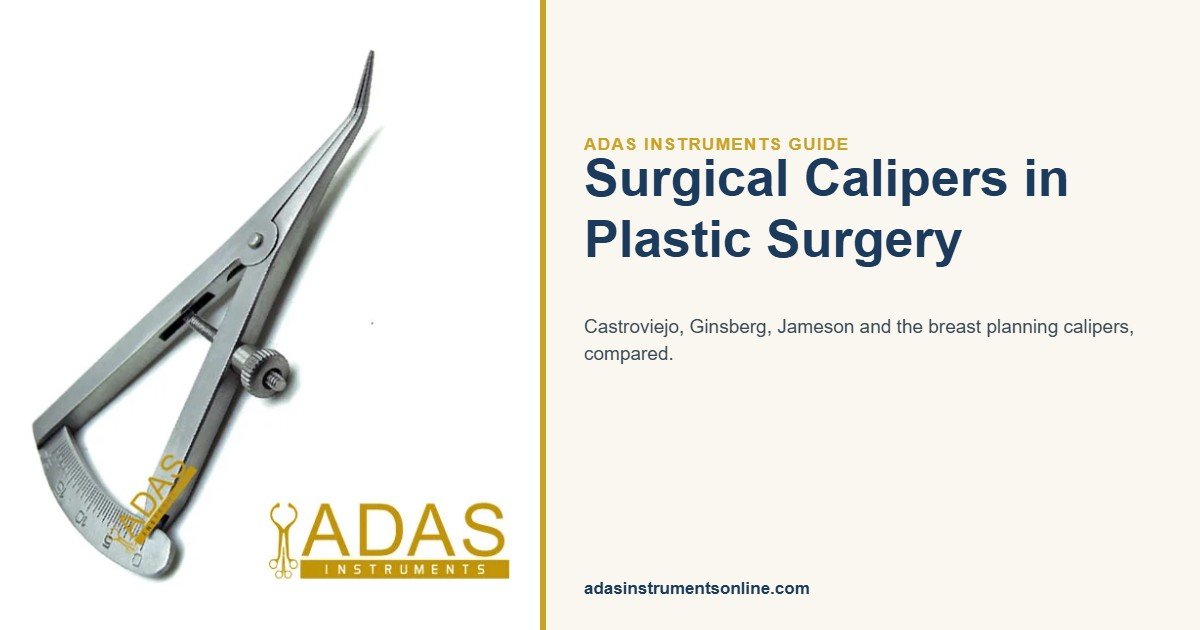
The Castroviejo caliper is the caliper most eye and oculoplastic trays carry, named after the ophthalmologist Ramon Castroviejo. Ours has a 0 to 20 mm scale on a compact 9 cm body, a screw that holds the points at the figure set, and pointed tips that can leave a mark as well as take a reading. Straight or curved points are chosen when it is ordered.
As a caliper eye instrument it measures ocular muscle, corneal grafts and the corneal diameter. The same short reach suits plastic surgery: crease height in a blepharoplasty, the width of a cartilage graft, the distance between two marks on a lip.
Sliding and Fine Scale Patterns: Ginsberg and Jameson
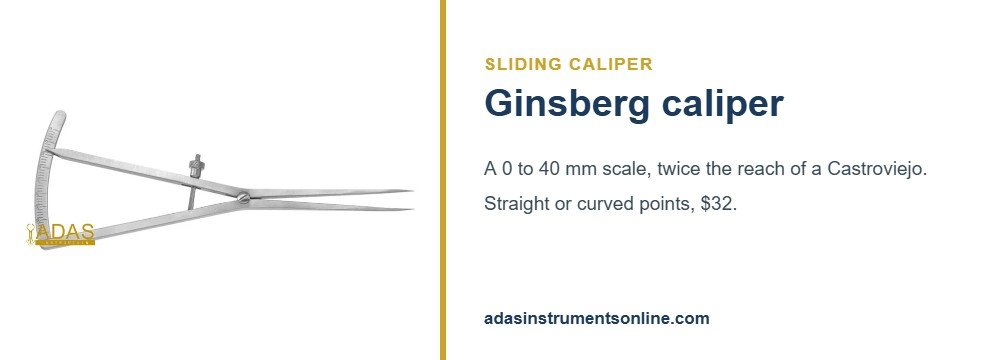
The Ginsberg caliper is a sliding pattern with a 0 to 40 mm scale, twice the reach of the Castroviejo. The slide stops where it is left, which makes it the caliper for flap boundaries, larger grafts and incision lengths on the face and neck. It also comes with straight or curved points.
The Jameson caliper is the small one, with its scale cut into the instrument and a short reach made for work inside the eye socket. Strabismus surgeons use it to mark muscle recessions and resections, and oculoplastic surgeons use it where tissue will not take a second mark.

Breast Planning Calipers: McKissock and Martin
Breast reduction and mastopexy are planned from one number first: the distance from the sternal notch to where the new nipple will sit. A straight caliper cannot follow the chest wall, so these two have curved frames that go around the breast instead of across it. The NIH StatPearls review of breast reduction describes how those markings are set before surgery.
The McKissock mammaplasty caliper takes that notch to nipple distance and then maps the vertical and horizontal limbs of a T or L pattern. The Martin mammaplasty caliper does the same job with a 0 to 10 cm scale read straight off the frame, and is gold plated throughout so it stands out on a crowded tray.
Surgical Calipers Compared
| Pattern | Scale | How it holds | Main use | Price |
|---|---|---|---|---|
| Castroviejo caliper | 0 to 20 mm | Screw | Eyelid, graft and eye measurements | $24.50 |
| Ginsberg caliper | 0 to 40 mm | Sliding stop | Flaps, larger grafts, incision length | $32 |
| Jameson caliper | Cut into the frame | Set points | Strabismus and oculoplastic marking | $32 |
| McKissock mammaplasty caliper | Curved frame scale | Set arms | Notch to nipple, T or L pattern limbs | $55 |
| Martin mammaplasty caliper | 0 to 10 cm | Set arms | Notch to nipple and flap dimensions | $65 |
Shop surgical calipers direct from the maker
All five calipers in the table are made in the Adas Instruments workshop with the scale cut into the steel. Castroviejo from 24.50 dollars, breast planning calipers from 55 dollars. Wholesale pricing for clinics and distributors, branded or plain.
Five Caliper Surgery Checks That Prevent Asymmetry
Asymmetry after surgery is rarely a cutting problem. It is usually a measuring problem nobody caught before the incision, and most of it comes down to five habits.
- Measure before infiltration. Local and tumescent fluid move every landmark. Mark and measure first, then confirm after.
- Use one fixed reference. Measure both sides from the same point, the midline or the sternal notch, never from each other.
- Check the points meet. Close the caliper and hold it to the light. Any gap between the tips means every reading is off by that much.
- Read a cut scale. Printed marks fade with repeated autoclaving, and a half read figure is a guess.
- Keep one caliper for the case. Two patterns with different scales will disagree by a fraction, and that fraction shows in the photographs.
Calipers and the Rest of the Marking Tray
A caliper measures and a marker draws, so the two are bought together. Straight lengths are faster with our surgical ruler, graduated in millimetres and inches, and round areolar shapes are drawn with an areola marker once the caliper has set the position. For flap outlines in abdominoplasty and face lifts, the demarcators in the same range transfer the line from one side of the flap to the other.
Frequently Asked Questions
What is a surgical caliper used for?
A surgical caliper measures a distance on tissue and carries it to a second site, so both sides can be compared. In plastic surgery it sets eyelid crease height, graft size and nipple position before any incision is made.
What is a Castroviejo caliper used for?
The Castroviejo caliper measures small distances up to 20 mm. Eye surgeons use it for ocular muscle and corneal graft measurements, and plastic surgeons use it for eyelid creases, cartilage grafts and other fine symmetry marks.
How do you read a surgical caliper?
Open the points to the distance on the tissue, then read the figure where the moving arm or slide meets the graduations. Keep the setting, lift the caliper and lay it on the second side to compare.
Which caliper is used in breast reduction?
Breast reduction is planned with a curved frame caliper such as the McKissock or the Martin mammaplasty caliper. The curved arms follow the chest to measure the sternal notch to nipple distance and the limbs of the skin pattern.
Can surgical calipers be autoclaved?
Yes. Stainless steel calipers with the scale cut into the frame are fully autoclavable. Clean the joint or slide before sterilising, and check that the points still meet when closed.
