

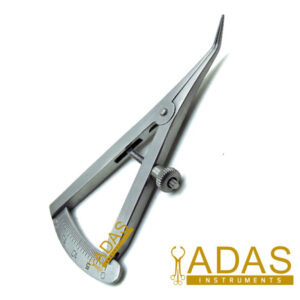
Castroviejo Caliper 20mm | Graduated Measuring Caliper with Straight or Curved Tips
Price range: $ 24.50 through $ 25.60
The Castroviejo caliper is a two point measuring instrument with a 0 to 20 mm graduated scale, named after the ophthalmologist Ramon Castroviejo and still the caliper most eye trays carry. A screw holds the points at whatever the surgeon sets them to, so a figure can be set, read, carried across to the other side and set down again without drifting. It measures ocular muscle, graft sizes in corneal transplant work and the horizontal diameter of the cornea, and the same short reach suits plastic surgery symmetry marks and dental implant gaps.
Key Features
- 0 to 20 mm graduated scale
- Screw mechanism holds the points at the set figure
- Straight or curved points, chosen at order
- Pointed tips for setting a mark as well as reading one
- Compact 9 cm body for small deep fields
- Cut from high quality medical grade stainless steel and fully autoclavable
- Three year replacement warranty against manufacturing defects
- Item code AA-31.15

What a Castroviejo caliper is
Ramon Castroviejo put his name on a good deal of eye surgery and this is the piece of it that ended up on everybody’s tray. A 0 to 20 mm scale, two points, and a screw that holds them where you put them. It is an instrument that carries the measurement, so the surgeon brings the judgement and the steel holds the number.
Twenty millimeters sounds like very little until you notice what it covers: the width of a cornea, the length of a graft, the distance a muscle is being moved. Those are the numbers eye surgery is made of, and almost none of them are larger than 20 mm. A caliper with a longer scale would be a longer instrument, and length is the one thing an eye socket has no room for.
This is also the one product in this whole category that a stranger finds. Search volume for the name runs to about 1,600 a month in the United States, which is more than every other instrument on these seventeen pages added together. Most of that is surgeons and residents checking what the thing is for, and a good part of it is people who have typed the word caliper meaning the brake on a car. If you are in the second group, this is a surgical instrument and it will not help you.
Two things people search for by name are worth answering here. Castroviejo caliper uses are the list in the table further down, and they run well past ophthalmology. And a castroviejo caliper 20mm is this one: 20 mm is the standard scale and the only length we cut it in. A castroviejo caliper dental is the same instrument again, bought for implant gaps and bone width rather than for a cornea.
Key design features
The screw
The screw is what separates a caliper from a pair of dividers. Set the points, tighten, and the figure survives being lifted out of the field, read, and brought back. Without it every measurement is a measurement you have to take again on the second side rather than repeat.
Straight or curved points
Straight points are the default and give an unobstructed view down onto what is being measured. Curved points exist for the measurement you cannot approach straight on, which in practice means anything behind the globe or under a lid. We make both and the choice is made at order.
A 0 to 20 mm scale, read in one millimeter steps
The scale runs the full range of the instrument in single millimeter steps, which is the resolution the work actually needs. A finer scale on an instrument used on living tissue under retraction is a scale nobody can read honestly.
Compact, at 9 cm
The whole instrument is 9 cm long. That is the feature, not a footnote: a caliper you can work with between a lid speculum and a microscope objective is a different instrument from one that measures the same distances on a bench.
Which points to order
One scale, one length, and one decision, which is the shape of the points.
| Points | Why people choose them | Note |
|---|---|---|
| Straight | Clear view down onto the measurement | The default choice on most eye trays |
| Curved | Reaching behind the globe or under a lid | For measurements you cannot approach straight on |
| Both, one of each | Where one tray covers several kinds of case | Two instruments, 49 dollars |
| Either | Both carry the same 0 to 20 mm scale | The scale and the screw are identical |
Where it is used
It started in ophthalmology and it did not stay there, because a graduated two point caliper that fits in a small field is useful anywhere small things are measured.
| Field | What it measures there | Why this caliper |
|---|---|---|
| Ophthalmology | Ocular muscle, graft size in corneal transplant work, corneal diameter | Nearly every figure falls inside 20 mm |
| Oculoplastic and eyelid surgery | Lid and canthal distances, symmetry between two sides | Reaches under a lid with curved points |
| Plastic and reconstructive surgery | Spacing, symmetry marks and skin graft measurement | Small figures in a tight field |
| Dental and implant work | Gaps between teeth, bone width before drilling | The screw holds a figure outside the mouth |
What it measures, and what it must not do
A caliper with pointed tips and a screw invites two specific misuses, and they are rows two and four.
| The task | What the caliper does | What it must not do |
|---|---|---|
| Setting a distance | Holds a figure on the 0 to 20 mm scale | It does not decide the figure. The plan does |
| Marking | Leaves two points where the tips were set | The tips are not pressed hard enough to break a surface |
| Carrying a figure to the other side | Holds the setting while the instrument is moved | A setting that has been nudged is not a measurement |
| Working in a small field | Fits between a speculum and an objective | It is never used to retract, hold or separate tissue |
How it compares with the rest of the family
Four measuring instruments here, and the choice between them is range and reach rather than how carefully they are made.
| Instrument | Range | Points | Our price |
|---|---|---|---|
| Castroviejo caliper | 0 to 20 mm | Straight or curved, screw held | 24.50 dollars |
| Ginsberg caliper | 0 to 40 mm | Straight or curved, sliding | 32 dollars |
| Jameson caliper | Graduated on the instrument | Short reach, for strabismus marking | 32 dollars |
| Surgical ruler | mm and inches | Flat, for straight distances | 12 dollars |
Materials and finish
Every Castroviejo caliper we make is cut from high quality medical grade stainless steel. The steel itself is made to a German specification. We do not publish a grade number. The number on a certificate tells a surgeon nothing about whether the screw still holds a 12 mm setting through a whole case, and the answer to that is in the making rather than in the alloy.
The graduations are cut into the frame, not printed on it, because a printed scale on an instrument that is autoclaved several times a week does not stay a scale. The screw thread is cut rather than rolled, which is why it still bites after years of being tightened with wet gloves on.
The points are finished last, so they meet each other instead of crossing. On a 20 mm instrument a pair of points that overlap by half a millimeter is reading nearly three per cent short, and nothing about the instrument looks wrong.
Caring for it
Back the screw off before it goes in the autoclave and leave it loose in storage. A thread left tight through a cycle is a thread that seizes, and a seized screw on this instrument is the end of it.
Clean the graduations and dry the thread. Dried fluid in a cut graduation makes a figure unreadable long before the steel wears out, and water sitting in a thread does the rest. Store it in a slot rather than loose, because fine points in a general tray become blunt points.
Check the points against each other every few cycles. Close them fully and look at where the tips meet; if one sits past the other, the instrument is reading short and it should come back to us rather than go onto the next list.
Ordering and wholesale
The Castroviejo caliper is made in our own workshop and sold direct, which is why the price sits where it does against the catalogue houses. Order one for a single tray, or in quantity for a hospital list or a distributor line. We do OEM work under your own brand and your own item numbers. Send us a sample and we will hold a run to your pattern rather than ours. Stock items ship from our own workshop. Backorder items take 10 to 12 working days to make. Every instrument carries a three year replacement warranty against manufacturing defects. Production is controlled under an ISO 13485 quality management system.
Frequently asked questions
What is a Castroviejo caliper used for?
Measuring small distances in surgery and marking at a set figure: ocular muscle measurement, graft size in corneal transplant work, the horizontal diameter of the cornea, and in plastic surgery spacing, symmetry marks and skin graft measurement. The range is 0 to 20 mm.
What is the measuring range of a Castroviejo caliper?
0 to 20 mm on this one, read in single millimeter steps. Longer versions of the pattern exist up to 0 to 40 mm, and in our range that is the Ginsberg caliper rather than a longer Castroviejo.
Should I order a Castroviejo caliper straight or curved?
Straight if you look down onto what you are measuring, which covers most corneal and graft work. Curved if you have to reach behind the globe or under a lid. Both carry the same scale and the same screw, so the only difference is access.
Is a Castroviejo caliper used outside ophthalmology?
Yes, widely. Plastic surgeons use it for symmetry marks and graft measurement, and dental and implant practitioners use it for gaps between teeth and bone width before drilling. The reason is always the same: the figures are under 20 mm and the field is small.
What does a Castroviejo caliper cost?
Ours is 24.50 dollars. The same instrument runs from about 10 dollars at the cheapest industrial suppliers to over 300 dollars from a surgical catalogue house, which is a spread of thirty times for a 20 mm scale and a screw. We sit near the bottom of that range and make them ourselves.
Related products and categories
For twice the range on the same principle, the Ginsberg caliper 0-40mm runs to 40 mm. For strabismus marking specifically the Jameson caliper graduated scale marking is the shorter instrument, and for straight distances outside a small field the surgical ruler graduated in mm and inches is simpler.
The rest of the family sits under marking and measuring instruments, and the wider set for eyelid work is under blepharoplasty instruments.
| Weight | 0.07 kg |
|---|---|
| Tip options | Curved Tip, Straight Tip |
Be the first to review “Castroviejo Caliper 20mm | Graduated Measuring Caliper with Straight or Curved Tips”
Shipping & Delivery Policy
Processing Time: In-stock items are dispatched within 24-48 hours. For custom or out-of-stock items, production time is approximately 10-15 days.
Global Delivery Estimates
We partner with world-class couriers (DHL, FedEx) to ensure fast, tracked delivery.
- USA & Canada: 3-5 Business Days
- Europe & UK: 4-6 Business Days
- Rest of World: 5-7 Business Days
*We offer Air Cargo and Sea Freight options for bulk wholesale orders.
Customs & Duties
International buyers are responsible for any customs duties or taxes imposed by their country. Adas Instruments is not responsible for delays caused by customs clearance.
Lost Packages & Insurance
If your package is lost in transit, please contact us immediately. We offer full support and replacements for confirmed lost shipments. Note: You must report non-delivery within 3 weeks to be eligible for an insurance claim.
Related products

Reviews
There are no reviews yet.