
Ginsberg Caliper 0-40mm | Surgical Measuring Caliper
$ 32.00
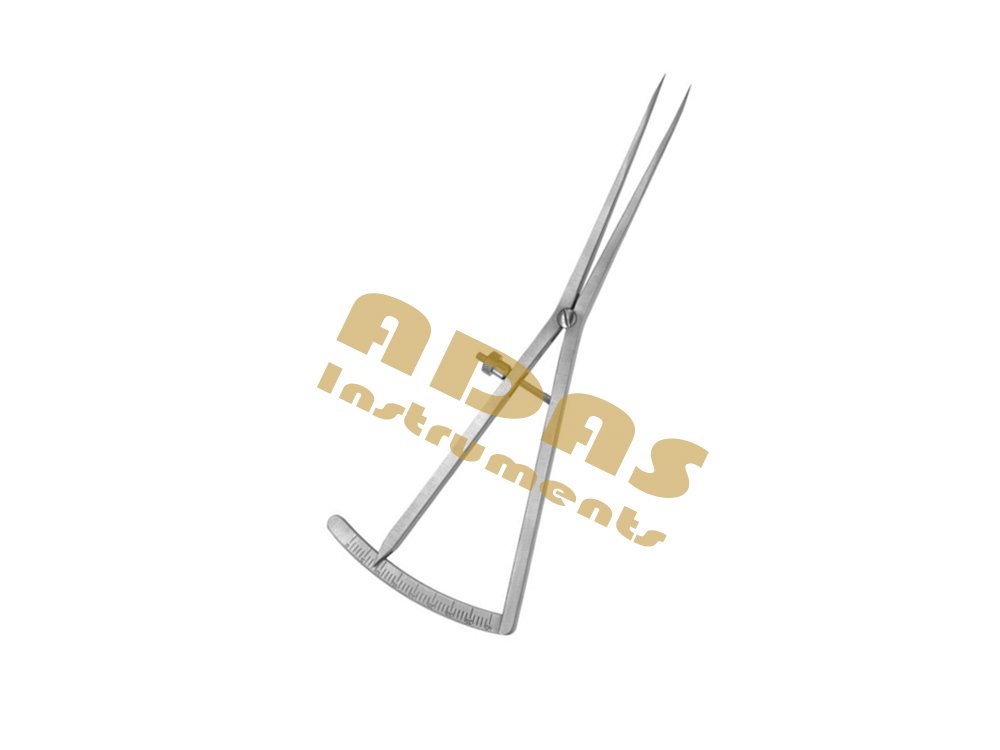
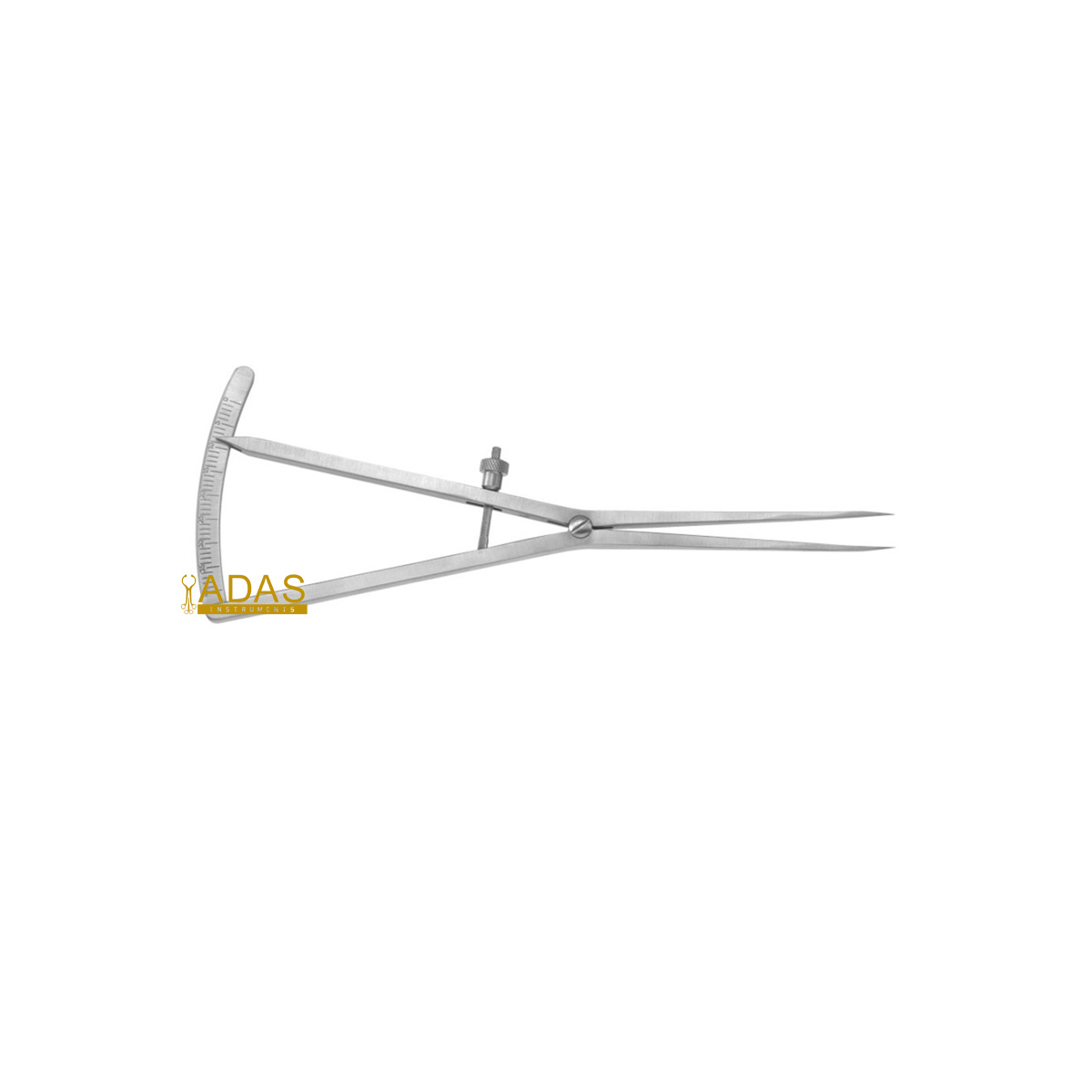
The Ginsberg caliper 0 40mm is a sliding two point caliper with a 0 to 40 mm scale, used in plastic, reconstructive and eye surgery to measure small tissue areas, set the boundaries of an incision and check that two sides agree. The slide moves smoothly and stops where it is left, so a figure can be set, read off the scale and carried across to the second side. It is the longer reaching of the two calipers we make, at twice the 20 mm range of a Castroviejo, and it comes with straight or curved points for graft and flap work.
Key Features
- 0 to 40 mm scale, twice the range of a 20 mm caliper
- Smooth sliding action that holds where it is left
- Straight or curved points, chosen at order
- Graduations cut into the instrument, not printed
- Cut from high quality medical grade stainless steel and fully autoclavable
- Reusable, with nothing to replace or recharge
- Three year replacement warranty against manufacturing defects
- Item code AA-31.75
Available on backorder

What a Ginsberg caliper is
Forty millimeters, on a slide. That is the whole description. The reason it exists beside a 20 mm caliper is that a good deal of plastic surgery measurement sits between 20 and 40 mm, where a Castroviejo has run out and a ruler is too clumsy to hold against tissue.
It is an instrument that carries the measurement, so the surgeon brings the judgement and the steel holds the number. The surgeon sets the two points, the slide holds, the figure comes off the scale, and the same figure can be put on the other side without being remembered.
Nobody searches for this instrument. The seed returned one idea, which is a proven zero, and that is worth saying out loud rather than papering over: the surgeon who wants a Ginsberg already knows the name and is here for a range, a price and a tip option. So that is what this page leads with, and there is no attempt to explain the instrument to somebody who was not looking for it.
Catalogues also list it as a surgical caliper 40mm, which is the same instrument under a plainer name. A Ginsberg caliper 0-40mm is what we call it, because the eponym is what a surgeon asks for.
Key design features
The slide, rather than a screw
A sliding surgical caliper is set with one hand. There is no screw to tighten and nothing to release, so the Ginsberg caliper 0-40mm can be adjusted while it is in position rather than lifted out, set and brought back. The friction is cut to hold the slide where it is left and no tighter.
A 0 to 40 mm range
Twice what a Castroviejo covers, and the reason to own one. Graft dimensions, the width of a flap, the distance between two marks on skin and the gap across a defect all live between 20 and 40 mm more often than they live under 20. As a graft measuring caliper that range is the whole argument, because almost no graft is under 20 mm.
Straight or curved points
Straight points give a clear view down onto the measurement. Curved points go around something, which on this instrument usually means around a raised flap or behind a margin. Both carry the same scale and the same slide.
Graduations that stay readable
The scale is cut into the metal. On a 40 mm instrument the graduations are necessarily close together, and a printed scale at that spacing becomes unreadable the first time anything is cleaned off it with any enthusiasm.
Which points to order
One range, one length, one decision.
| Points | Why people choose them | Note |
|---|---|---|
| Straight | A clear view down onto what is being measured | The default on most plastics trays |
| Curved | Reaching around a raised flap or behind a margin | For measurements you cannot take straight on |
| Both, one of each | Where one tray covers several kinds of case | Two instruments, 64 dollars |
| Either | Both carry the same 0 to 40 mm scale | Only the access differs |
Where it is used
It is at home anywhere the figure is bigger than an eye measurement and smaller than a breast measurement, which is most of plastic surgery.
| Field | What it measures there | Why this caliper |
|---|---|---|
| Plastic and reconstructive surgery | Graft dimensions, flap width, defect size | The 20 to 40 mm range a 20 mm caliper cannot reach |
| Rhinoplasty and facial work | Cartilage graft dimensions and symmetry between two sides | Set and carried across without remembering |
| Ophthalmic and oculoplastic surgery | Lid and canthal distances on the larger side | Longer reach than a Castroviejo |
| Hand and small part surgery | Spacing and incision boundaries | Held against tissue rather than laid on it |
What it measures, and what it must not do
A sliding caliper is easier to set than a screw one, which is exactly why row three is on this table.
| The task | What the caliper does | What it must not do |
|---|---|---|
| Setting a distance | Holds a figure on the 0 to 40 mm scale | It does not decide the figure. The plan does |
| Marking | Leaves two points where the tips were set | The tips are not pressed hard enough to break a surface |
| Carrying a figure across | Holds the slide where it was left | A slide that has been knocked is reset, not read |
| Measuring a curve | Takes the straight line between two points | It does not measure around a contour. A mammaplasty caliper does |
How it compares with the rest of the family
The range is the whole argument between these four.
| Instrument | Range | How it holds a setting | Our price |
|---|---|---|---|
| Ginsberg caliper | 0 to 40 mm | A sliding action | 32 dollars |
| Castroviejo caliper | 0 to 20 mm | A screw | 24.50 dollars |
| Jameson caliper | Graduated on the instrument | A short reach joint | 32 dollars |
| Surgical ruler | mm and inches | Nothing to hold, it is a rule | 12 dollars |
Materials and finish
Every Ginsberg caliper we make is cut from high quality medical grade stainless steel. The steel itself is made to a German specification. We do not publish a grade number. The number on a certificate tells a surgeon nothing about whether the slide still stops where it is left after two hundred autoclave cycles, and the answer to that is in the making rather than in the alloy.
The slide is cut to a fit rather than sprung. A sprung slide feels better in the hand on the first day and loosens over a year; a cut fit feels the same in year five, which is the only thing that matters on an instrument whose job is to hold a figure.
The points are finished after the frame, so they meet instead of crossing. A pair of points that overlap reads short by the amount of the overlap and there is nothing about the instrument that looks wrong.
Caring for it
Run the slide through its full travel under warm water, both directions, before it goes in the tray. Residue dries in the track rather than on it, and a track with dried residue in it is a slide that sticks in one place and moves freely in another.
Clean the graduations and dry the track. Autoclave with the rest of the tray. Store it in a slot rather than loose, because fine points among other instruments become blunt points and a blunt point on a caliper is a reading taken from the wrong place.
No finish option is offered on this one. The satin matte surface it comes with is chosen for exactly one reason, which is that a scale being read under an overhead light should not be reflecting it back.
One habit worth having with a sliding caliper: zero it before every case. Close the points fully and check the slide reads nought. It takes two seconds and it is the only way to catch an instrument that has been dropped since the last time anybody looked.
Ordering and wholesale
The Ginsberg caliper is made in our own workshop and sold direct, which is why the price sits where it does against the catalogue houses. Order one for a single tray, or in quantity for a hospital list or a distributor line. We do OEM work under your own brand and your own item numbers. Send us a sample and we will hold a run to your pattern rather than ours. Stock items ship from our own workshop. Backorder items take 10 to 12 working days to make. Every instrument carries a three year replacement warranty against manufacturing defects. Production is controlled under an ISO 13485 quality management system.
Frequently asked questions
What is a Ginsberg caliper used for?
Measuring small tissue areas and setting the boundaries of an incision in plastic, reconstructive and eye surgery, and checking that the same figure has been used on both sides. The range is 0 to 40 mm.
What is the measuring range of the Ginsberg caliper 0 40mm?
0 to 40 mm, read in single millimeter steps off a scale cut into the instrument. The Ginsberg caliper 0-40mm covers twice the range of a 20 mm Castroviejo, which is the usual reason for owning one.
Is the Ginsberg caliper a sliding caliper?
Yes. A Ginsberg caliper 0-40mm is set with one hand and the slide stops where it is left, with no screw to tighten and nothing to release. That makes it quicker to adjust in position than a screw caliper and slightly easier to knock out of a setting.
Ginsberg or Castroviejo: which caliper should I order?
Castroviejo if your figures are under 20 mm, which covers most eye work, and if you want a screw that will not be nudged. Ginsberg if you need up to 40 mm or want to set it with one hand. Plenty of trays carry both at 56 dollars for the pair.
Is the Ginsberg caliper autoclavable?
Yes. There is one moving part, a cut slide, and nothing to lubricate or replace. Run the slide through its travel under warm water first so nothing dries in the track, then autoclave it with the rest of the tray.
Related products and categories
The shorter range version of the same idea is the Castroviejo caliper 20mm at 24.50 dollars, with a screw instead of a slide. For strabismus marking the Jameson caliper graduated scale marking is the specialised instrument, and when a cartilage graft has to be measured and then cut the Sheen grid plate does both on one surface.
The rest of the family sits under marking and measuring instruments, and the wider set for nasal work is under rhinoplasty instruments.
| Weight | 0.07 kg |
|---|---|
| Tip options | Curved Tip, Straight Tip |
Be the first to review “Ginsberg Caliper 0-40mm | Surgical Measuring Caliper”
Shipping & Delivery Policy
Processing Time: In-stock items are dispatched within 24-48 hours. For custom or out-of-stock items, production time is approximately 10-15 days.
Global Delivery Estimates
We partner with world-class couriers (DHL, FedEx) to ensure fast, tracked delivery.
- USA & Canada: 3-5 Business Days
- Europe & UK: 4-6 Business Days
- Rest of World: 5-7 Business Days
*We offer Air Cargo and Sea Freight options for bulk wholesale orders.
Customs & Duties
International buyers are responsible for any customs duties or taxes imposed by their country. Adas Instruments is not responsible for delays caused by customs clearance.
Lost Packages & Insurance
If your package is lost in transit, please contact us immediately. We offer full support and replacements for confirmed lost shipments. Note: You must report non-delivery within 3 weeks to be eligible for an insurance claim.
Related products

Reviews
There are no reviews yet.