Types of Surgical Retractors: A Complete Guide to Their Names and Uses
Oct
A surgical retractor is an instrument that holds tissue back so the surgeon can see and reach the working field. The types of surgical retractors fall into two families: hand held retractors, which an assistant holds in place, and self retaining retractors, which lock open on their own. Adas Instruments makes 56 retractor and hook patterns in Sialkot, from a 12.50 dollar Kilner alae retractor to fiber optic breast retractors, all in high quality medical grade stainless steel.
Most of them carry a surgeon’s name, and the names are how they are ordered. This guide sets out the retractor types with names you will meet on a tray list, what each one is for, and where our own hooks and retractors range and self retaining retractors fit.
Key takeaways
- A hand held retractor needs a pair of hands for the whole case. A self retaining retractor locks open with a ratchet or a spring and frees those hands.
- The names come from the surgeons who designed them, such as Senn, Deaver and Weitlaner, or from what the blade looks like: rake, ribbon, skin hook.
- Sharp prongs grip skin and fascia. Blunt prongs are the safe default wherever a vessel or nerve sits underneath.
- Our hand held patterns start at 8 dollars for a malleable ribbon retractor. Self retaining frames start at 22 dollars for the Alm.
What Is a Retractor in Surgery?
A retractor does two jobs at once. It opens the wound so light and instruments can get in, and it keeps everything that is not being operated on out of the way: skin edges, fat, muscle, a lobe of liver, a breast implant pocket wall. The blade or the prongs press on tissue for as long as the retractor is in, so the shape of that contact matters as much as the reach.
The split between the two families is about who holds it. A hand held retractor gives the surgeon fine control, because the assistant can ease off or change the angle on request. A self retaining retractor gives up some of that control in return for a steady field and one less person leaning over the table.
Hand Held Retractor Types with Names
Of all the types of surgical retractors, these hand held patterns are the ones surgeons ask for by name. The prices are ours, for the base version of each.
| Name | What it looks like | Typical use | From |
|---|---|---|---|
| Gillies skin hook | One fine sharp prong on a straight handle | Lifting a skin edge for suturing in facial work | $18 |
| Guthrie skin hook | Two prongs, sharp or blunt | Holding a wound edge open without crushing it | $17.50 |
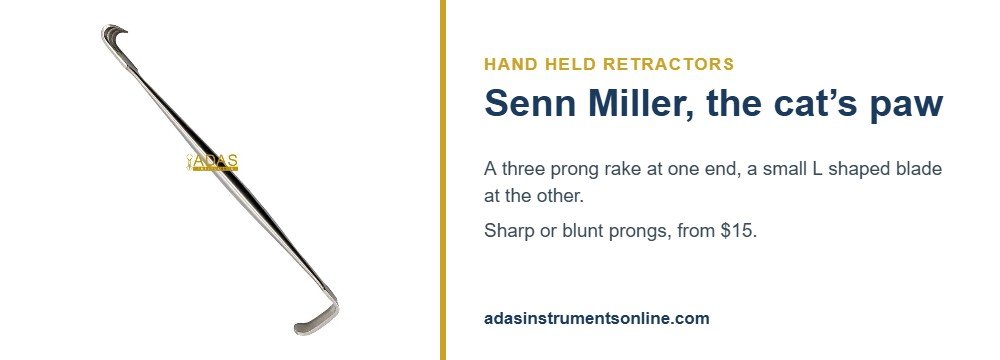
| Senn Miller retractor | Three prongs at one end, a small blade at the other | Small incisions in plastic and hand surgery | $15 |
| US Army retractor | Double ended flat blades, Army Navy pattern | General purpose retraction of skin and muscle | $25 a pair |
| Mini Langenbeck retractor | A right angled blade, 10 mm to 22 mm wide | Deeper but narrow wounds | $18.50 |
| Volkmann retractor | A rake with 1 to 4 prongs, sharp or blunt | Holding back skin and subcutaneous fat | $13 |
| Farabeuf retractor | Short double ended blades, sold as a pair | Superficial exposure, the first incision | $12 |
| Deaver retractor | A broad curved blade, 19 mm to 25 mm | Moving organs aside in abdominal and breast cases | $25 |
| Ribbon retractor | A flat malleable strip, 6 mm to 25 mm | Bent by hand to fit any cavity | $8 |
| Desmarres lid retractor | A curved saddle blade, 10 mm to 14 mm | Eyelid eversion in oculoplastic surgery | $18.50 |
The nickname cat’s paw belongs to the Senn Miller, after the three curled prongs. The US Army retractor is the same instrument many American theatres call the Army Navy, and we also make an insulated US Army set for cases where the blade sits near an electrosurgery tip. The story behind many of these names is told in a published history of hooks and simple retractors.
Self Retaining Retractor Types
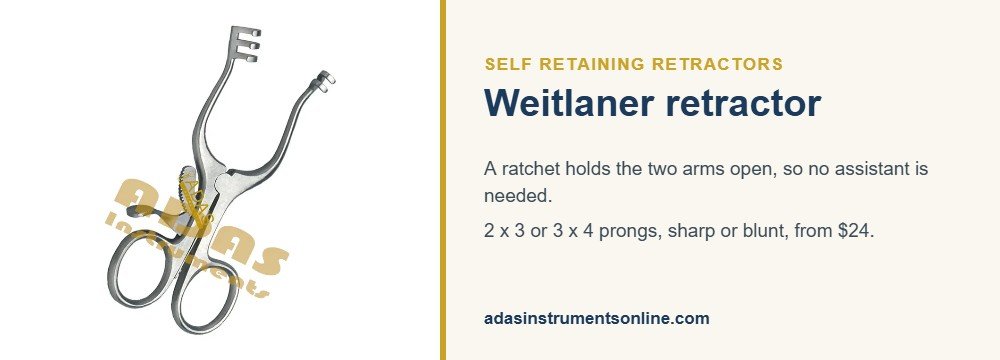
A self retaining retractor has two arms that spread apart and stay there, held by a ratchet, a screw or a spring. The prongs at the end of each arm sink into the wound edge and the frame does the holding. Our self retaining retractor range covers the patterns below.
| Name | Prongs | Typical use | From |
|---|---|---|---|
| Weitlaner retractor | 2 x 3 or 3 x 4, sharp or blunt | Superficial wounds in general, plastic and orthopaedic surgery | $24 |
| Alm retractor | 4 x 4, set with a thumb screw | Microsurgery and small incisions | $22 |
| Williger retractor | Sharp prongs | Small superficial fields | $34 |
| Plester retractor | Post aural pattern | Mastoid surgery | $34 |
| Wullstein retractor | Fine prongs | Micro ear work and tympanoplasty | $34 |
| Belluci retractor | Fine prongs | Myringoplasty and micro ear surgery | $34 |
The Weitlaner is the one most trays carry first. Larger abdominal and chest frames exist for open trunk surgery, but in plastic, ENT and hand surgery the small ratcheted frames above do almost all of the self retaining work.
Shop retractors direct from the maker
All 56 retractor and hook patterns on this page are made in the Adas Instruments workshop, sharp and blunt, with fiber optic and insulated options on selected patterns. Ribbon retractors from 8 dollars, self retaining frames from 22 dollars. Wholesale pricing for clinics and distributors, branded or plain.
Types of Surgical Retractors by Specialty
Specialist retractors are shaped for one region of the body, and their names travel with the operation more than with the hospital.
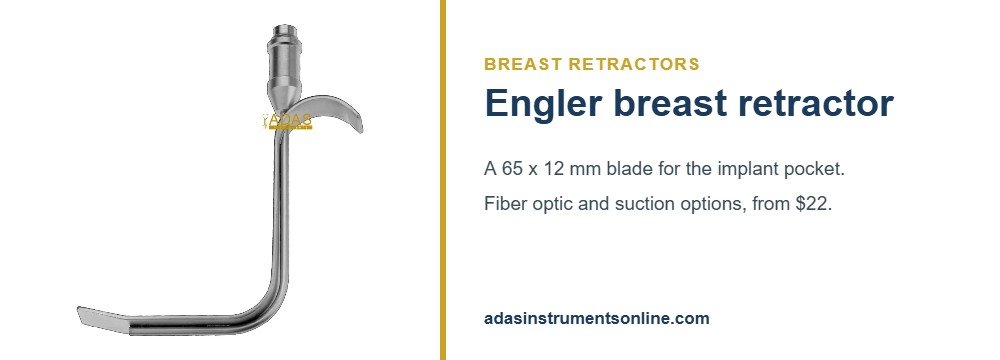
- Breast. The Engler breast retractor and the Marx open the implant pocket, and our LumaPocket adds a fiber optic light and suction channel, from 80 dollars.
- Face lift. Freeman, Ferreira and Biggs retractors lift the skin flap, with fiber optic options for a long, deep tunnel.
- Rhinoplasty. The Aufricht nasal retractor lifts the dorsal skin, and the Cottle alar and Kilner alae retractors hold the nostril rim.
- Abdominoplasty. The Yancoskie retractor has 6 offset sharp prongs for the upper flap, and the Saldanha comes with 4 or 8 prongs and a fiberoptic option.
- Ear. The Plester, Wullstein and Belluci frames are small enough to sit behind or inside the ear.
For the instruments that work alongside nasal retractors, our rhinoplasty instruments guide lists the full tray.
Sharp or Blunt Prongs, Insulated or Lighted Blades
Almost every rake and self retaining pattern comes with a choice of prong. Sharp prongs bite into skin and fascia and will not slip, which is why they suit the dermis at a wound edge. Blunt prongs push tissue rather than piercing it, so they are the choice anywhere a vessel or a nerve could sit beneath the tip. A tray that carries only sharp versions forces the surgeon into a risk every time the field goes deep.
Two other options change the blade itself. An insulated coating, as on the Kawamoto insulated retractor, stops current from an electrosurgery tip passing into tissue that touches the blade. A fiber optic blade carries light from a cable to the tip, which matters in a breast pocket or a face lift tunnel where the overhead lamp cannot reach.
Building a Retractor Tray
Knowing the types of surgical retractors by name makes a tray list quick to write. A practical plastic surgery tray starts small: two skin hooks, a Senn Miller, a pair of US Army retractors, a Langenbeck, one malleable ribbon and a Weitlaner in each prong size the list needs. Specialist retractors are added by procedure rather than bought as a set, because a face lift tray and a breast tray share almost nothing beyond the basics. Buy sharp and blunt versions of the self retaining frame together, since the cost of the second one is far less than a case delayed while one is found.
Frequently Asked Questions
What is a retractor in surgery?
A retractor is an instrument that holds skin, muscle or organs out of the way so the surgeon can see and reach the working field. It is either held by an assistant or locks itself open, and its blade or prongs are shaped for the tissue it touches.
What are the main types of surgical retractors?
The types of surgical retractors fall into two families. Hand held retractors include skin hooks, the Senn Miller, the US Army, Langenbeck, Volkmann, Deaver and ribbon retractors. Self retaining retractors include the Weitlaner and Alm frames and small ear frames such as the Plester.
What is a cat’s paw retractor?
Cat’s paw is the nickname for the Senn Miller retractor. It is a small double ended hand held retractor with three curled prongs at one end and a short blade at the other, used for small incisions in plastic and hand surgery.
What is the difference between a hand held and a self retaining retractor?
A hand held retractor is held by an assistant for the whole case, which allows fine adjustment. A self retaining retractor spreads two arms and locks them with a ratchet or spring, so it holds the wound open with no hands at all.
Why are some surgical retractors insulated?
An insulated retractor has a coating that stops electrosurgical current passing from the blade into tissue it touches. It is used when the blade sits close to a diathermy tip, as in breast and abdominal flap surgery.
