
Tonsillectomy Instruments: The Complete Tray, Name by Name
Oct
Tonsillectomy instruments are the ENT tools used to open the mouth, hold the tonsil, free it from its bed and stop the bleeding once it is out. A standard tray is built in five groups: mouth gags, tonsil holding forceps, dissectors and knives, artery forceps and suction. Adas Instruments makes more than 30 of these patterns in high quality medical grade stainless steel, all listed under our tonsillectomy instruments range.
Tonsillectomy is one of the most common operations in ENT, so the tray gets heavy use and gets copied from hospital to hospital. This guide goes through the tonsillectomy instruments in the order they are picked up, with the names that appear on the count sheet.
Key takeaways
- A tonsillectomy tray works in five steps: expose, grasp, dissect, control bleeding, suction.
- The mouth gag is the one instrument that sets up the whole case. A gag that slips means re positioning mid operation.
- Blunt dissectors such as the Hurd and Henke do most of the work. Knives only start the incision.
- Curved tonsil artery forceps, such as the Schnidt and Negus, are the hemostats made for the tonsil bed.
Exposure: Mouth Gags and Tongue Depressors
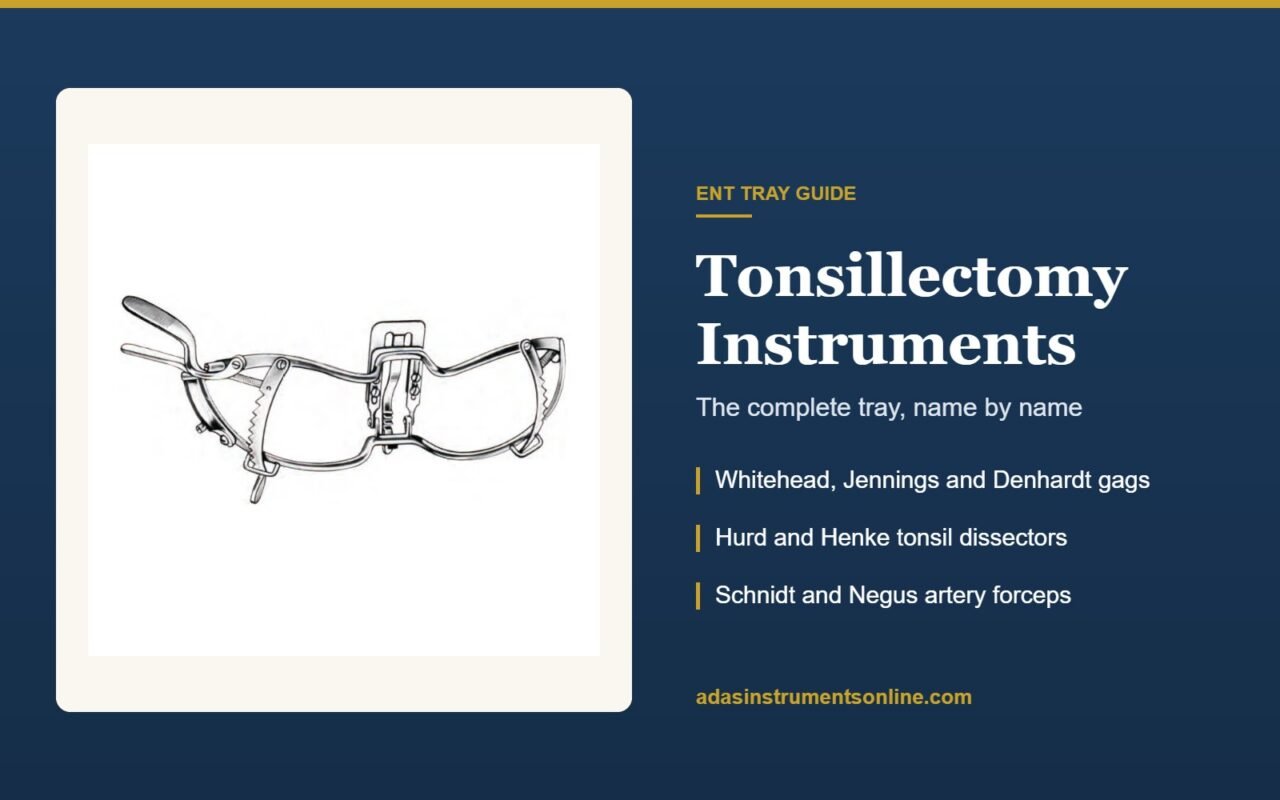
Nothing happens until the mouth is held open and the tongue is out of the way. A tonsil mouth gag does both: a frame that props the jaws apart and a tongue blade that presses the tongue down and forward. The Whitehead mouth gag carries its own tongue depressor and opens on a ratchet, so it stays where it was set. The Jennings mouth gag is self retaining with a side ratchet, and the Denhardt mouth gag is a smaller 12 cm pattern.
Around the gag sit the smaller exposure tools. A steel tongue depressor, 14 cm on our standard pattern, gives a quick look before the gag goes in. The Love uvula retractor lifts the uvula and soft palate, the Nager soft palate retractor at 23 cm does the same with a longer reach, and the Hofer tonsil retractor at 24 cm pulls the anterior pillar aside.
Grasping: Tonsil Holding Forceps
The tonsil has to be pulled toward the midline so the dissection plane opens behind it. Tonsil holding forceps do that with a firm grip that will not tear the capsule. The White tonsil forceps has fenestrated, serrated jaws, and the Museux tonsil forceps grips with sharp prongs. The Blohmke tonsil forceps and the Colver tonsil forceps, both around 19 to 20 cm, are the longer patterns that keep the surgeon’s hand clear of the line of sight.
The ratchet is the part to test. A tonsil forceps is held under steady pull for the whole dissection on each side, so a ratchet that slips a tooth lets the tonsil drop back into the field at the worst moment.
Dissection: Knives and Dissectors
Cold steel dissection still starts with a small incision through the mucosa of the anterior pillar. A tonsil knife such as the Fischer tonsil knife at 22 cm makes that cut. From there the work is blunt. The Hurd tonsil dissector has a flat dissecting end on one side and a pillar retractor on the other, so one instrument both separates and holds back. The Henke tonsil dissector adds a serrated edge for firmer tissue, and the Lopez Reinke dissector is a finer double ended pattern.
Two older tools are still asked for. The Sluder Ballenger tonsillectome, a guillotine with three interchangeable blades, removes the tonsil in one movement and is now used mostly where surgeons trained on it. Tonsil punch forceps, the Hartmann punch and the Schmeden punch, bite away remaining tissue and are also used on the adenoid bed.
Tonsillectomy Instruments at a Glance
| Step | Instrument | What it does |
|---|---|---|
| Expose | Whitehead mouth gag | Opens the mouth and holds the tongue down |
| Expose | Love uvula retractor | Lifts the uvula and soft palate |
| Grasp | White tonsil forceps | Pulls the tonsil to the midline |
| Incise | Fischer tonsil knife | Opens the mucosa of the anterior pillar |
| Dissect | Hurd dissector | Separates the tonsil from its bed and retracts the pillar |
| Control bleeding | Schnidt tonsil forceps | Clamps vessels in the tonsil bed |
| Pack | Luniatschek gauze packer | Presses gauze into the tonsil fossa |
| Suction | Frazier suction tubes | Clears blood from the field |
Equip a tonsillectomy tray direct from the maker
Every instrument in the table above is made in the Adas Instruments workshop. Tongue depressors from 8 dollars, Schnidt tonsil forceps from 15 dollars, the Whitehead gag at 55 dollars. Hospitals and distributors can order single pieces or full trays, plain or laser marked.
Shop tonsillectomy instruments or start with the Whitehead gag
Hemostasis: Artery Forceps and Ties
Bleeding from the tonsil bed is the main risk of the operation, so the tonsillectomy instruments include clamps made for that space. The Schnidt tonsil forceps, 19 cm on our pattern, is a curved artery forceps with a long reach and fine jaws that pick up a single vessel in the fossa. The Negus tonsil artery forceps is a heavier curved pattern. Both are used with ties or with diathermy, and many trays carry two of each so one can stay clamped while the next vessel is found.
Gauze packing finishes the job. The Luniatschek tonsil gauze packer pushes a swab into the fossa and holds pressure while the other side is done.
Suction and Swabs
A clear field is half of a safe tonsillectomy. Most trays carry a Yankauer for bulk suction and a set of fine Frazier suction tubes for the tonsil bed itself, where a broad tip would pull on the dissection. Our guide to the Yankauer suction tip explains when each one fits.
What to Check When Buying Tonsillectomy Instruments
- Gag ratchet. Open the gag fully and press on the tongue blade. It should not slip a tooth.
- Tonsil forceps teeth. The jaws should meet evenly along their length and hold a folded swab without tearing it.
- Dissector edges. The blunt end of a Hurd should be smooth, with no sharp corner that could tear the capsule.
- Curve of the artery forceps. A Schnidt should reach the lower pole of the fossa with the handle clear of the gag frame.
- Count sheet. A full tray has a lot of small parts. Each instrument should be marked so the count closes without doubt.
Adas Instruments supplies single pieces or a full tray built to a hospital’s own count sheet, with laser marking on request. Shipping is by DHL or FedEx; for quotes, message +92 321 6126225 on WhatsApp. The operation itself is described in detail in the NIH StatPearls chapter on tonsillectomy.
Frequently Asked Questions
What instruments are used in a tonsillectomy?
A tonsillectomy tray holds a mouth gag with tongue blade, tonsil holding forceps, a tonsil knife, blunt dissectors such as the Hurd, curved tonsil artery forceps such as the Schnidt, a gauze packer and suction tubes. Many trays add uvula retractors and tonsil punch forceps.
What is a mouth gag used for in tonsillectomy?
The mouth gag holds the jaws open and presses the tongue down and forward with its blade, so the tonsils are in view and both of the surgeon’s hands are free. The Whitehead and Jennings are common self retaining patterns.
What is the Hurd tonsil dissector?
The Hurd is a double ended tonsil instrument with a flat blunt dissector on one end and a pillar retractor on the other. Surgeons use it to separate the tonsil from its bed while holding the anterior pillar back.
Which forceps is used to hold the tonsil?
Tonsil holding forceps such as the White, Museux, Blohmke or Colver grip the tonsil and pull it toward the midline so the dissection plane opens behind it.
What is a Schnidt forceps used for?
A Schnidt tonsil forceps is a long curved artery forceps used to clamp bleeding vessels in the tonsil bed. Its reach lets the jaws pick up a single vessel deep in the fossa with the handle clear of the mouth gag.
